The Emperor in Love
The Emperor in love gets read as dominance or commitment. What it actually names is the urge to impose order on something that won't hold still.
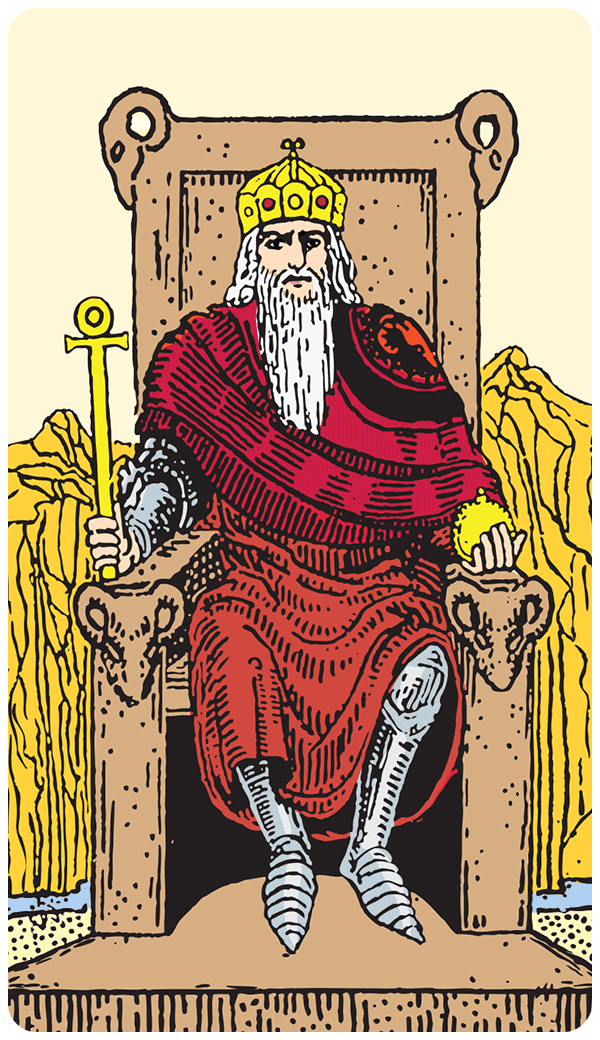
The Emperor · plate 4
What the card is actually doing
The Emperor shows up in a love reading and the querent assumes one of two things: either this card describes their partner (controlling, rigid, emotionally unavailable) or it promises commitment is coming (structure, stability, someone who will finally stay). Neither reading is correct. The Emperor does not describe a person. It describes what you are trying to do to the relationship — the part of you that wants to make love legible, predictable, safe. The card names the impulse to build a framework around something that does not yet have one.
Reading The Emperor in love
What the card is doing and why people misread it
The Emperor is Major Arcana, which means it describes a psychological archetype, not an event or a person. The figure on the card sits on a stone throne in barren mountains. He holds a scepter. He wears armor under his robes. The posture is upright, frontal, immovable. This is the part of the psyche that organizes, that draws boundaries, that says this is how it will be. When this card appears in a love reading, it is naming the impulse to impose structure on intimacy — to define the relationship, to set terms, to make someone commit or clarify or stop being ambiguous.
People misread it because they want the card to be about the other person. If the relationship feels unstable, they read The Emperor as the partner who won't open up. If they are hoping for commitment, they read it as a promise that structure is arriving from outside. But the card does not describe what someone else is doing. It describes what you are doing. It names the moment you stop waiting for the relationship to clarify itself and start trying to force it into a shape you can manage.
How the card reads differently depending on who is asking
For the querent who is anxiously waiting for commitment, The Emperor shows up as the part of them that wants to skip ahead to the stable version. They want to know where this is going. They want a title, a timeline, a plan. The card is not saying the other person will provide that. It is saying you are trying to make the relationship legible before it has earned its own shape. The tell is when you find yourself drafting the conversation you want to have — the one where you ask what this is, where it is going, whether they are serious. You are not asking because you are curious. You are asking because you need the uncertainty to stop.
For the querent who is in a relationship that feels too rigid, The Emperor names the dynamic they are stuck in. One person (often them, sometimes the partner) has decided how things should be, and the relationship now operates inside that framework whether or not it still fits. The sex happens on certain nights. Feelings are discussed in a certain tone. Conflict follows a script. The card is not diagnosing the partner as controlling. It is naming the fact that someone — possibly you — decided love required rules, and now the rules are running the relationship instead of the people.
The tell that someone is misreading the card on themselves
The misreading sounds like this: "The Emperor means he is going to commit" or "The Emperor means he is emotionally unavailable and I should leave." Both versions treat the card as a judgment about the other person's character or a prediction about what they will do. The correct reading asks: what am I trying to control here that I cannot actually control? Where am I trying to make this relationship follow a blueprint instead of letting it be what it is? The card does not answer whether you should stay or go. It names the fact that you are trying to force an answer.
From the practice
“A card never tells you what to do. It tells you what you're already deciding — and gives you the words to name it.”
A grounded observation
Go back through the last month of the relationship and look for the moments you tried to make it make sense. The Emperor is not the moment it made sense. It is the moment you stopped tolerating the not-knowing.
Key themes to watch for
- № 01Theme
Vulnerability
- № 02Theme
New chapters
- № 03Theme
Emotional truth
What to do with this reading
Read the upright meaning first, even if you pulled the card reversed. The reversal is a commentary on the upright — not a separate card.
Notice what your body did when you saw The Emperor. That reaction is usually closer to the truth than the interpretation.
Write down one sentence: What is this card asking me to stop avoiding? Let the answer be smaller than you expect.
Come back to this card in 48 hours. Most love readings sharpen with a little distance.
Questions answered
Frequently asked
In love, The Emperor brings a focus on stability and commitment. This card suggests that a relationship could benefit from more structure, or that a partner may desire more predictability and security. If you're single, it might indicate a time to evaluate what kind of long-term relationship you're seeking. The Emperor encourages you to think about boundaries and how they can support a healthy partnership. Reflect on how you can build a relationship that is both nurturing and secure, and consider what foundational values are most important to you in love.
Reversed in love, The Emperor might highlight issues with control or rigidity. Perhaps there's a power struggle, or one partner is too domineering. This card could also suggest a fear of commitment or an inability to find balance within the relationship. It might be time to explore how control dynamics are impacting your connection and whether they align with your desires. Consider where flexibility and compromise might be needed, and how you can both feel respected and heard. Reflect on whether the structures in place truly serve both parties.
The Emperor colors the cards around it. Pay attention to where its themes — archetype, pattern, invitation — show up in the next card. That is usually where the story is.
Tarot is observational, not predictive. The Emperor describes the conditions in front of you right now and where they tend to lead if nothing changes — not a guarantee of timing.
Repeat cards are the deck underlining a theme. With The Emperor, that usually means the question you are asking is the right one — but you have not yet acted on what the card is showing you.
Read next
Related readings
Other The Emperor readings
- General MeaningThe Emperor read for general meaning.
- Career & WorkThe Emperor read for career & work.
- Money & FinanceThe Emperor read for money & finance.
- Health & WellbeingThe Emperor read for health & wellbeing.
- SpiritualityThe Emperor read for spirituality.
- Yes / No AnswerThe Emperor read for yes / no answer.