The Emperor in Money
The Emperor in money readings gets read as 'big success is coming.' What it actually names is the system you're running — or the one running you.
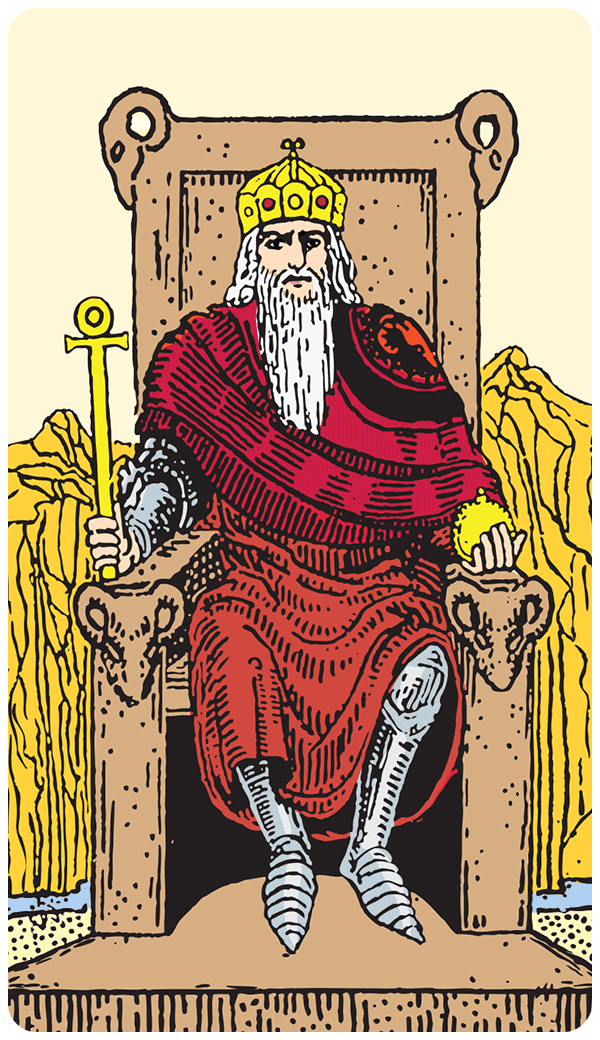
The Emperor · plate 4
What the card is actually doing
The Emperor shows up in a finance reading and the querent relaxes. They think it means they're about to win. Authority, power, control — those words land like validation that the money situation is handled, that success is imminent, that someone with resources is coming to fix it. That is not what the card is doing. The Emperor does not predict windfalls. It describes the structure you are currently operating inside of, and whether that structure is yours.
Reading The Emperor in money
What the Major Arcana rank and the throne image are actually pointing to
The Emperor is Major Arcana IV, which means it governs a foundational psychological pattern, not a temporary circumstance. Major Arcana cards don't describe events; they describe the organizing principle underneath the events. The Emperor's principle is imposed order. The image shows a figure on a stone throne, holding a scepter, wearing armor under robes, with ram heads carved into the throne. The landscape is barren. The figure is not building anything. He is presiding over what has already been built. His power comes from the fact that the system is already in place and he controls access to it.
In a finance reading, the card is naming the structure governing your material reality. That structure might be a budget you created. It might be a corporate hierarchy you work inside. It might be a loan agreement you signed. It might be the way your family has always handled money and you have never questioned it. The Emperor does not tell you whether the structure is good. It tells you the structure is what's running the situation. The most common misreading is to interpret the card as "you're about to be powerful" or "money is coming from someone in authority." What it actually says is: there is a system here, and your financial reality is being shaped by that system's rules.
How the card reads for someone who built the system versus someone who inherited it
If you are the person who created the structure — you set the budget, you negotiated the contract, you designed the business model — the Emperor reads as confirmation that the system is holding. You have control because you built the rules. The card is not telling you to do anything new. It is telling you the thing you put in place is working as designed. Your job is to maintain it, not to innovate out of it.
If you did not create the structure — you work for someone else, you're inside a family financial dynamic you didn't choose, you're operating under terms you inherited — the Emperor reads as diagnosis. You are inside someone else's system. The rules were set before you arrived. The card is not saying this is bad. It is saying: this is the constraint. If your financial situation feels stuck, the stuckness is structural. You are trying to solve a budget problem, but the Emperor is saying the issue is architectural. Reversed, the card often appears when the structure has ossilified into rigidity — when the rules that once organized things now strangle them, or when authority has curdled into authoritarianism and the system is eating resources instead of generating them.
The tell that you are misreading the card on yourself
You are misreading the Emperor if you walk away from the reading waiting for someone to show up and fix your financial situation. You are misreading it if you think it means a promotion is coming, or a loan will be approved, or a client will finally pay. The card does not describe an event on the horizon. It describes the operating system that is already running. If you are not asking "what structure am I inside of, and who set the terms," you are not reading the card. Go back through your last six months of financial decisions and look for the pattern you keep repeating — the rule you follow without naming it. That is what the Emperor is pointing to.
From the practice
“A card never tells you what to do. It tells you what you're already deciding — and gives you the words to name it.”
A grounded observation
The Emperor does not arrive. It is already seated. If your money situation feels immovable, the card is naming the throne, not the person on it.
Key themes to watch for
- № 01Theme
Non-material wealth
- № 02Theme
Generosity
- № 03Theme
Values check
What to do with this reading
Read the upright meaning first, even if you pulled the card reversed. The reversal is a commentary on the upright — not a separate card.
Notice what your body did when you saw The Emperor. That reaction is usually closer to the truth than the interpretation.
Write down one sentence: What is this card asking me to stop avoiding? Let the answer be smaller than you expect.
Come back to this card in 48 hours. Most money readings sharpen with a little distance.
Questions answered
Frequently asked
In finances, The Emperor suggests a time for discipline and careful management. You might benefit from creating a budget or a savings plan that provides a sense of security. This card points toward the value of financial stability and encourages you to take control of your monetary situation. It's an opportunity to establish more structured financial habits. Consider where you can create a solid financial foundation that supports your long-term goals, and reflect on the role that discipline plays in achieving economic security.
Reversed, The Emperor in finances can indicate disorganization or impulsive spending. There might be a lack of control over your financial situation or a feeling of instability. This card invites you to reassess your approach to money management and consider where you might need to impose more structure. Reflect on whether your current financial habits support your goals and how you can regain control to create a more stable financial future.
The Emperor colors the cards around it. Pay attention to where its themes — archetype, pattern, invitation — show up in the next card. That is usually where the story is.
Tarot is observational, not predictive. The Emperor describes the conditions in front of you right now and where they tend to lead if nothing changes — not a guarantee of timing.
Repeat cards are the deck underlining a theme. With The Emperor, that usually means the question you are asking is the right one — but you have not yet acted on what the card is showing you.
Read next
Related readings
Other The Emperor readings
- General MeaningThe Emperor read for general meaning.
- Love & RelationshipsThe Emperor read for love & relationships.
- Career & WorkThe Emperor read for career & work.
- Health & WellbeingThe Emperor read for health & wellbeing.
- SpiritualityThe Emperor read for spirituality.
- Yes / No AnswerThe Emperor read for yes / no answer.