The Devil in Love
The Devil shows up in a love reading and most people think it means their partner is toxic. That's not what the card is doing. Here's the mechanical read.
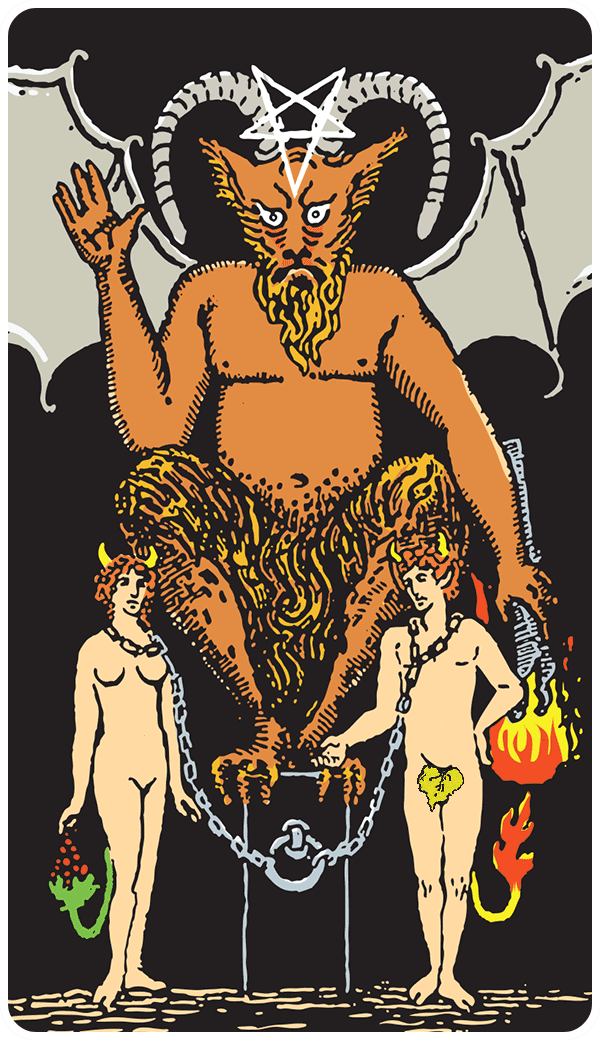
The Devil · plate 15
What the card is actually doing
The Devil shows up in a love reading and the querent's first move is to assign it to the other person. Their partner is the problem. Their ex was manipulative. The person they're dating is emotionally unavailable and that's why this card appeared. I watch this happen at least twice a week. The querent treats the card like a diagnosis of someone else's character, which means they've already missed what it's naming. The Devil does not describe your partner. It describes the part of you that stays.
Reading The Devil in love
What the Major Arcana rank and the image are each doing
The Devil is Major Arcana, which means it points to a structural pattern in the psyche, not a person or an event. Major cards describe the architecture underneath your choices — the recurring logic that shows up across multiple relationships, multiple years, multiple versions of what you tell yourself you want. When a Major card appears in a love reading, the question is not about whether this relationship works. The question is about what you are using relationships to avoid looking at.
Look at the image. Two figures stand chained to a pedestal. The chains are loose. They could remove them. They don't. The Devil figure above them is not holding them there. The card is not depicting captivity. It is depicting the choice to stay in a situation you have correctly identified as constrictive because leaving would require you to face something harder than staying. Most people read the chains as the relationship. The chains are not the relationship. The chains are whatever you are getting from the relationship that you have decided you cannot live without.
The most common misread in a love context is "this person is bad for me." The honest version is: "I am staying in this situation because it gives me something I am not willing to generate for myself, and I would rather blame the situation than look at what I am avoiding by staying in it."
How the card reads for two different querent situations
For someone in a relationship they know is not working: the Devil names the specific benefit you are extracting that makes leaving feel impossible. Not love. Not hope that it will get better. The actual transactional piece. Financial stability. Social proof. The relief of not having to date. The structure that lets you avoid your own life. Go back through the last six months and count how many times you said "I can't leave because" and then named something that is not actually an immovable obstacle. That sentence is the card.
For someone not in a relationship but stuck in a pattern: the Devil points to the recurring setup. You are attracted to people who need saving, or people who are unavailable, or people who mirror a specific childhood dynamic, and you have built an entire relational identity around that attraction. The card is not saying the pattern is wrong. It is saying you are aware of it, you can see it operating, and you are choosing not to interrupt it because interrupting it would mean rebuilding your understanding of what intimacy is.
The tell that someone is misreading the card on themselves
The tell is deflection. If your first response to the Devil is to describe your partner's behavior, you are not reading the card. If your second response is "but I really can't leave because [external constraint]," you are not reading the card. The Devil does not appear to tell you that you are trapped. It appears when you already know you are not trapped and you are pretending you don't know. The card is the moment the pretending becomes visible.
The other tell: if you feel relief when the card appears because now you have permission to leave, you are also misreading it. The Devil is not permission. It is the question you have been refusing to ask, which is: what am I getting from this that I am unwilling to admit I want?
From the practice
“A card never tells you what to do. It tells you what you're already deciding — and gives you the words to name it.”
A grounded observation
The Devil does not show up to condemn the relationship. It shows up when the relationship has become the excuse for not doing the thing you know you need to do, and you have started to believe your own excuse.
Key themes to watch for
- № 01Theme
Vulnerability
- № 02Theme
New chapters
- № 03Theme
Emotional truth
What to do with this reading
Read the upright meaning first, even if you pulled the card reversed. The reversal is a commentary on the upright — not a separate card.
Notice what your body did when you saw The Devil. That reaction is usually closer to the truth than the interpretation.
Write down one sentence: What is this card asking me to stop avoiding? Let the answer be smaller than you expect.
Come back to this card in 48 hours. Most love readings sharpen with a little distance.
Questions answered
Frequently asked
The Devil in a love context often points to intense, passionate connections that might be tinged with obsession or a sense of entrapment. This card can suggest relationships where boundaries blur, and emotions run high but not always in a healthy way. It might be a time to reflect on whether your desires in this relationship are genuinely fulfilling or if they mask deeper insecurities. The Devil invites you to explore the balance between passion and control, asking what you truly seek from this bond.
Reversed, The Devil card in love suggests a release from unhealthy bonds or patterns. It might indicate a relationship that’s moving away from codependency or a personal realization about unhelpful dynamics. This could be a time when clarity replaces confusion, allowing for more genuine connections. Perhaps you're beginning to see your partner in a new light or finding strength in your independence. The card invites you to embrace this newfound clarity and consider how it might reshape your relationships.
The Devil colors the cards around it. Pay attention to where its themes — archetype, pattern, invitation — show up in the next card. That is usually where the story is.
Tarot is observational, not predictive. The Devil describes the conditions in front of you right now and where they tend to lead if nothing changes — not a guarantee of timing.
Repeat cards are the deck underlining a theme. With The Devil, that usually means the question you are asking is the right one — but you have not yet acted on what the card is showing you.
Read next
Related readings
Other The Devil readings