The Devil in Money
The Devil in a finance reading doesn't predict ruin. It names the spending pattern or money story you already know is running but haven't named yet.
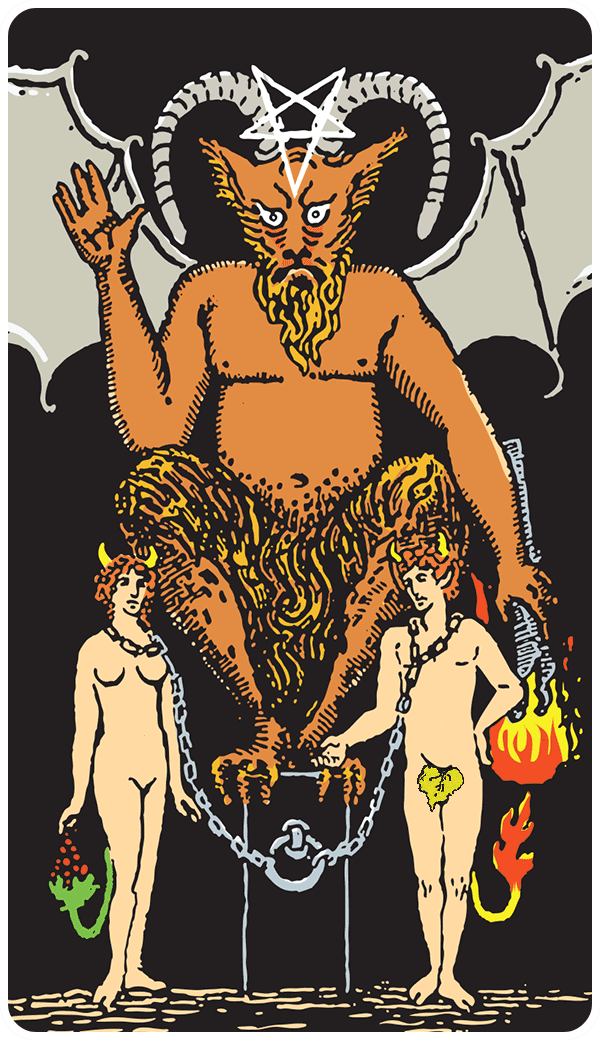
The Devil · plate 15
What the card is actually doing
The Devil shows up in a money reading and the querent assumes catastrophe. They think it means debt spiral, financial ruin, something external coming for them. That is not what the card is doing. The Devil does not describe what is about to happen to your finances. It describes the thing you are already doing that you have not yet admitted you are doing. The misreading happens because people treat the Devil as a warning about the future when it is actually a diagnosis of the present.
Reading The Devil in money
What the Major Arcana rank and the image are doing
The Devil is Major Arcana, which means it points to a structural pattern, not a transaction. This is not "you overspent last Tuesday." This is "you have been overspending every Tuesday for two years and the reason is older than the credit card." Major Arcana cards name the organizing logic underneath the behavior. They describe what you are optimizing for, often without knowing it.
Look at the image. Two figures are chained to a pedestal. The chains are loose. They could remove them. They do not. Above them is a horned figure — not a person, not a demon, but a symbol of the thing they have made into an authority. The card is not about external constraint. It is about voluntary constraint that has started to feel mandatory. In a finance reading, the Devil names the money behavior you could stop but have not stopped, and the unexamined belief that is keeping the behavior in place.
The most common misreading is treating the Devil as a prediction of collapse. "This card means I'm going to lose everything." No. What it means is: you are spending or earning or hoarding in a way that serves something other than your stated financial goals, and you already know what that something is. The card is not warning you. It is naming what you have been avoiding naming.
How the card reads for two different financial situations
For someone in consumer debt, the Devil often points to the story underneath the spending. Not "I bought too much," but "I buy things when I feel small because purchasing briefly makes me feel like I have status / control / proof I am not failing." The card describes the emotional trade you are making with money. The debt is the artifact. The trade is the pattern. What tends to happen after this card is the querent goes back through their statements and sees the same purchase category appear every time a specific feeling shows up.
For someone who earns well but cannot save, the Devil reads differently. Here it often names the belief that stopping work or reducing income or letting money sit idle feels like death. The card points to the part of the psyche that has made "producing" into an identity and "rest" into a threat. The person is chained to the income stream not because they need the money, but because they need the proof the money provides that they are not worthless. The card is describing what the work is serving instead of what the work is earning.
The tell that someone is misreading the card on themselves
The tell is when the querent describes the Devil as something being done TO them. "The card is saying the economy is going to crash" or "It means my partner is going to ruin us financially" or "It's warning me about a scam." If the Devil is about an external force, the reading is wrong. The Devil is always about the internal trade. The chain is loose. You are holding the chain in place because some part of you believes you need to. The card is asking you to name what you are getting in exchange for staying chained.
From the practice
“A card never tells you what to do. It tells you what you're already deciding — and gives you the words to name it.”
A grounded observation
Go back through six months of spending or earning and look for the pattern that appears every time a specific emotional state shows up. That pattern is what the Devil is pointing to.
Key themes to watch for
- № 01Theme
Non-material wealth
- № 02Theme
Generosity
- № 03Theme
Values check
What to do with this reading
Read the upright meaning first, even if you pulled the card reversed. The reversal is a commentary on the upright — not a separate card.
Notice what your body did when you saw The Devil. That reaction is usually closer to the truth than the interpretation.
Write down one sentence: What is this card asking me to stop avoiding? Let the answer be smaller than you expect.
Come back to this card in 48 hours. Most money readings sharpen with a little distance.
Questions answered
Frequently asked
The Devil card in finances may highlight an attachment to material wealth or spending habits that feel out of control. It suggests a time when money might be driving decisions more than you'd like. Reflect on whether purchases are fulfilling genuine needs or filling voids. This card invites you to consider how you can regain control without sacrificing enjoyment.
Reversed, The Devil suggests a shift towards financial freedom. It may indicate breaking free from debt or unhealthy spending habits. This could be a time to redefine what wealth means to you. Notice what financial habits have changed and how they impact your sense of security.
The Devil colors the cards around it. Pay attention to where its themes — archetype, pattern, invitation — show up in the next card. That is usually where the story is.
Tarot is observational, not predictive. The Devil describes the conditions in front of you right now and where they tend to lead if nothing changes — not a guarantee of timing.
Repeat cards are the deck underlining a theme. With The Devil, that usually means the question you are asking is the right one — but you have not yet acted on what the card is showing you.
Read next
Related readings
Other The Devil readings
- General MeaningThe Devil read for general meaning.
- Love & RelationshipsThe Devil read for love & relationships.
- Career & WorkThe Devil read for career & work.
- Health & WellbeingThe Devil read for health & wellbeing.
- SpiritualityThe Devil read for spirituality.
- Yes / No AnswerThe Devil read for yes / no answer.