The Devil in Health
The Devil in health readings doesn't predict disease. It names the pattern you're already running — the thing you keep choosing that you say you can't stop.
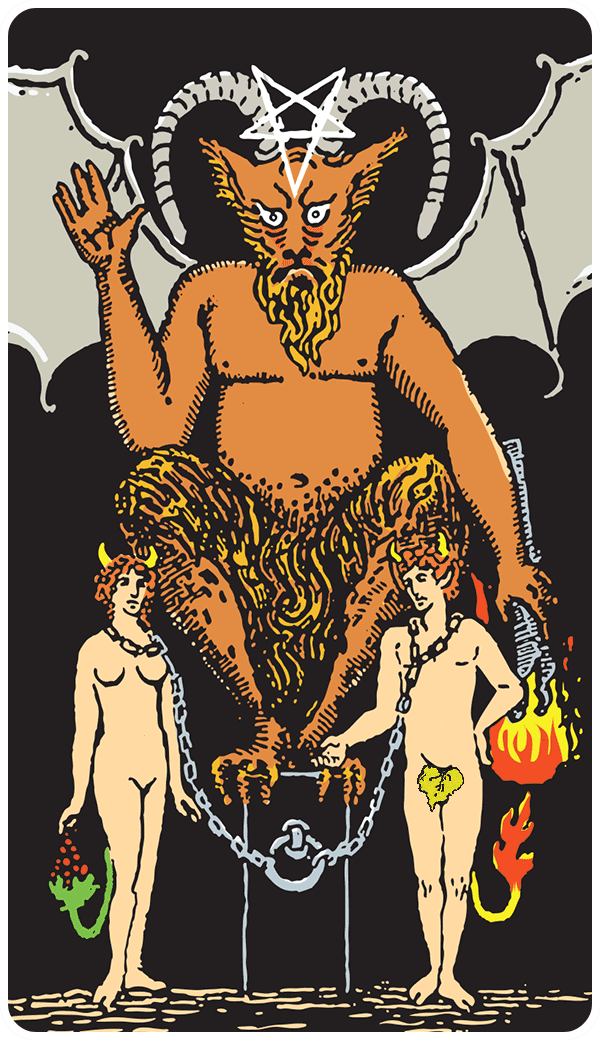
The Devil · plate 15
What the card is actually doing
The Devil shows up in a health reading and the querent assumes the worst. They think the card is warning them about disease, addiction spiraling out of control, or something catastrophic coming. That is not what the card does. The Devil does not predict outcomes. It names a pattern that is already running — the specific behavior or thought loop you are choosing and then pretending you are not choosing. The panic comes from finally seeing the pattern named on the table in front of you.
Reading The Devil in health
What the Major Arcana rank and the image are doing
Major Arcana cards describe archetypal psychological states, not events. They name the internal posture you are holding, the myth you are living inside of, the frame through which you are interpreting everything that happens to you. The Devil is the myth of captivity. It is the story you tell yourself about why you cannot stop, cannot leave, cannot change the thing that is hurting you.
Look at the image. Two figures are chained to a pedestal. The chains are loose. They could slip them off. They do not. The Devil figure above them is not holding them there. They are staying. This is the mechanical point: the card does not describe an external force trapping you. It describes the moment you mistake a habit for a necessity. In health readings, this is the difference between "I am sick" and "I am doing the thing that makes me sick and calling it something I cannot help."
How the card reads for two different querent situations
For someone asking about chronic pain or fatigue, the Devil usually points to the secondary behavior that has formed around the symptom. Not the pain itself, but the way they have started arranging their entire day to avoid triggering it, and how that avoidance has become more rigid than the pain ever required. They stop moving, stop eating certain foods, stop seeing people — not because the body demands it, but because the mind has built a cage and called it protection. The card is naming the cage, not the pain.
For someone asking about a specific behavior they want to stop — binge eating, drinking, doomscrolling until 3 a.m. — the Devil describes the moment right before they do it again. The moment they tell themselves they have no choice, that this is who they are, that trying to stop is pointless. The card does not say the behavior is impossible to stop. It says you are currently invested in believing it is impossible to stop, because that belief protects you from the discomfort of stopping. The Devil names the story that makes the chain feel necessary.
The tell that someone is misreading the card on themselves
The clearest tell is when someone sees the Devil and immediately starts talking about external circumstances — their job, their family, their genetics, the healthcare system. All of those things may be real constraints. But if the Devil is the card that turned, the reading is pointing one layer deeper: to the place where you are using those constraints as the reason you do not have to look at the choice you are making inside the constraint. The card is not saying your circumstances are not hard. It is saying you have started using the hardness as permission to stop trying, and you are calling that realism.
From the practice
“A card never tells you what to do. It tells you what you're already deciding — and gives you the words to name it.”
A grounded observation
Go back through your last two weeks and find the sentence you said out loud that started with "I can't." Write down what you said. Now replace "I can't" with "I am choosing not to." Notice which one makes you angry. That is where the Devil is sitting.
Key themes to watch for
- № 01Theme
Emotional renewal
- № 02Theme
Mind-body link
- № 03Theme
Soft restoration
What to do with this reading
Read the upright meaning first, even if you pulled the card reversed. The reversal is a commentary on the upright — not a separate card.
Notice what your body did when you saw The Devil. That reaction is usually closer to the truth than the interpretation.
Write down one sentence: What is this card asking me to stop avoiding? Let the answer be smaller than you expect.
Come back to this card in 48 hours. Most health readings sharpen with a little distance.
Questions answered
Frequently asked
In health matters, The Devil card can point to habits or addictions that impact well-being. It might suggest a time when indulgence feels hard to resist, whether in diet, exercise, or lifestyle choices. Consider what patterns could be holding you back from feeling your best. This card invites you to explore healthier alternatives that align with your goals.
Reversed, The Devil in health suggests breaking free from unhealthy habits. It points to a period of recovery or newfound discipline. This could be a time when positive changes feel more attainable. Notice how these shifts affect your overall vitality and sense of well-being.
The Devil colors the cards around it. Pay attention to where its themes — archetype, pattern, invitation — show up in the next card. That is usually where the story is.
Tarot is observational, not predictive. The Devil describes the conditions in front of you right now and where they tend to lead if nothing changes — not a guarantee of timing.
Repeat cards are the deck underlining a theme. With The Devil, that usually means the question you are asking is the right one — but you have not yet acted on what the card is showing you.
Read next
Related readings
Other The Devil readings
- General MeaningThe Devil read for general meaning.
- Love & RelationshipsThe Devil read for love & relationships.
- Career & WorkThe Devil read for career & work.
- Money & FinanceThe Devil read for money & finance.
- SpiritualityThe Devil read for spirituality.
- Yes / No AnswerThe Devil read for yes / no answer.