The Chariot in Yes / No
The Chariot reads as 'yes' in binary spreads, but only when the querent already has forward motion. Here's what the card is actually measuring.
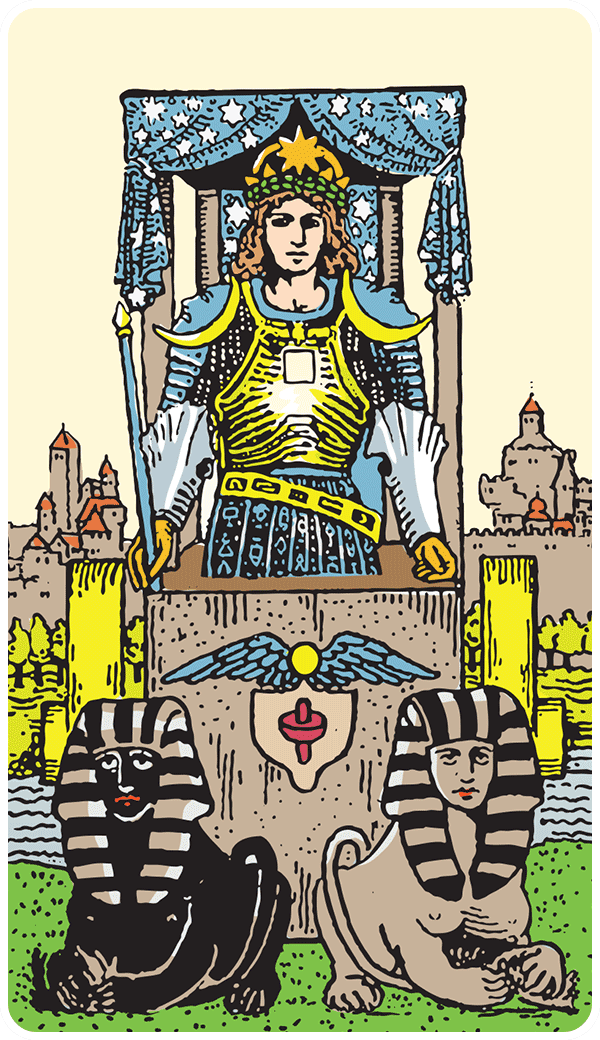
The Chariot · plate 7
YES
The Chariot is a yes. But it's a yes with a condition most readers skip: you have to already be moving. The card does not promise that momentum will arrive or that circumstances will suddenly align. It confirms that the forward motion you've already generated is sufficient to carry the thing through. When someone pulls the Chariot and hears 'yes' and then nothing happens, it's because they were waiting for permission to start. The card was measuring something they hadn't built yet.
Why The Chariot reads this way
What the card is actually tracking
The Chariot is Major Arcana VII, the card of directed will meeting sustained effort. It sits between The Lovers (choice) and Strength (endurance), which tells you what it governs: the gap between deciding and completing. The image shows a figure in armor, holding reins, standing in a chariot pulled by two sphinxes — one black, one white. The sphinxes face forward but are not moving in unison. The figure is not whipping them into action. The card depicts controlled momentum, not the beginning of momentum. The yes/no misreading happens here: people read the Chariot as 'the universe says go' when the card is actually saying 'you have enough forward motion to get this done if you hold the reins.' It measures capacity, not permission.
In a yes/no pull, the Chariot leans yes when the querent has already taken the first three steps. They've made the choice, they've done the groundwork, they've committed resources or attention. The card confirms that the momentum they've built is real and that opposing forces — doubt, distraction, other people's agendas — will not stop them if they stay focused. It is not saying the path will be easy. It is saying the path is clearable. The Chariot becomes a no when the querent is asking whether they should start, whether conditions will improve, whether someone else will do the work. The card does not answer hypothetical questions. It answers questions about things already in motion.
How reversed Chariot changes the answer
Reversed, the Chariot is a no — but the no is about loss of control, not lack of capacity. The querent has momentum but they've lost the reins. They're being pulled in two directions by competing priorities or by their own conflicting wants. The sphinxes are no longer facing the same direction. The yes/no answer flips because the question is no longer 'can I do this' but 'will I be able to stay on course long enough to finish.' The reversed card says: not until you resolve the split. The tell that someone is misreading reversed Chariot on themselves is when they interpret it as 'I need to try harder.' Reversed Chariot is not about effort. It is about the thing inside you that is pulling against the thing you say you want.
The tell that you're misreading the card
If you pull the Chariot as a yes and feel relief, you misread it. The card does not grant relief. It confirms that you are capable of the thing you are already doing. If you pull it and feel pressure, you read it correctly. The pressure is the point. The Chariot does not remove obstacles; it tells you that you have enough force to move through them if you don't stop halfway.
A grounded observation
Go back through your calendar and look at the last time you finished something difficult. The Chariot was the middle third of that process — the part where you were tired and it wasn't done yet and you kept going anyway.
Key themes to watch for
- № 01Theme
Affirmative current
- № 02Theme
Open door
- № 03Theme
Forward motion
What to do with this reading
Read the upright meaning first, even if you pulled the card reversed. The reversal is a commentary on the upright — not a separate card.
Notice what your body did when you saw The Chariot. That reaction is usually closer to the truth than the interpretation.
Write down one sentence: What is this card asking me to stop avoiding? Let the answer be smaller than you expect.
Come back to this card in 48 hours. Most yes / no readings sharpen with a little distance.
Questions answered
Frequently asked
The Chariot is a yes. But it's a yes with a condition most readers skip: you have to already be moving. The card does not promise that momentum will arrive or that circumstances will suddenly align. It confirms that the forward motion you've already generated is sufficient to carry the thing through. When someone pulls the Chariot and hears 'yes' and then nothing happens, it's because they were waiting for permission to start. The card was measuring something they hadn't built yet.
Reversed cards are rarely "bad." The Chariot reversed asks you to look at where the same theme is blocked, postponed, or being avoided — usually with more compassion than the upright version.
The Chariot colors the cards around it. Pay attention to where its themes — archetype, pattern, invitation — show up in the next card. That is usually where the story is.
Tarot is observational, not predictive. The Chariot describes the conditions in front of you right now and where they tend to lead if nothing changes — not a guarantee of timing.
Repeat cards are the deck underlining a theme. With The Chariot, that usually means the question you are asking is the right one — but you have not yet acted on what the card is showing you.
Read next
Related readings
Other The Chariot readings
- General MeaningThe Chariot read for general meaning.
- Love & RelationshipsThe Chariot read for love & relationships.
- Career & WorkThe Chariot read for career & work.
- Money & FinanceThe Chariot read for money & finance.
- Health & WellbeingThe Chariot read for health & wellbeing.
- SpiritualityThe Chariot read for spirituality.