The Chariot in Career
The Chariot in career readings gets misread as momentum. What it actually describes is the exhausting work of holding two opposing forces in harness.
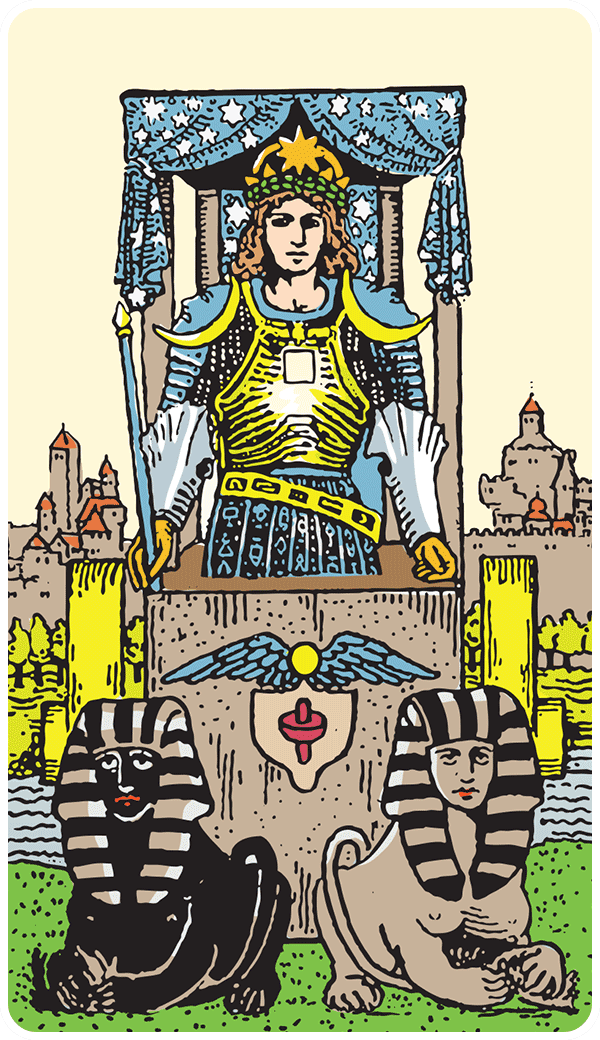
The Chariot · plate 7
What the card is actually doing
The Chariot shows up in a career reading and the querent exhales. They think it means they're about to win. They think it means the project is going to take off, the promotion is coming, the business is about to scale. They think the hard part is over. That is the opposite of what the card is saying. The Chariot describes the moment you realize you have to steer two things that want to go in different directions, and neither one can be let go.
Reading The Chariot in career
What the rank, the image, and the sphinxes are doing
The Chariot is Major Seven. The Majors govern the large structural movements of a life — the moments where the question isn't what to do next week but what framework you're operating inside. Seven in tarot is the number of tested mastery. It's the point where skill meets resistance and you find out whether the skill holds.
Look at the image. A figure sits in a chariot pulled by two sphinxes — one black, one white. The sphinxes face forward but they are not yoked together. They are not pulling in sync. The figure holds no reins. The card's central tension is right there: you are trying to move forward while managing two forces that have their own agendas. The Chariot is not about speed. It is about the amount of focus it takes to keep both sphinxes aimed at the same destination when neither one naturally wants to go there.
In a career context, this is almost always about competing priorities that cannot be reconciled by choosing one. The job that pays well but drains you and the creative work that fills you but pays nothing. The team that needs your leadership and the project that needs your deep focus. The client work that funds the business and the product work that would let you scale. The Chariot says: both are in harness now, and your job is to drive them.
The most common misreading is treating the card as a green light. The querent sees a chariot and thinks momentum. They think the universe is cosigning their plan. What they miss is that the card is describing effort, not ease. If the Chariot is showing up, it means you are already holding tension, and the question is whether you can hold it long enough to get where you need to go.
How the card reads for two different querent situations
For someone early in their career or just after a pivot, the Chariot tends to describe the split between what they were trained to do and what they actually want to build. One sphinx is the skill set that makes them employable. The other is the vision that doesn't yet have infrastructure. The card is not saying quit your job. It is saying: you are going to have to do both for longer than feels sustainable, and that is the price of the transition.
For someone already established, the Chariot more often describes operational tension — the part of the business or role that requires two incompatible modes. The strategic work and the execution work. The revenue-generating track and the reputation-building track. The card reads as: you have built something that now requires you to be two people at once, and neither role can be delegated yet.
The tell that someone is misreading the card on themselves
The tell is when someone sees the Chariot and starts talking about momentum, acceleration, or winning. If they say "things are finally moving," they are not reading the card — they are reading their wish. The Chariot does not describe things moving on their own. It describes you holding two opposing forces in alignment through sheer sustained attention. If you are not tired, you are not in a Chariot moment. The card is named for the vehicle, not the destination.
From the practice
“A card never tells you what to do. It tells you what you're already deciding — and gives you the words to name it.”
A grounded observation
Go back through your calendar for the last month. If you see the Chariot in a career reading, look for the two projects or roles you've been toggling between. The exhaustion is not a sign you're doing it wrong. It is confirmation the card is describing what is.
Key themes to watch for
- № 01Theme
Creative purpose
- № 02Theme
Heart-led work
- № 03Theme
Right alignment
What to do with this reading
Read the upright meaning first, even if you pulled the card reversed. The reversal is a commentary on the upright — not a separate card.
Notice what your body did when you saw The Chariot. That reaction is usually closer to the truth than the interpretation.
Write down one sentence: What is this card asking me to stop avoiding? Let the answer be smaller than you expect.
Come back to this card in 48 hours. Most career readings sharpen with a little distance.
Questions answered
Frequently asked
The Chariot in your career signifies a period where ambition and determination are driving forces. You're likely in a position to take charge of a project or steer your career path with clarity and purpose. Success comes from your ability to harness different strengths and guide them towards a common goal. It’s a time for bold moves and clear vision. Think about what professional victories mean to you. Are you chasing your own ambitions, or are you being pulled along by someone else's agenda?
In a career reading, The Chariot reversed suggests a loss of direction or a struggle to keep control over your professional path. You might feel like you're trying to move forward but are stuck in place, possibly due to external pressures or internal uncertainties. This can lead to frustration or stagnation. It's a good moment to evaluate whether you're truly aligned with your career goals or if adjustments are needed to regain your footing and direction.
The Chariot colors the cards around it. Pay attention to where its themes — archetype, pattern, invitation — show up in the next card. That is usually where the story is.
Tarot is observational, not predictive. The Chariot describes the conditions in front of you right now and where they tend to lead if nothing changes — not a guarantee of timing.
Repeat cards are the deck underlining a theme. With The Chariot, that usually means the question you are asking is the right one — but you have not yet acted on what the card is showing you.
Read next
Related readings
Other The Chariot readings
- General MeaningThe Chariot read for general meaning.
- Love & RelationshipsThe Chariot read for love & relationships.
- Money & FinanceThe Chariot read for money & finance.
- Health & WellbeingThe Chariot read for health & wellbeing.
- SpiritualityThe Chariot read for spirituality.
- Yes / No AnswerThe Chariot read for yes / no answer.