Ten of Swords in Health
The Ten of Swords in health readings gets read as catastrophe. What it actually describes is the moment you stop pretending the body isn't asking for attention.
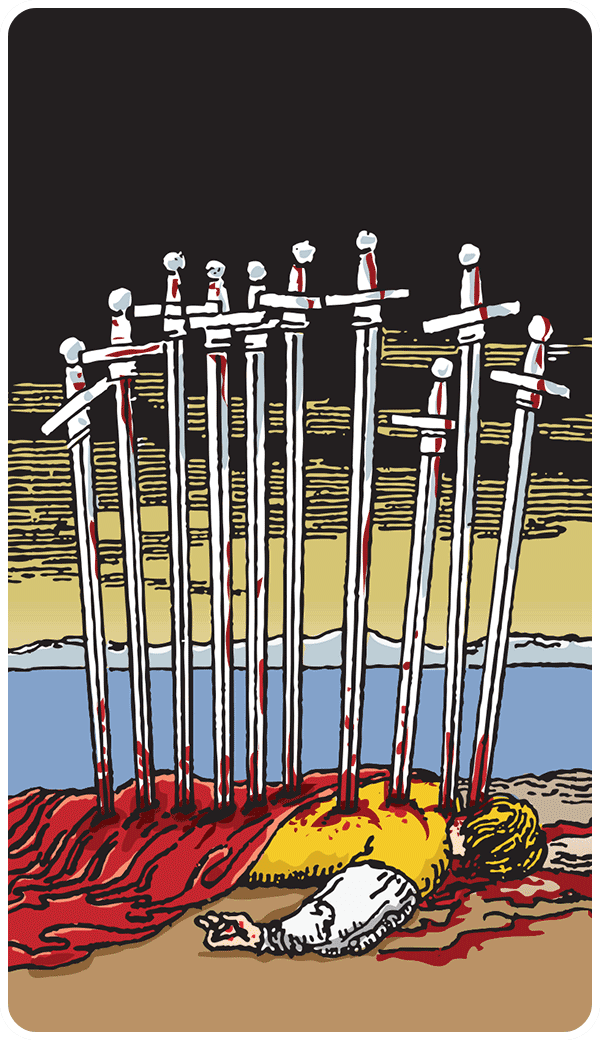
Ten of Swords · plate 10
What the card is actually doing
The Ten of Swords shows up in a health reading and the querent's face drops. They think the card is telling them something terrible is coming — a diagnosis, a collapse, the worst-case scenario they've been trying not to think about. That is not what the card is doing. The Ten of Swords does not predict disaster. It names the moment you can no longer ignore what the body has been saying for months.
Reading Ten of Swords in health
What the suit, the rank, and the image are doing
Swords is the suit of thought, pattern recognition, and the stories you tell yourself about what is happening. In a health context, Swords governs how you interpret physical sensation, what you decide counts as "serious," and the mental loop that either moves you toward care or keeps you in denial. When Swords cards dominate a health reading, the body is not the problem — the way you are thinking about the body is the problem.
Tens in tarot are endpoints. They describe the moment a cycle completes, a pattern reaches its logical conclusion, or a structure that has been building finally lands. The Ten of Swords is the end of a particular way of thinking that was never going to hold. It is not the crisis itself. It is the moment the crisis becomes undeniable.
Now look at the image. A figure lies face-down with ten swords in their back. The sky is dark, but the horizon is brightening. The figure is still. The swords are already in place. This is not the moment of injury. This is the moment after — the moment you stop moving, stop pretending, and let yourself see what has already happened. The card is describing recognition, not catastrophe.
How it reads for two different situations
If you have been ignoring symptoms — the headache that comes back every afternoon, the knee that hurts after every run, the exhaustion that sleep does not fix — the Ten of Swords is the moment you admit you cannot keep going like this. The swords are not the illness. The swords are every rationalization you used to avoid the doctor. The card is saying: the avoidance has reached its limit. You already know what you need to do.
If you are already in treatment or managing a chronic condition, the Ten of Swords reads differently. It is the moment a particular approach stops working, or the moment you realize the way you have been managing the condition is no longer sustainable. The card is not saying the condition is worsening. It is saying the framework you have been using to cope with it has completed. You need a new one.
The tell that you are misreading it
You are misreading the Ten of Swords if you walk away from the reading convinced something terrible is about to happen to your body. The card does not work that way. The Ten describes a mental threshold, not a physical event. If you find yourself spiraling into catastrophic thinking after pulling this card, go back and ask: what have I been refusing to acknowledge? What conversation have I been postponing? What symptom have I been explaining away? The answer to that question is what the card is pointing at. The swords are already in place. The card is just naming them.
From the practice
“A card never tells you what to do. It tells you what you're already deciding — and gives you the words to name it.”
A grounded observation
Go back through your calendar and look for the last time you told yourself "I'll deal with that later" about something physical. That is what the Ten of Swords is naming.
Key themes to watch for
- № 01Theme
Emotional renewal
- № 02Theme
Mind-body link
- № 03Theme
Soft restoration
What to do with this reading
Read the upright meaning first, even if you pulled the card reversed. The reversal is a commentary on the upright — not a separate card.
Notice what your body did when you saw Ten of Swords. That reaction is usually closer to the truth than the interpretation.
Write down one sentence: What is this card asking me to stop avoiding? Let the answer be smaller than you expect.
Come back to this card in 48 hours. Most health readings sharpen with a little distance.
Questions answered
Frequently asked
In health, the Ten of Swords often reflects a period of significant stress or a health setback. It’s that moment when you feel you can’t take any more. While daunting, this card also marks a turning point, where acknowledging the issue is the first step towards recovery. Reflect on how you can prioritize your well-being. What changes can you make to support your health journey?
Reversed, this card suggests healing and recovery from a health issue. The worst may be behind you, and you’re moving towards improvement. It’s like the body slowly mending after an exhausting illness. Consider what ongoing care and kindness you can offer yourself. How can you sustain this healing momentum?
Ten of Swords colors the cards around it. Pay attention to where its themes — mental clarity, the truth being named, what the mind needs to release — show up in the next card. That is usually where the story is.
Tarot is observational, not predictive. Ten of Swords describes the conditions in front of you right now and where they tend to lead if nothing changes — not a guarantee of timing.
Repeat cards are the deck underlining a theme. With Ten of Swords, that usually means the question you are asking is the right one — but you have not yet acted on what the card is showing you.
Read next
Related readings
More Swords · Health
- Ace of Swords — HealthHow Ace of Swords reads in a health context.
- Two of Swords — HealthHow Two of Swords reads in a health context.
- Three of Swords — HealthHow Three of Swords reads in a health context.
- Four of Swords — HealthHow Four of Swords reads in a health context.
- Five of Swords — HealthHow Five of Swords reads in a health context.
- Six of Swords — HealthHow Six of Swords reads in a health context.
Other Ten of Swords readings
- General MeaningTen of Swords read for general meaning.
- Love & RelationshipsTen of Swords read for love & relationships.
- Career & WorkTen of Swords read for career & work.
- Money & FinanceTen of Swords read for money & finance.
- SpiritualityTen of Swords read for spirituality.
- Yes / No AnswerTen of Swords read for yes / no answer.