Ten of Pentacles in Yes / No
The Ten of Pentacles reads as yes in yes/no spreads, but only if the question involves legacy systems. Here's what the card is actually measuring.
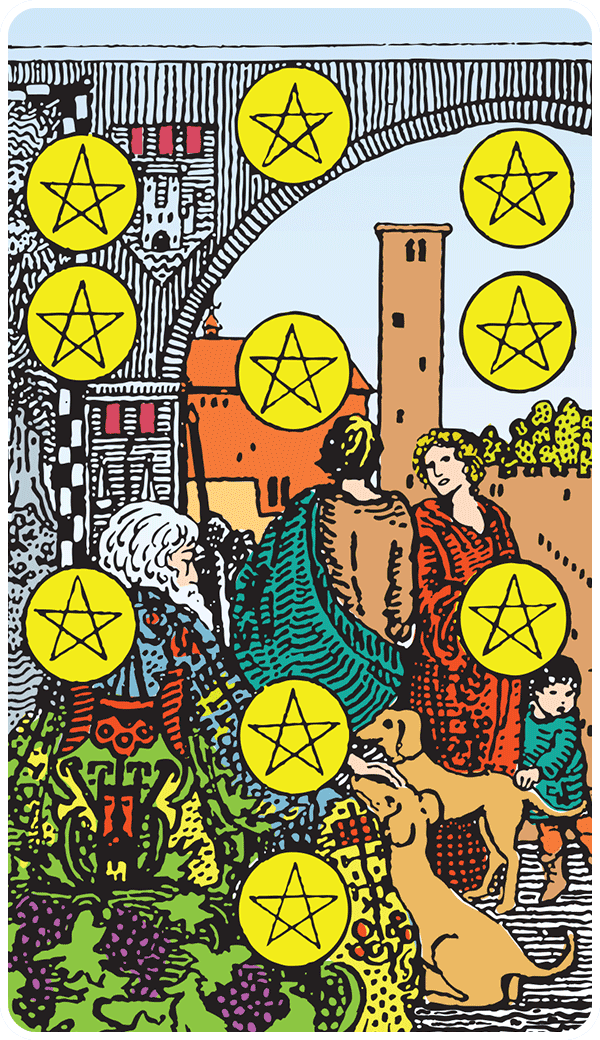
Ten of Pentacles · plate 10
YES
The Ten of Pentacles is a yes. But it is a yes that arrives slowly, through structures that were already in motion before you asked the question. Most querents read it as cosmic approval and stop there. What they miss is that the card is not measuring whether the thing will happen — it is measuring whether the thing fits into the long-term architecture of your life. If the question is about a shortcut, a gamble, or something that requires dismantling what you have already built, the answer flips to no.
Why Ten of Pentacles reads this way
What the suit, the rank, and the image are doing
Pentacles is the material suit. It governs money, property, work, physical health, and anything you can measure or hold in your hand. When Pentacles cards appear, the question being asked is almost always about resources, security, or the structures that produce stability over time. The suit does not care about feelings or ideas. It cares about what actually exists in the world.
Tens in tarot mark completion. They are the last card of the numbered sequence before the court cards arrive. A Ten says the cycle has run its full course — the thing has been built, the pattern has finished expressing itself, the container is full. Tens are not beginnings. They are culminations.
Now look at the image. An older man sits under an archway. A couple stands behind him. A child plays with two dogs. Coins are arranged across the scene in a deliberate pattern — ten of them, marking the family crest, the gate, the ground. Everyone in the card is inside the structure. No one is arriving. No one is leaving. The wealth is inherited. The security is multi-generational. This is not a card about getting something new. It is a card about what has already been secured.
The most common misreading in a yes/no context is treating the Ten of Pentacles as a green light for any question about money or success. The querent asks "Should I take this job?" or "Will this investment work out?" and pulls the Ten and assumes the universe is saying yes. What the card is actually measuring is whether the question aligns with long-term legacy — whether it builds on what you have already established, whether it serves the structures you are trying to maintain. If the question is about a lateral move, a gamble, or starting over, the card is not confirming the move. It is showing you what you would be leaving.
How the card reads for two different questions
If the question is "Should I buy this house?" and the querent has been saving for years, has stable income, and is asking about a property they plan to keep for decades, the Ten of Pentacles is a yes. The card is describing the long-term container the house will become. It fits.
If the question is "Should I quit my job to start a business?" and the querent has a mortgage, dependents, and no runway, the Ten of Pentacles is a no. The card is not measuring whether the business idea is good. It is measuring whether the risk is structurally sound given what the querent has already built. The answer is that the foundation is not there yet. The card is naming what would be dismantled, not what would be gained.
The tell that someone is misreading it
The tell is when the querent pulls the Ten of Pentacles and immediately starts planning the next move as if permission has been granted. They book the flight. They make the offer. They quit the thing. Three months later, they are financially worse off than before and confused about why the card "lied." The card did not lie. The querent asked a yes/no question and read the yes as unconditional. What the card was actually saying is that yes is available if the question serves the long-term structure. If it does not, the yes evaporates. The Ten of Pentacles does not bless shortcuts. It confirms legacy moves.
A grounded observation
Go back through the last five years and look for the moments you stayed when you wanted to leave. That is what the Ten of Pentacles measures — whether the thing you are asking about will make those years matter.
Key themes to watch for
- № 01Theme
Affirmative current
- № 02Theme
Open door
- № 03Theme
Forward motion
What to do with this reading
Read the upright meaning first, even if you pulled the card reversed. The reversal is a commentary on the upright — not a separate card.
Notice what your body did when you saw Ten of Pentacles. That reaction is usually closer to the truth than the interpretation.
Write down one sentence: What is this card asking me to stop avoiding? Let the answer be smaller than you expect.
Come back to this card in 48 hours. Most yes / no readings sharpen with a little distance.
Questions answered
Frequently asked
The Ten of Pentacles is a yes. But it is a yes that arrives slowly, through structures that were already in motion before you asked the question. Most querents read it as cosmic approval and stop there. What they miss is that the card is not measuring whether the thing will happen — it is measuring whether the thing fits into the long-term architecture of your life. If the question is about a shortcut, a gamble, or something that requires dismantling what you have already built, the answer flips to no.
Reversed cards are rarely "bad." Ten of Pentacles reversed asks you to look at where the same theme is blocked, postponed, or being avoided — usually with more compassion than the upright version.
Ten of Pentacles colors the cards around it. Pay attention to where its themes — embodiment, material follow-through, the slow build of resource — show up in the next card. That is usually where the story is.
Tarot is observational, not predictive. Ten of Pentacles describes the conditions in front of you right now and where they tend to lead if nothing changes — not a guarantee of timing.
Repeat cards are the deck underlining a theme. With Ten of Pentacles, that usually means the question you are asking is the right one — but you have not yet acted on what the card is showing you.
Read next
Related readings
More Pentacles · Yes / No
- Ace of Pentacles — Yes / NoHow Ace of Pentacles reads in a yes / no context.
- Two of Pentacles — Yes / NoHow Two of Pentacles reads in a yes / no context.
- Three of Pentacles — Yes / NoHow Three of Pentacles reads in a yes / no context.
- Four of Pentacles — Yes / NoHow Four of Pentacles reads in a yes / no context.
- Five of Pentacles — Yes / NoHow Five of Pentacles reads in a yes / no context.
- Six of Pentacles — Yes / NoHow Six of Pentacles reads in a yes / no context.
Other Ten of Pentacles readings
- General MeaningTen of Pentacles read for general meaning.
- Love & RelationshipsTen of Pentacles read for love & relationships.
- Career & WorkTen of Pentacles read for career & work.
- Money & FinanceTen of Pentacles read for money & finance.
- Health & WellbeingTen of Pentacles read for health & wellbeing.
- SpiritualityTen of Pentacles read for spirituality.