Four of Pentacles in Yes / No
The Four of Pentacles in a yes/no reading leans no — not because the outcome is bad, but because the card describes a grip that prevents movement.
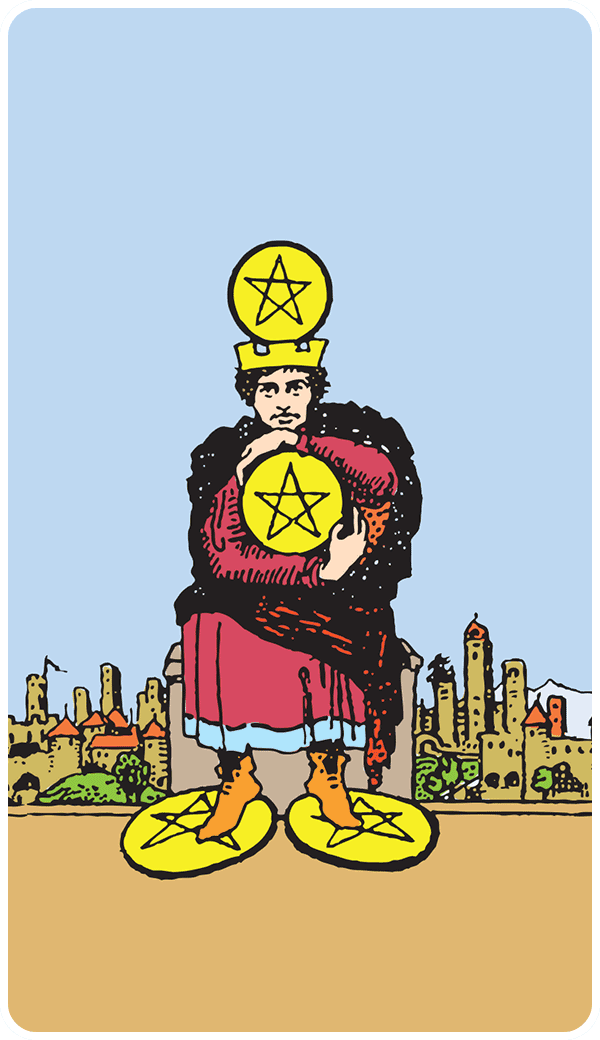
Four of Pentacles · plate 4
NO
The Four of Pentacles in a yes/no reading leans no. Not because the thing you want is impossible, but because the card describes a posture that makes movement unlikely. Most people read this card as stability or security and assume that means the answer tilts yes. That's backwards. The Four of Pentacles names the moment you are holding so tightly to what you have that you cannot reach for what you want. The question isn't whether the outcome is available — it's whether you are willing to let go long enough to let it happen.
Why Four of Pentacles reads this way
What the suit, rank, and image are doing — and the misread
Pentacles is the material suit. It governs money, resources, physical security, the structures that keep your life intact. When Pentacles cards show up, the question being asked is almost always about something you can count or lose or protect. The Four is the number of structure and containment — the square, the four walls, the box. It is not inherently negative, but it is inherently fixed. A Four describes something that has been locked into place.
Look at the image. A figure sits on a stone block in the middle of a city, clutching one pentacle to his chest, one under each foot, one balanced on his head. His posture is rigid. His hands do not move. He is not using the pentacles. He is not investing them or spending them or trading them. He is holding them. The city behind him is active, but he is not participating. He has what he has, and he is not letting it go.
The misread happens when people see the pentacles and think resources secured, answer is yes. But the card is not describing wealth in motion. It is describing wealth frozen. The yes/no question is almost always about something new — a new job, a new relationship, a move, a risk. The Four of Pentacles says: you are not in a posture to receive something new, because your hands are full of what you already have.
How the card reads for two different querent situations
If the question is should I take this financial risk, the Four of Pentacles is a clean no. The card is not saying the risk is bad. It is saying you are not the person who takes it. Your nervous system is wired for preservation right now, not expansion. You will either not take the risk, or you will take it while white-knuckling the whole way through, which means you will pull out early or hedge so hard you neutralize the upside. The no is mechanical, not moral.
If the question is will this relationship move forward, the Four of Pentacles is still a no, but the reason shifts. The card is naming emotional hoarding. You are holding onto control, or holding onto the safety of distance, or holding onto the last relationship's lessons so tightly that you cannot be surprised by this person. The relationship might be good. You might want it. But you are not available for it to move, because movement requires letting something go — your guard, your script, your certainty about how people are. The card is not about the other person. It is about your grip.
The tell that someone is misreading the card on themselves
The tell is when someone pulls the Four of Pentacles in a yes/no reading and says good, I have what I need, so the answer is yes. That sentence is the misread in real time. If you had what you needed, you would not be asking the question. The Four of Pentacles shows up when the thing you are holding is preventing the thing you are asking for. If you find yourself defending your current position after pulling this card — explaining why it makes sense to stay cautious, why you can't afford to lose what you have, why the timing isn't right — you are describing the no. The card is not wrong. You are just naming the mechanism.
A grounded observation
Go back through your calendar and look for the last time you said no to something because you weren't ready to let go of something else. That's the Four of Pentacles. The card doesn't judge the grip. It just names it.
Key themes to watch for
- № 01Theme
Affirmative current
- № 02Theme
Open door
- № 03Theme
Forward motion
What to do with this reading
Read the upright meaning first, even if you pulled the card reversed. The reversal is a commentary on the upright — not a separate card.
Notice what your body did when you saw Four of Pentacles. That reaction is usually closer to the truth than the interpretation.
Write down one sentence: What is this card asking me to stop avoiding? Let the answer be smaller than you expect.
Come back to this card in 48 hours. Most yes / no readings sharpen with a little distance.
Questions answered
Frequently asked
The Four of Pentacles in a yes/no reading leans no. Not because the thing you want is impossible, but because the card describes a posture that makes movement unlikely. Most people read this card as stability or security and assume that means the answer tilts yes. That's backwards. The Four of Pentacles names the moment you are holding so tightly to what you have that you cannot reach for what you want. The question isn't whether the outcome is available — it's whether you are willing to let go long enough to let it happen.
Reversed cards are rarely "bad." Four of Pentacles reversed asks you to look at where the same theme is blocked, postponed, or being avoided — usually with more compassion than the upright version.
Four of Pentacles colors the cards around it. Pay attention to where its themes — embodiment, material follow-through, the slow build of resource — show up in the next card. That is usually where the story is.
Tarot is observational, not predictive. Four of Pentacles describes the conditions in front of you right now and where they tend to lead if nothing changes — not a guarantee of timing.
Repeat cards are the deck underlining a theme. With Four of Pentacles, that usually means the question you are asking is the right one — but you have not yet acted on what the card is showing you.
Read next
Related readings
More Pentacles · Yes / No
- Ace of Pentacles — Yes / NoHow Ace of Pentacles reads in a yes / no context.
- Two of Pentacles — Yes / NoHow Two of Pentacles reads in a yes / no context.
- Three of Pentacles — Yes / NoHow Three of Pentacles reads in a yes / no context.
- Five of Pentacles — Yes / NoHow Five of Pentacles reads in a yes / no context.
- Six of Pentacles — Yes / NoHow Six of Pentacles reads in a yes / no context.
- Seven of Pentacles — Yes / NoHow Seven of Pentacles reads in a yes / no context.
Other Four of Pentacles readings
- General MeaningFour of Pentacles read for general meaning.
- Love & RelationshipsFour of Pentacles read for love & relationships.
- Career & WorkFour of Pentacles read for career & work.
- Money & FinanceFour of Pentacles read for money & finance.
- Health & WellbeingFour of Pentacles read for health & wellbeing.
- SpiritualityFour of Pentacles read for spirituality.