Six of Pentacles in Yes / No
The Six of Pentacles leans yes, but only if you're willing to accept the terms. Here's what the card is actually measuring in a binary question.
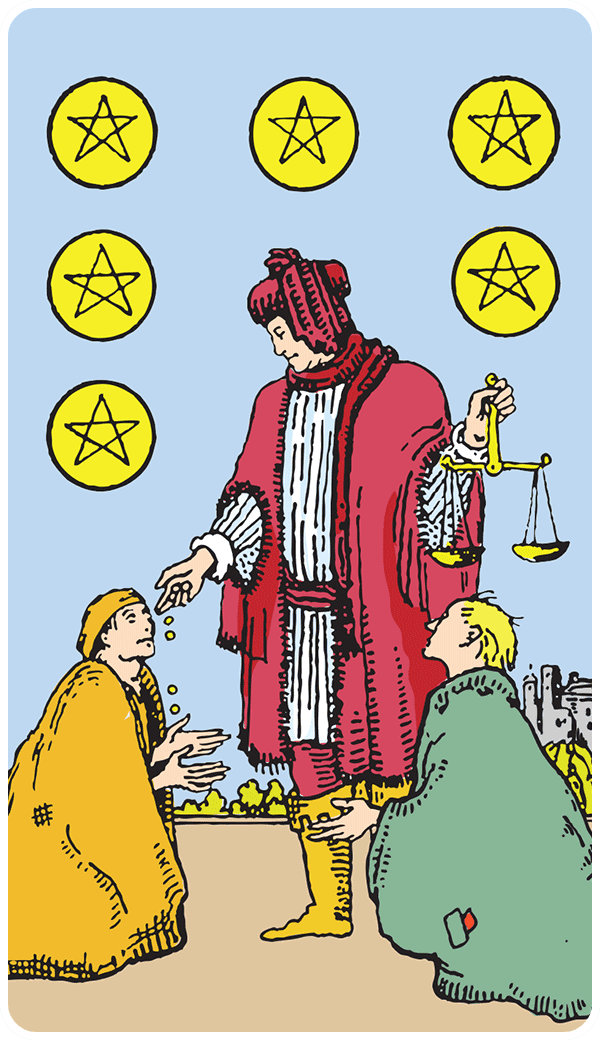
Six of Pentacles · plate 6
YES
The Six of Pentacles leans yes, but it's a yes with strings attached. The card doesn't describe a clean outcome — it describes an exchange. Something is being offered, but the offer comes with a power dynamic you'll need to accept or negotiate. Most people read this card as generous abundance and stop there. What they miss is the figure holding the scale. The answer isn't about whether you get what you want; it's about whether you're willing to take it on the terms being offered.
Why Six of Pentacles reads this way
What the suit, the rank, and the image are doing
Pentacles governs material reality — money, resources, time, physical security, the structures that keep you fed and housed. When a Pentacles card shows up in a yes/no reading, the question being asked is almost always about something concrete: a job, a loan, a financial decision, a practical outcome you can measure. The suit doesn't care about feelings. It cares about what actually moves.
Sixes in tarot describe equilibrium. Not victory, not completion — balance. The hard part has passed, but you're now holding a position that requires maintenance. The Six of Cups is emotional nostalgia held in place. The Six of Swords is travel that's already underway. The Six of Pentacles is resource flow that has stabilized into a pattern.
Now look at the image. A wealthy figure holds a scale in one hand and distributes coins with the other. Two beggars kneel at his feet. The coins are moving, but they're moving downward. The person receiving is not the person deciding how much gets distributed or when. This is the mechanical answer: the card describes an exchange where the terms are set by someone else. You can get what you need, but you don't control the conditions.
Why the answer is yes — and when it flips to no
The card leans yes because the resource you're asking about is available. The money exists, the opportunity is real, the thing you need is within reach. If your question is "Will I get the loan?" or "Will this client pay me?" or "Will I be offered the position?" — the Six of Pentacles says yes, someone is willing to give you what you're asking for.
But here's where it flips. If your question is actually "Will I get this on my terms?" or "Will I have control over how this unfolds?" — the answer is no. The card describes receiving, not negotiating. If you need the thing badly enough to accept the power imbalance, the answer is yes. If you need autonomy more than you need the resource, the answer is no. The card doesn't judge which choice is correct. It just names the trade you're being asked to make.
Reversed, the flow stops or reverses. The person who was distributing pulls back, or you're the one being asked to give and you don't have enough to spare. A reversed Six of Pentacles in a yes/no reading reads as "not right now" — the exchange can't happen because one side of the scale is empty.
The tell that you're misreading it
You're misreading the card if you walk away thinking "great, I'm getting what I want" and you haven't asked yourself what you're agreeing to in order to get it. Go back through the last time someone gave you something you needed. What did they expect in return? How long did you owe them attention, or gratitude, or deference? That's what this card is measuring. If you can't name the cost, you're not reading the card — you're just hoping.
A grounded observation
The Six of Pentacles doesn't describe generosity. It describes a transaction where one person holds the purse and the other person holds out their hand. The card works when you see the dynamic clearly before you say yes.
Key themes to watch for
- № 01Theme
Affirmative current
- № 02Theme
Open door
- № 03Theme
Forward motion
What to do with this reading
Read the upright meaning first, even if you pulled the card reversed. The reversal is a commentary on the upright — not a separate card.
Notice what your body did when you saw Six of Pentacles. That reaction is usually closer to the truth than the interpretation.
Write down one sentence: What is this card asking me to stop avoiding? Let the answer be smaller than you expect.
Come back to this card in 48 hours. Most yes / no readings sharpen with a little distance.
Questions answered
Frequently asked
The Six of Pentacles leans yes, but it's a yes with strings attached. The card doesn't describe a clean outcome — it describes an exchange. Something is being offered, but the offer comes with a power dynamic you'll need to accept or negotiate. Most people read this card as generous abundance and stop there. What they miss is the figure holding the scale. The answer isn't about whether you get what you want; it's about whether you're willing to take it on the terms being offered.
Reversed cards are rarely "bad." Six of Pentacles reversed asks you to look at where the same theme is blocked, postponed, or being avoided — usually with more compassion than the upright version.
Six of Pentacles colors the cards around it. Pay attention to where its themes — embodiment, material follow-through, the slow build of resource — show up in the next card. That is usually where the story is.
Tarot is observational, not predictive. Six of Pentacles describes the conditions in front of you right now and where they tend to lead if nothing changes — not a guarantee of timing.
Repeat cards are the deck underlining a theme. With Six of Pentacles, that usually means the question you are asking is the right one — but you have not yet acted on what the card is showing you.
Read next
Related readings
More Pentacles · Yes / No
- Ace of Pentacles — Yes / NoHow Ace of Pentacles reads in a yes / no context.
- Two of Pentacles — Yes / NoHow Two of Pentacles reads in a yes / no context.
- Three of Pentacles — Yes / NoHow Three of Pentacles reads in a yes / no context.
- Four of Pentacles — Yes / NoHow Four of Pentacles reads in a yes / no context.
- Five of Pentacles — Yes / NoHow Five of Pentacles reads in a yes / no context.
- Seven of Pentacles — Yes / NoHow Seven of Pentacles reads in a yes / no context.
Other Six of Pentacles readings
- General MeaningSix of Pentacles read for general meaning.
- Love & RelationshipsSix of Pentacles read for love & relationships.
- Career & WorkSix of Pentacles read for career & work.
- Money & FinanceSix of Pentacles read for money & finance.
- Health & WellbeingSix of Pentacles read for health & wellbeing.
- SpiritualitySix of Pentacles read for spirituality.