Ten of Cups in Health
The Ten of Cups in health readings gets read as 'you're fine' when it's actually describing emotional homeostasis as the body's baseline condition.
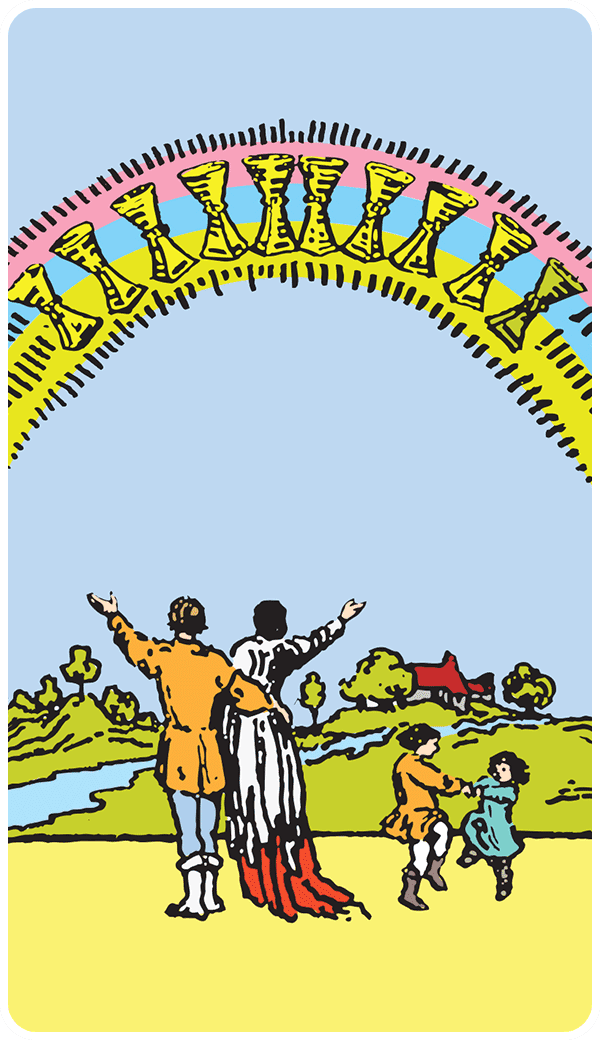
Ten of Cups · plate 10
What the card is actually doing
The Ten of Cups shows up in a health reading and the querent exhales. They take it as reassurance — everything is fine, the body is working, there's nothing to worry about. That is not what the card is describing. The Ten of Cups does not diagnose wellness. It names the emotional conditions under which the body returns to its resting state. When people mistake it for a clean bill of health, they miss what the card is actually pointing at: the role relational stability plays in whether the nervous system can stand down.
Reading Ten of Cups in health
What the suit, the rank, and the image are doing
Cups governs the emotional body and the relational field. In a health reading, Cups cards describe how feeling moves through you — whether grief is stuck in the chest, whether anxiety lives in the gut, whether the nervous system registers safety or threat in the presence of other people. The suit does not track symptoms. It tracks the emotional infrastructure underneath symptoms.
Tens are completion cards. They describe a cycle that has run its course and arrived at its natural endpoint. The Ten of Pentacles is material security achieved. The Ten of Swords is the moment the worst has already happened. The Ten of Cups is emotional homeostasis — the relational field is stable, the heart is not in crisis, the nervous system has what it needs to regulate.
Look at the image: a family stands together under a rainbow. Ten cups arc across the sky. Arms are raised. The scene reads as celebration, but the card is not describing an event. It is describing a condition. The people are not doing anything. They are standing in a field where everything they need emotionally is already present. The cups are arranged, not spilling. The rainbow is overhead, not approaching. This is the resting state.
The most common misreading in a health context is to treat the Ten of Cups as confirmation that the body is fine. It is not. The card is describing the emotional conditions under which the body can return to baseline — not the baseline itself.
How the card reads for two different situations
For someone asking whether their chronic symptoms will resolve: the Ten of Cups says the symptoms are tied to relational stress or nervous system dysregulation, and that when the relational field stabilizes, the body will have room to heal. It does not say the symptoms will vanish. It says the precondition for healing is emotional safety, and that precondition is either present or about to be.
For someone asking whether they should pursue a specific treatment: the card is irrelevant to the treatment question. It is describing the emotional environment, not the physical intervention. If the querent reads it as "don't bother with treatment, everything will be fine," they are projecting reassurance onto a card that is not offering it. The Ten of Cups in this context is more likely pointing at whether the person feels supported enough to go through treatment, or whether the treatment itself will restore a sense of emotional equilibrium.
The tell that someone is misreading the card on themselves
The querent reads the Ten of Cups and stops asking questions. They treat it as permission to ignore the symptom, to cancel the appointment, to assume the problem will resolve on its own. That is the misread. The card is not a diagnosis. It is not clearance. It is a description of the emotional conditions that allow the body to do what it already knows how to do — which is regulate, repair, and return to rest when it is safe to do so.
From the practice
“A card never tells you what to do. It tells you what you're already deciding — and gives you the words to name it.”
A grounded observation
Go back through the last six months and look for the moments your symptoms eased. Check whether those moments coincided with feeling emotionally held, or with a stretch of time when you were not managing anyone else's distress.
Key themes to watch for
- № 01Theme
Emotional renewal
- № 02Theme
Mind-body link
- № 03Theme
Soft restoration
What to do with this reading
Read the upright meaning first, even if you pulled the card reversed. The reversal is a commentary on the upright — not a separate card.
Notice what your body did when you saw Ten of Cups. That reaction is usually closer to the truth than the interpretation.
Write down one sentence: What is this card asking me to stop avoiding? Let the answer be smaller than you expect.
Come back to this card in 48 hours. Most health readings sharpen with a little distance.
Questions answered
Frequently asked
In the realm of health, the Ten of Cups suggests a balanced and nurturing lifestyle, like a well-tended garden. It points to emotional well-being and the positive impact of supportive relationships on your overall health. This card encourages you to cherish the healthy habits and connections that contribute to your vitality. Consider how your emotional and physical health are intertwined and what small steps you can take to maintain this balance.
When reversed, the Ten of Cups in health may highlight emotional stressors affecting your well-being, like a cloudy sky obscuring the sun. It suggests that unresolved tensions in personal relationships could be impacting your health. This card invites you to explore how emotional dynamics might be influencing your physical state. Think about the connections in your life that could use some healing to improve your overall health.
Ten of Cups colors the cards around it. Pay attention to where its themes — emotional intimacy, felt-sense knowing, where the water level is rising — show up in the next card. That is usually where the story is.
Tarot is observational, not predictive. Ten of Cups describes the conditions in front of you right now and where they tend to lead if nothing changes — not a guarantee of timing.
Repeat cards are the deck underlining a theme. With Ten of Cups, that usually means the question you are asking is the right one — but you have not yet acted on what the card is showing you.
Read next
Related readings
More Cups · Health
- Ace of Cups — HealthHow Ace of Cups reads in a health context.
- Two of Cups — HealthHow Two of Cups reads in a health context.
- Three of Cups — HealthHow Three of Cups reads in a health context.
- Four of Cups — HealthHow Four of Cups reads in a health context.
- Five of Cups — HealthHow Five of Cups reads in a health context.
- Six of Cups — HealthHow Six of Cups reads in a health context.
Other Ten of Cups readings
- General MeaningTen of Cups read for general meaning.
- Love & RelationshipsTen of Cups read for love & relationships.
- Career & WorkTen of Cups read for career & work.
- Money & FinanceTen of Cups read for money & finance.
- SpiritualityTen of Cups read for spirituality.
- Yes / No AnswerTen of Cups read for yes / no answer.