Five of Cups in Health
The Five of Cups in health readings isn't predicting illness—it's naming the physical cost of unprocessed loss. Here's what the card is actually tracking.
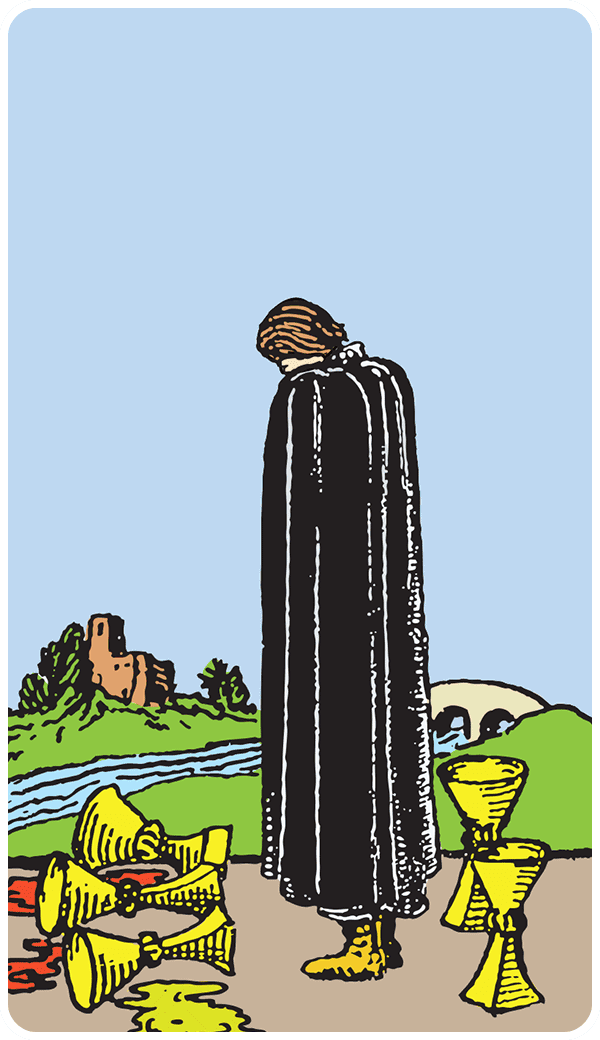
Five of Cups · plate 5
What the card is actually doing
The Five of Cups shows up in a health reading and people panic. They read it as loss, as something breaking, as a diagnosis they don't have yet. They start scanning their bodies for symptoms that match the dread the card seems to carry. That is not what the card is doing. The Five of Cups is not predicting a health crisis. It is describing what happens to the body when emotional loss goes unmetabolized—when grief or disappointment or regret stays lodged in the system because the person hasn't let themselves feel it all the way through.
Reading Five of Cups in health
What the suit, rank, and image are doing
Cups governs the emotional body and its physical expressions. When Cups cards land in health readings, they point to the places where feeling and physiology intersect—how stress lands in your jaw, how heartbreak disrupts sleep, how unspoken anger shows up as digestive trouble. Cups doesn't predict disease; it tracks the somatic consequences of emotional states.
Fives in tarot describe loss and the adjustment period that follows. They are the card of "something is missing now and I have to reorganize my life around that absence." The Five of Pentacles is material loss. The Five of Swords is relational rupture. The Five of Cups is emotional loss—grief, disappointment, the end of something you were attached to.
Look at the image. A figure in black stands before three spilled cups. Two cups remain upright behind them, but the figure does not turn around. They are fixed on what was lost. The card is not about the spilling. It is about the refusal to look away from the spill. That fixation—that repetitive loop of attention on what is gone—is what the card names. In a health context, it describes the body under the sustained weight of unprocessed grief.
How it reads for two different situations
If the querent has recently experienced a tangible loss—a relationship ended, a job disappeared, a loved one died—the Five of Cups is describing the physical symptoms that arrive with acute grief. Fatigue that doesn't respond to rest. A chest that feels compressed. Appetite gone or appetite unregulated. The immune system briefly vulnerable. These are not pathologies. These are the body's predictable response to emotional rupture. The card is saying: this is what grief does. Let it move.
If no recent loss is obvious, the Five of Cups points to old grief that never fully cleared. The breakup from two years ago that still flares when you see their name. The career you didn't get to have. The version of your body you keep mourning. When loss becomes a chronic mental loop, the body stays in a low-grade stress state. The card shows up as: fatigue you can't explain, tension you can't release, a system that won't quite settle. The issue is not new damage. The issue is that the old wound is still being touched every day.
The tell that someone is misreading the card
The misreading sounds like this: "The Five of Cups showed up in my health reading, so something bad is going to happen to my body." That is the querent assigning the card predictive power it does not have. The card is not a warning. It is a description of what is already occurring—the somatic cost of a grief state that hasn't been allowed to complete. If someone reads the Five of Cups and immediately starts worrying about future illness, they are doing exactly what the figure on the card is doing: staring at the wrong thing. The card is an invitation to turn around, not a prophecy of more spilling.
From the practice
“A card never tells you what to do. It tells you what you're already deciding — and gives you the words to name it.”
A grounded observation
Go back through your calendar and find the loss you haven't let yourself finish crying about. The Five of Cups is describing the body that is still holding it.
Key themes to watch for
- № 01Theme
Emotional renewal
- № 02Theme
Mind-body link
- № 03Theme
Soft restoration
What to do with this reading
Read the upright meaning first, even if you pulled the card reversed. The reversal is a commentary on the upright — not a separate card.
Notice what your body did when you saw Five of Cups. That reaction is usually closer to the truth than the interpretation.
Write down one sentence: What is this card asking me to stop avoiding? Let the answer be smaller than you expect.
Come back to this card in 48 hours. Most health readings sharpen with a little distance.
Questions answered
Frequently asked
In health, the Five of Cups may indicate a focus on what isn't working in your body or mind. It's like being stuck on a rainy day, unable to recall the sunny ones. You might be dwelling on setbacks or ailments rather than small victories. This card invites you to take stock of what is still going well, to offer a more balanced perspective. Could acknowledging these positives change your approach to wellness?
Reversed, the Five of Cups in health suggests a shift towards healing or acceptance. Imagine a gentle dawn after a long night. You might be finding ways to move past setbacks, embracing a more hopeful outlook. What small steps might you take today to continue this journey of healing?
Five of Cups colors the cards around it. Pay attention to where its themes — emotional intimacy, felt-sense knowing, where the water level is rising — show up in the next card. That is usually where the story is.
Tarot is observational, not predictive. Five of Cups describes the conditions in front of you right now and where they tend to lead if nothing changes — not a guarantee of timing.
Repeat cards are the deck underlining a theme. With Five of Cups, that usually means the question you are asking is the right one — but you have not yet acted on what the card is showing you.
Read next
Related readings
More Cups · Health
- Ace of Cups — HealthHow Ace of Cups reads in a health context.
- Two of Cups — HealthHow Two of Cups reads in a health context.
- Three of Cups — HealthHow Three of Cups reads in a health context.
- Four of Cups — HealthHow Four of Cups reads in a health context.
- Six of Cups — HealthHow Six of Cups reads in a health context.
- Seven of Cups — HealthHow Seven of Cups reads in a health context.
Other Five of Cups readings
- General MeaningFive of Cups read for general meaning.
- Love & RelationshipsFive of Cups read for love & relationships.
- Career & WorkFive of Cups read for career & work.
- Money & FinanceFive of Cups read for money & finance.
- SpiritualityFive of Cups read for spirituality.
- Yes / No AnswerFive of Cups read for yes / no answer.