Six of Cups in Health
The Six of Cups in health readings gets read as nostalgia or childhood wounds. What it's actually naming is a pattern your body already knows how to do.
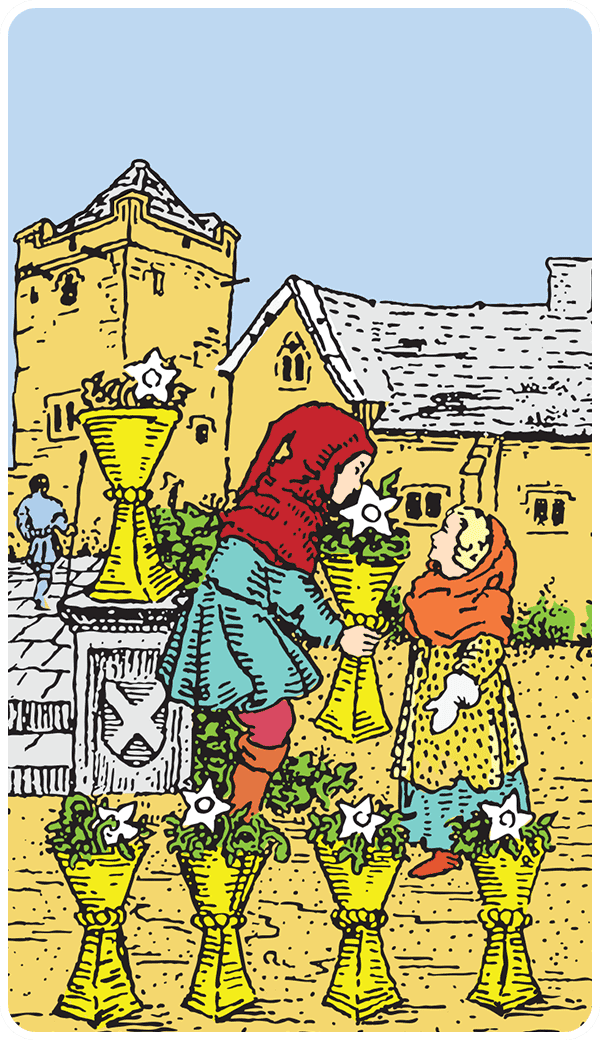
Six of Cups · plate 6
What the card is actually doing
The Six of Cups shows up in a health reading and the querent immediately goes to childhood. Old injuries. Unresolved trauma lodged in the body. Something from the past that needs to be healed before they can move forward. That is not what the card is describing. The Six of Cups is not about excavating the past. It is about recognizing that your body already has a template for the thing you think you need to learn from scratch.
Reading Six of Cups in health
What the suit, the rank, and the image are doing
Cups governs the emotional body and the somatic experience of feeling. It is the suit of how sensation moves through you, how the heart registers in the chest, how grief or tenderness or dread shows up as a physical thing. When Cups appears in a health reading, the question being asked is almost always about the felt experience of the body, not the clinical diagnosis.
Sixes in tarot describe reciprocity and established rhythm. They are the number of something that has been practiced enough times to become automatic. The Six of Pentacles is exchange that no longer requires negotiation. The Six of Swords is a route you have traveled before. Sixes are not new. They are return.
The image shows two children in a courtyard. One child hands the other a cup filled with flowers. There are five more cups, all filled, arranged around them. The exchange is easy. No one is teaching anyone how to receive. The gesture is already known.
The card is naming a somatic pattern your body has already run successfully. A rhythm it remembers. A way of regulating or recovering or moving that worked before and still works now. The Six of Cups in a health reading is not about going back to fix something. It is about going back to retrieve a tool.
How it reads for two different situations
For someone recovering from illness or injury, the Six of Cups describes the body's memory of what normal felt like. Not as a fantasy, but as a functional template. Your nervous system knows what regulated feels like because it has been regulated before. Your gait knows what uncompensated movement feels like because you walked that way for twenty years. The card is not saying you will return to that exact state. It is saying the body has a reference point, and the reference point is weight-bearing.
For someone dealing with chronic or recurring symptoms, the Six of Cups points to a coping mechanism that worked in childhood or early adulthood and then got abandoned. Not because it stopped working, but because someone told you it was childish or because you decided you should have outgrown it. The querent who used to feel better after a nap but now pushes through fatigue because rest feels like failure. The querent who stopped stretching in the morning because it seemed indulgent. The card is naming the thing you already know how to do and are not doing.
The tell that someone is misreading it
The misreading sounds like this: "I need to heal my inner child before my body will get better." The querent is constructing a psychological prerequisite that delays action. They are treating the Six of Cups as a diagnostic — something wrong that must be addressed — instead of as an inventory of what is already available.
If you pull the Six of Cups in a health reading and your first move is to book trauma therapy or start journaling about your childhood, you are probably misreading it. The card is not asking you to process the past. It is asking you to notice what your body already knows how to do and has stopped doing.
From the practice
“A card never tells you what to do. It tells you what you're already deciding — and gives you the words to name it.”
A grounded observation
Go back through your calendar and look for the last time your body felt easy in itself. What were you doing differently then? That is the cup being handed to you.
Key themes to watch for
- № 01Theme
Emotional renewal
- № 02Theme
Mind-body link
- № 03Theme
Soft restoration
What to do with this reading
Read the upright meaning first, even if you pulled the card reversed. The reversal is a commentary on the upright — not a separate card.
Notice what your body did when you saw Six of Cups. That reaction is usually closer to the truth than the interpretation.
Write down one sentence: What is this card asking me to stop avoiding? Let the answer be smaller than you expect.
Come back to this card in 48 hours. Most health readings sharpen with a little distance.
Questions answered
Frequently asked
The Six of Cups in health matters suggests a return to simple, comforting routines that once brought well-being. It may be beneficial to revisit activities like childhood sports or walking routes that fostered joy. This card encourages a gentle approach, focusing on nurturing both body and spirit. What past habits contributed positively to your health, and how might they be integrated again?
When reversed, the Six of Cups might indicate being stuck in old habits that no longer serve your health. There could be a reluctance to try new approaches due to comfort in familiarity. Consider if these patterns are hindering your progress. How might you open yourself to fresh health ideas or routines?
Six of Cups colors the cards around it. Pay attention to where its themes — emotional intimacy, felt-sense knowing, where the water level is rising — show up in the next card. That is usually where the story is.
Tarot is observational, not predictive. Six of Cups describes the conditions in front of you right now and where they tend to lead if nothing changes — not a guarantee of timing.
Repeat cards are the deck underlining a theme. With Six of Cups, that usually means the question you are asking is the right one — but you have not yet acted on what the card is showing you.
Read next
Related readings
More Cups · Health
- Ace of Cups — HealthHow Ace of Cups reads in a health context.
- Two of Cups — HealthHow Two of Cups reads in a health context.
- Three of Cups — HealthHow Three of Cups reads in a health context.
- Four of Cups — HealthHow Four of Cups reads in a health context.
- Five of Cups — HealthHow Five of Cups reads in a health context.
- Seven of Cups — HealthHow Seven of Cups reads in a health context.
Other Six of Cups readings
- General MeaningSix of Cups read for general meaning.
- Love & RelationshipsSix of Cups read for love & relationships.
- Career & WorkSix of Cups read for career & work.
- Money & FinanceSix of Cups read for money & finance.
- SpiritualitySix of Cups read for spirituality.
- Yes / No AnswerSix of Cups read for yes / no answer.