Seven of Swords in Health
The Seven of Swords in health readings names avoidance patterns and partial information — not betrayal by your body. Here's what the card is doing.
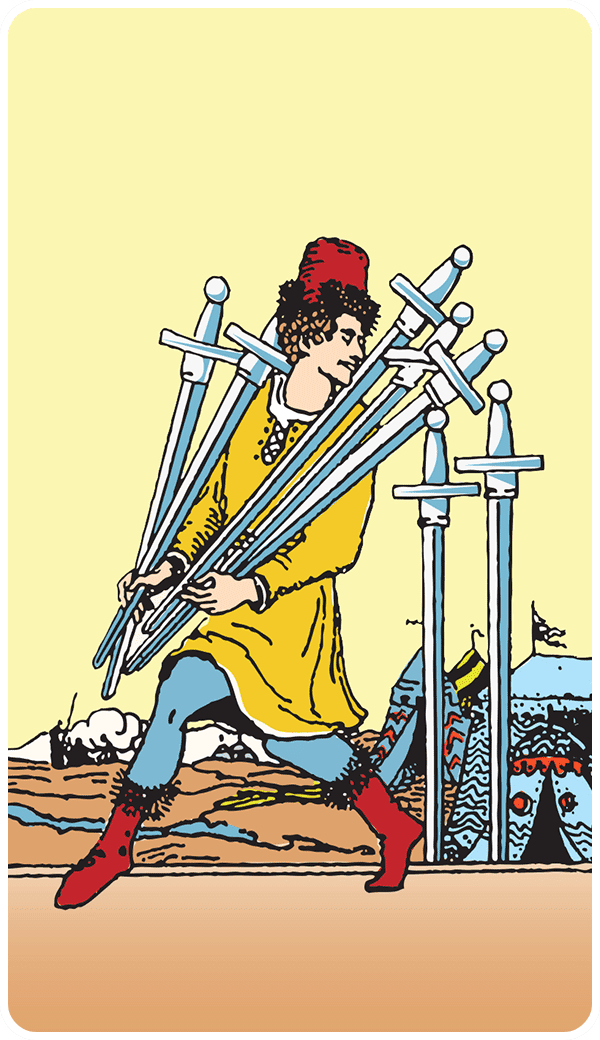
Seven of Swords · plate 7
What the card is actually doing
The Seven of Swords shows up in a health reading and the querent hears betrayal. Their body is lying to them. The diagnosis was hidden. Someone didn't tell them the truth. The card gets read as secrecy from the outside — a withheld test result, a symptom that appeared without warning, a condition that snuck up on them.
That is almost never what the card is pointing at. The Seven of Swords describes avoidance behavior and partial engagement. It names the part of the situation you are not looking at directly, usually because looking at it directly would require a decision you don't want to make yet.
Reading Seven of Swords in health
What the suit, rank, and image are doing
Swords is the suit of thought, assessment, and the stories you tell yourself about what is happening. It governs how you frame a problem, what information you let yourself see, and whether you are naming the situation accurately or editing it into something more manageable. When Swords cards dominate a health reading, the question is usually about clarity — what you know, what you are pretending not to know, and whether the mental story matches the physical reality.
Sevens in tarot describe strategy under constraint. They are the card of working around a problem instead of solving it, of getting some of what you want but not all of it, of partial wins that leave the core issue unresolved. The Seven of Swords specifically describes the strategy of selective engagement — taking what you can carry and leaving the rest behind.
Now look at the image. A figure walks away from a camp, carrying five swords. Two swords remain planted in the ground behind them. The figure is not being chased. They are choosing what to take. The camp is still there. The two swords are still available. This is not theft. It is selective attention. The card is describing the moment you decide which parts of the health situation you are going to deal with right now and which parts you are going to leave unaddressed.
How this reads for two different querent situations
For someone who has been given a diagnosis or treatment plan and is not following through, the Seven of Swords names the partial compliance. You are doing the easy parts — the supplements, the app tracking, the surface-level adjustments — and not doing the hard part, which is usually the thing that would require changing your schedule, telling people what is happening, or admitting how much support you actually need. The card is not judging this. It is naming it so you can see what you are doing.
For someone dealing with chronic symptoms who keeps saying they will address it later, the Seven of Swords describes the avoidance strategy itself. You are managing the flare-ups, you are working around the bad days, you are carrying what you can carry — but you are not booking the appointment, not asking for the referral, not having the conversation with your doctor about the thing that scares you. The two swords left behind are the parts of the situation you know you are not dealing with. The card is pointing at them.
The tell that someone is misreading the card on themselves
The tell is when the querent reads the Seven of Swords and immediately starts talking about what their body did to them, or what the doctor didn't tell them, or how the symptoms appeared out of nowhere. If the first move is to locate the secrecy outside yourself, you are misreading the card. The Seven of Swords is about your own strategy, not someone else's withholding. It describes the information you have but are not integrating, the appointment you keep rescheduling, the conversation you are editing in your head before you have it.
From the practice
“A card never tells you what to do. It tells you what you're already deciding — and gives you the words to name it.”
A grounded observation
Go back through your calendar for the last six months and look for the health-related task you have moved forward three times without completing. That is what the card is naming.
Key themes to watch for
- № 01Theme
Emotional renewal
- № 02Theme
Mind-body link
- № 03Theme
Soft restoration
What to do with this reading
Read the upright meaning first, even if you pulled the card reversed. The reversal is a commentary on the upright — not a separate card.
Notice what your body did when you saw Seven of Swords. That reaction is usually closer to the truth than the interpretation.
Write down one sentence: What is this card asking me to stop avoiding? Let the answer be smaller than you expect.
Come back to this card in 48 hours. Most health readings sharpen with a little distance.
Questions answered
Frequently asked
In health matters, the Seven of Swords suggests a private approach to personal well-being. You might be keeping your health concerns to yourself or tackling them solo. This card invites you to consider if this is isolating you or empowering you. Is there a reason for this discretion, and is it serving your overall well-being? Reflect on whether sharing your journey could bring support or insight from others.
When reversed, the Seven of Swords in health could indicate that hidden health issues are surfacing. It's a moment to address any symptoms or concerns openly. Consider whether there's been avoidance in dealing with these matters. This card suggests that facing health issues head-on might clear the path for better understanding and care.
Seven of Swords colors the cards around it. Pay attention to where its themes — mental clarity, the truth being named, what the mind needs to release — show up in the next card. That is usually where the story is.
Tarot is observational, not predictive. Seven of Swords describes the conditions in front of you right now and where they tend to lead if nothing changes — not a guarantee of timing.
Repeat cards are the deck underlining a theme. With Seven of Swords, that usually means the question you are asking is the right one — but you have not yet acted on what the card is showing you.
Read next
Related readings
More Swords · Health
- Ace of Swords — HealthHow Ace of Swords reads in a health context.
- Two of Swords — HealthHow Two of Swords reads in a health context.
- Three of Swords — HealthHow Three of Swords reads in a health context.
- Four of Swords — HealthHow Four of Swords reads in a health context.
- Five of Swords — HealthHow Five of Swords reads in a health context.
- Six of Swords — HealthHow Six of Swords reads in a health context.
Other Seven of Swords readings
- General MeaningSeven of Swords read for general meaning.
- Love & RelationshipsSeven of Swords read for love & relationships.
- Career & WorkSeven of Swords read for career & work.
- Money & FinanceSeven of Swords read for money & finance.
- SpiritualitySeven of Swords read for spirituality.
- Yes / No AnswerSeven of Swords read for yes / no answer.