Page of Wands in Love
The Page of Wands in love gets read as excitement arriving. What it actually describes is the impulse before the follow-through—and why that matters.
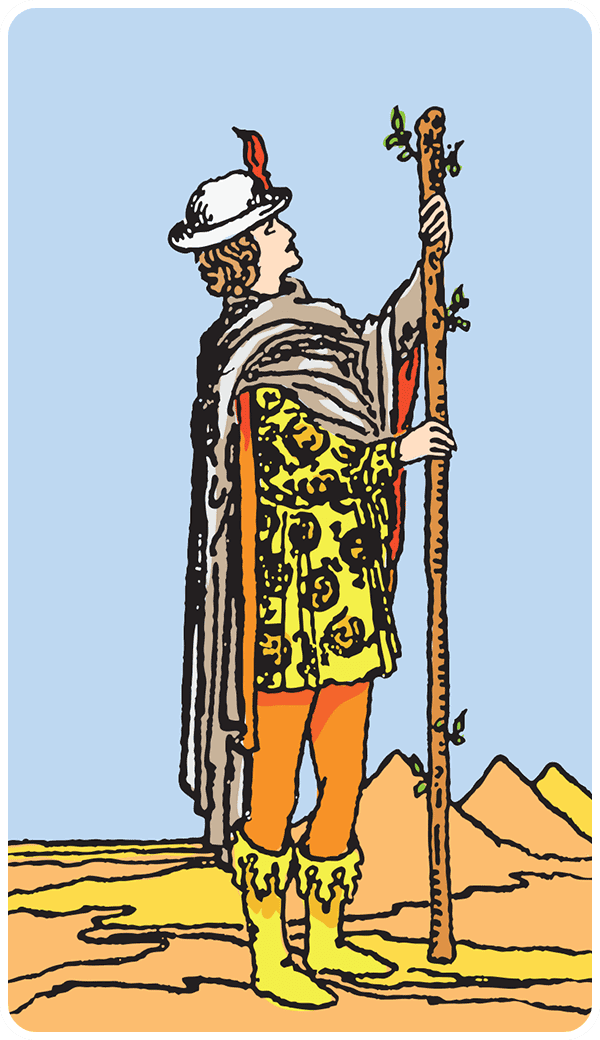
Page of Wands · plate page
What the card is actually doing
The Page of Wands shows up in a love reading and the querent hears: someone fun is coming. Someone spontaneous. Someone who will shake things up. The energy feels good, so they stop reading. What they miss is that Pages are not people. Pages are movements inside the querent. The Page of Wands is the first flare of interest—the text you want to send, the plan you want to suggest, the version of yourself that feels brave enough to try something. It is not the relationship. It is the moment before you decide whether to act on the wanting.
Reading Page of Wands in love
What the suit, the rank, and the image are doing
Wands governs will, desire, and the forward motion of energy. It is the suit of what you want to do, what excites you, what makes you feel like yourself when you move toward it. In a love reading, Wands describes the initiating impulse—the part of attraction that is about momentum, not attachment. It is the difference between "I want to see where this goes" and "I need this person to stay."
Pages in tarot are the first expression of a suit's energy. They are not mastery. They are not arrival. A Page is the moment you pick up the tool for the first time—tentative, curious, unpolished. The Page of Wands is the impulse to reach out, to flirt, to suggest the date, to say the risky thing. It is enthusiasm before experience has shaped it. The image shows a young figure holding a staff, staring at it like they are deciding what to do with it. They have not planted it. They have not swung it. They are holding the possibility.
The most common misreading in love contexts is treating this card as a person arriving—specifically, someone younger or more playful who will inject energy into the querent's life. That is not what the card describes. The Page of Wands is the querent's own readiness to try something new in how they show up relationally. It is the first flicker of "I could text them" or "I could say yes to that second date" or "I could stop pretending I don't care."
How the card reads differently depending on where the querent is
If the querent is single and stuck, the Page of Wands describes the moment the freeze breaks. They stop overthinking. They send the message. They match with someone and don't immediately unmatch. The card is not promising that the person will be right or that the conversation will go anywhere. It is naming that the querent's own willingness to engage has just come back online.
If the querent is in a relationship that has gone flat, the Page of Wands is the impulse to suggest the weird plan, to initiate sex differently, to try the thing they have been too self-conscious to try. It is the return of playfulness—not as a trait the other person has, but as a gear the querent can shift into again. Whether the other person meets them there is a different card.
Reversed, the Page of Wands is the impulse that fizzles. The text gets drafted and deleted. The plan gets suggested and then walked back. The querent feels the flicker of wanting and then talks themselves out of it before anything moves. It is not blockage from outside. It is the querent's own hand pulling back.
The tell that someone is misreading this card on themselves
If the querent walks away from the reading waiting for someone else to show up and do the exciting thing, they have misread the card. The Page of Wands is not about what someone else will bring to you. It is about the version of yourself that is willing to try again, willing to look foolish, willing to want something out loud. If three weeks pass and the querent has not sent a single message, suggested a single plan, or said a single vulnerable thing, the card did not fail. They mistook the card for a promise instead of a threshold.
From the practice
“A card never tells you what to do. It tells you what you're already deciding — and gives you the words to name it.”
A grounded observation
Go back through your texts from the last month. Look for the message you almost sent and didn't. That hesitation is what the Page of Wands is naming—and what it is asking you to notice you are doing.
Key themes to watch for
- № 01Theme
Vulnerability
- № 02Theme
New chapters
- № 03Theme
Emotional truth
What to do with this reading
Read the upright meaning first, even if you pulled the card reversed. The reversal is a commentary on the upright — not a separate card.
Notice what your body did when you saw Page of Wands. That reaction is usually closer to the truth than the interpretation.
Write down one sentence: What is this card asking me to stop avoiding? Let the answer be smaller than you expect.
Come back to this card in 48 hours. Most love readings sharpen with a little distance.
Questions answered
Frequently asked
In the realm of love, the Page of Wands heralds a time of discovery and playfulness. If you're single, you might feel more adventurous, eager to meet new people and experience different kinds of connections. For those in relationships, this could be a moment to infuse your partnership with spontaneity and joy, perhaps by trying something new together. The card invites you to view love as a journey rather than a destination, a chance to learn and grow alongside another. What new adventures in love await you?
Reversed, the Page of Wands in love suggests a period of uncertainty or hesitation. You might feel unsure about where a relationship is headed or question your own readiness for commitment. This card can indicate mixed signals or a lack of clarity in communication, making it hard to know which way to turn. It's a gentle nudge to pause and reflect on your true feelings and expectations. What do you genuinely want from your love life, and how can you express that to yourself and others?
Page of Wands colors the cards around it. Pay attention to where its themes — creative momentum, will and appetite, the spark that wants to be tended — show up in the next card. That is usually where the story is.
Tarot is observational, not predictive. Page of Wands describes the conditions in front of you right now and where they tend to lead if nothing changes — not a guarantee of timing.
Repeat cards are the deck underlining a theme. With Page of Wands, that usually means the question you are asking is the right one — but you have not yet acted on what the card is showing you.
Read next
Related readings
More Wands · Love
- Ace of Wands — LoveHow Ace of Wands reads in a love context.
- Two of Wands — LoveHow Two of Wands reads in a love context.
- Three of Wands — LoveHow Three of Wands reads in a love context.
- Four of Wands — LoveHow Four of Wands reads in a love context.
- Five of Wands — LoveHow Five of Wands reads in a love context.
- Six of Wands — LoveHow Six of Wands reads in a love context.
Other Page of Wands readings
- General MeaningPage of Wands read for general meaning.
- Career & WorkPage of Wands read for career & work.
- Money & FinancePage of Wands read for money & finance.
- Health & WellbeingPage of Wands read for health & wellbeing.
- SpiritualityPage of Wands read for spirituality.
- Yes / No AnswerPage of Wands read for yes / no answer.