Five of Wands in Love
The Five of Wands in love gets read as conflict. What it actually describes is the moment before anyone has decided who's leading the dance.
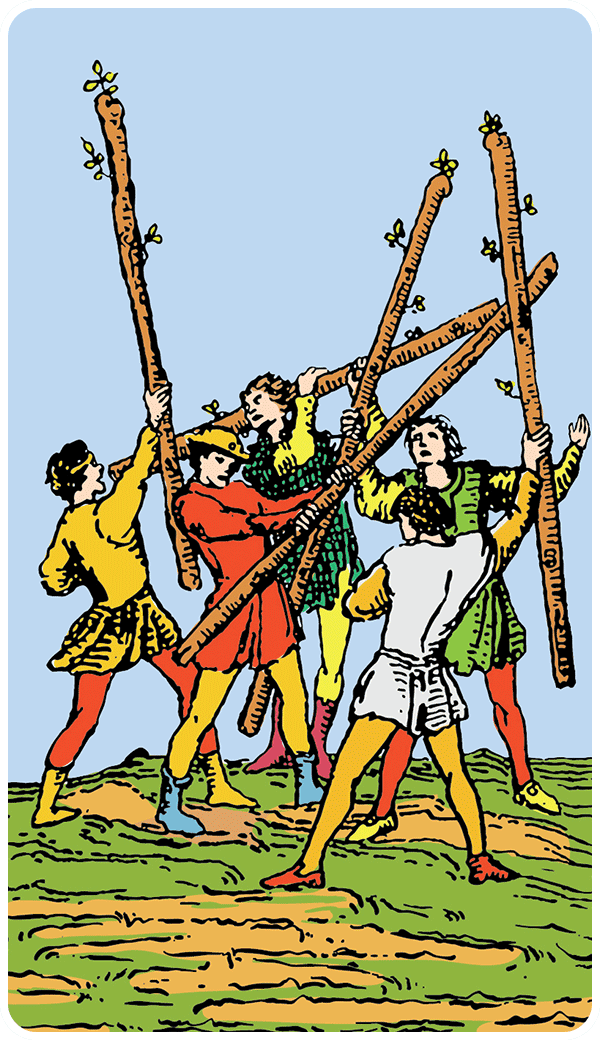
Five of Wands · plate 5
What the card is actually doing
The Five of Wands shows up in a love reading and the querent assumes fighting. They want to know if the relationship is doomed, if the other person is the problem, if they should leave. That is not what the card is describing. The Five of Wands is not naming destructive conflict. It is naming the specific friction that happens when two people want the same outcome but have not yet figured out how to coordinate their effort. The misreading costs people functional relationships.
Reading Five of Wands in love
What the suit, the rank, and the image are actually doing
Wands is the suit of will, direction, and forward motion. It governs what you want, how you pursue it, and whether your momentum is aligned with the momentum of the people around you. When Wands cards show up in a love reading, the question being asked is almost always about desire compatibility — not whether you want each other, but whether you want the same version of the relationship.
Fives in tarot describe instability and adjustment. They are the card of a system that has tipped out of balance and has not yet found its new equilibrium. The Four was stable. The Six will be stable again. The Five is the wobble in between.
Now look at the image. Five figures hold staffs. They are all swinging. No one is connecting. No one is injured. They are not fighting each other — they are trying to do something together and failing to synchronize. The card reads as chaos, but the chaos is positional, not hostile. What the Five of Wands is actually describing is a coordination problem. Two people both trying to steer. Two people both initiating and neither following. Two people who want the same thing but keep stepping on each other's timing.
How it reads for two different querent situations
If the querent is in an early relationship — first six months, still negotiating rhythms — the Five of Wands usually describes competing ideas about how intimacy is supposed to work. One person texts constantly; the other needs space to miss you. One person plans dates three weeks out; the other prefers spontaneity. Both people want closeness. Neither person has named their preferred method yet. The friction feels like incompatibility. What it actually is: no one has said the thing out loud.
If the querent is in a long-term relationship and the Five of Wands shows up, go back through the last two weeks and look for the moment both of you tried to solve the same problem at the same time. One person booked the restaurant; the other already made a reservation somewhere else. One person started the hard conversation; the other had a different version of the same conversation queued up for tomorrow. The card is not saying you are fighting. It is saying you are both leading and no one is dancing.
The tell that someone is misreading the card on themselves
The querent says, "We keep fighting," and when you ask what the fights are about, they cannot name a single recurring issue. Or they name five different issues and none of them connect. That is the tell. If the conflict has a theme — money, jealousy, in-laws — that is a different card. The Five of Wands describes the fight that is actually about "you are not doing it my way" when both people's way would work fine if either person would commit to following instead of co-piloting.
From the practice
“A card never tells you what to do. It tells you what you're already deciding — and gives you the words to name it.”
A grounded observation
If both of you want the relationship to work and you are still colliding, the question is not compatibility. The question is: has anyone said out loud what they need the other person to stop doing so they can do their part?
Key themes to watch for
- № 01Theme
Vulnerability
- № 02Theme
New chapters
- № 03Theme
Emotional truth
What to do with this reading
Read the upright meaning first, even if you pulled the card reversed. The reversal is a commentary on the upright — not a separate card.
Notice what your body did when you saw Five of Wands. That reaction is usually closer to the truth than the interpretation.
Write down one sentence: What is this card asking me to stop avoiding? Let the answer be smaller than you expect.
Come back to this card in 48 hours. Most love readings sharpen with a little distance.
Questions answered
Frequently asked
In love, the Five of Wands often signals friction and misunderstandings. It might feel like you're speaking different languages with your partner. Flirtations can turn into spats, and innocent comments might be taken out of context. This card invites you to see if the competition is playful or if it's wearing you down. If single, you might find yourself vying for attention in a crowded field. Look at what these tussles teach you about your desires and boundaries. What does this struggle reveal about what you truly want from a partner?
Reversed, this card points to a cooling of tensions in your love life. Arguments may start to resolve, or perhaps you're stepping away from romantic drama altogether. It's a time to consider whether peace feels genuine or if important issues are being ignored. If you're single, you might feel less urgency in the dating scene, either by choice or circumstance. Take this pause to reflect on what you've learned from past conflicts. Is there clarity in the calm, or is something still left unsaid?
Five of Wands colors the cards around it. Pay attention to where its themes — creative momentum, will and appetite, the spark that wants to be tended — show up in the next card. That is usually where the story is.
Tarot is observational, not predictive. Five of Wands describes the conditions in front of you right now and where they tend to lead if nothing changes — not a guarantee of timing.
Repeat cards are the deck underlining a theme. With Five of Wands, that usually means the question you are asking is the right one — but you have not yet acted on what the card is showing you.
Read next
Related readings
More Wands · Love
- Ace of Wands — LoveHow Ace of Wands reads in a love context.
- Two of Wands — LoveHow Two of Wands reads in a love context.
- Three of Wands — LoveHow Three of Wands reads in a love context.
- Four of Wands — LoveHow Four of Wands reads in a love context.
- Six of Wands — LoveHow Six of Wands reads in a love context.
- Seven of Wands — LoveHow Seven of Wands reads in a love context.
Other Five of Wands readings
- General MeaningFive of Wands read for general meaning.
- Career & WorkFive of Wands read for career & work.
- Money & FinanceFive of Wands read for money & finance.
- Health & WellbeingFive of Wands read for health & wellbeing.
- SpiritualityFive of Wands read for spirituality.
- Yes / No AnswerFive of Wands read for yes / no answer.