Three of Wands in Love
The Three of Wands in love gets read as 'they're coming back' or 'something's about to happen.' What it actually describes is the space between decision and arrival.
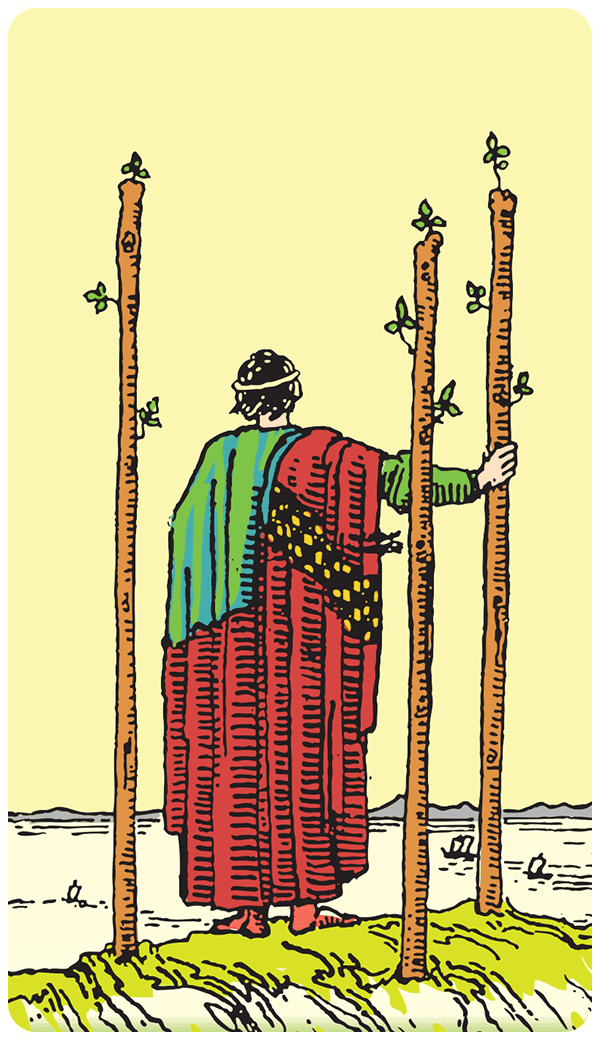
Three of Wands · plate 3
What the card is actually doing
The Three of Wands shows up in a love reading and the querent exhales. Finally. Movement. Progress. They read it as confirmation that the person is coming, that the relationship is about to shift, that the waiting is almost over. I watch this happen at least twice a month. The card does describe waiting — but not the kind where you sit by the phone. It describes the waiting that happens after you've already made a choice and sent something out into the world. The question is whether you actually sent anything.
Reading Three of Wands in love
What the card is structurally describing
Wands is the suit of will, initiative, and directed energy. It governs what you want and whether you're acting on it. When Wands cards dominate a reading, the question is almost always about agency — whether the querent is driving or stalled, whether they're moving toward something or circling it.
Threes in tarot mark the first stable point after the initial pairing. The Ace opens the channel, the Two establishes the connection, and the Three is what happens when that connection extends beyond the two people in the room. It's the moment the thing becomes visible to the outside world or requires outside resources to continue. The Three of Pentacles is collaborative work. The Three of Swords is the third party in the room. The Three of Wands is the moment your intention leaves your hands and moves into territory you don't control.
The image shows a figure standing on a cliff, back to the viewer, looking out at ships on the horizon. They are holding one wand; two more are planted in the ground beside them. The ships are distant but visible. This is not someone wondering whether to act. This is someone who has already acted and is now watching to see what comes back. The card describes the interval between sending and receiving.
The misreading: confusing observation with passivity
Most people read the Three of Wands in love as "wait and see what happens." They think it's permission to stay in limbo, to keep texting someone who doesn't text back, to hold space for a person who hasn't shown up. That is not what the card is doing. The figure on the card is waiting, yes — but they are waiting because they already sent the ships. They made a clear offer. They stated what they wanted. They created the conditions under which something could return to them. The waiting is strategic, not passive.
When the Three of Wands shows up for someone who hasn't actually said what they want or asked for what they need, the card is naming the gap. You are standing on the cliff, but the ships are still in the harbor. You are performing the posture of patience while avoiding the risk of declaration. The card reads differently depending on whether you've done the vulnerable part yet.
Reversed, the Three of Wands often marks impatience that short-circuits the process — texting again before they've answered the first time, asking for reassurance before the other person has had room to respond, collapsing the waiting because the uncertainty feels unbearable. The reversed card says: you didn't give it time to travel.
The tell that you're misreading it on yourself
If you pull the Three of Wands in a love reading and feel relieved because now you don't have to do anything, you are misreading it. The card assumes you already did the hard part. If you haven't — if you're waiting for them to notice you, waiting for them to bring it up, waiting for the universe to intervene — the Three of Wands is not describing your situation. It's describing the situation you're avoiding by not speaking.
From the practice
“A card never tells you what to do. It tells you what you're already deciding — and gives you the words to name it.”
A grounded observation
Go back through your last three conversations with this person. If you can't find the moment where you clearly said what you wanted, you are not at the Three of Wands yet. You are still at the Two, deciding whether to risk it.
Key themes to watch for
- № 01Theme
Vulnerability
- № 02Theme
New chapters
- № 03Theme
Emotional truth
What to do with this reading
Read the upright meaning first, even if you pulled the card reversed. The reversal is a commentary on the upright — not a separate card.
Notice what your body did when you saw Three of Wands. That reaction is usually closer to the truth than the interpretation.
Write down one sentence: What is this card asking me to stop avoiding? Let the answer be smaller than you expect.
Come back to this card in 48 hours. Most love readings sharpen with a little distance.
Questions answered
Frequently asked
In love, the Three of Wands upright suggests a period of growth and expansion. Your relationship may be entering a phase where long-term plans and shared visions are becoming more concrete. This card can indicate travel or new experiences together, enhancing your bond. If single, your approach to love might be evolving, making room for new possibilities or partners. Consider how your openness to new experiences can deepen connections or lead to meaningful encounters.
Reversed, the Three of Wands in love may point to delays or unmet expectations in relationships. You might feel as though plans with a partner are not progressing as hoped, or that your romantic life isn't unfolding the way you envisioned. This can lead to frustration or doubt, but it also offers a chance to reassess priorities. Are there underlying issues that need addressing, or is it time to explore new perspectives on what you desire in love?
Three of Wands colors the cards around it. Pay attention to where its themes — creative momentum, will and appetite, the spark that wants to be tended — show up in the next card. That is usually where the story is.
Tarot is observational, not predictive. Three of Wands describes the conditions in front of you right now and where they tend to lead if nothing changes — not a guarantee of timing.
Repeat cards are the deck underlining a theme. With Three of Wands, that usually means the question you are asking is the right one — but you have not yet acted on what the card is showing you.
Read next
Related readings
More Wands · Love
- Ace of Wands — LoveHow Ace of Wands reads in a love context.
- Two of Wands — LoveHow Two of Wands reads in a love context.
- Four of Wands — LoveHow Four of Wands reads in a love context.
- Five of Wands — LoveHow Five of Wands reads in a love context.
- Six of Wands — LoveHow Six of Wands reads in a love context.
- Seven of Wands — LoveHow Seven of Wands reads in a love context.
Other Three of Wands readings
- General MeaningThree of Wands read for general meaning.
- Career & WorkThree of Wands read for career & work.
- Money & FinanceThree of Wands read for money & finance.
- Health & WellbeingThree of Wands read for health & wellbeing.
- SpiritualityThree of Wands read for spirituality.
- Yes / No AnswerThree of Wands read for yes / no answer.