Page of Swords in Health
The Page of Swords in health readings gets read as anxiety or overthinking. What it actually names is the body sending signals you haven't learned to read yet.
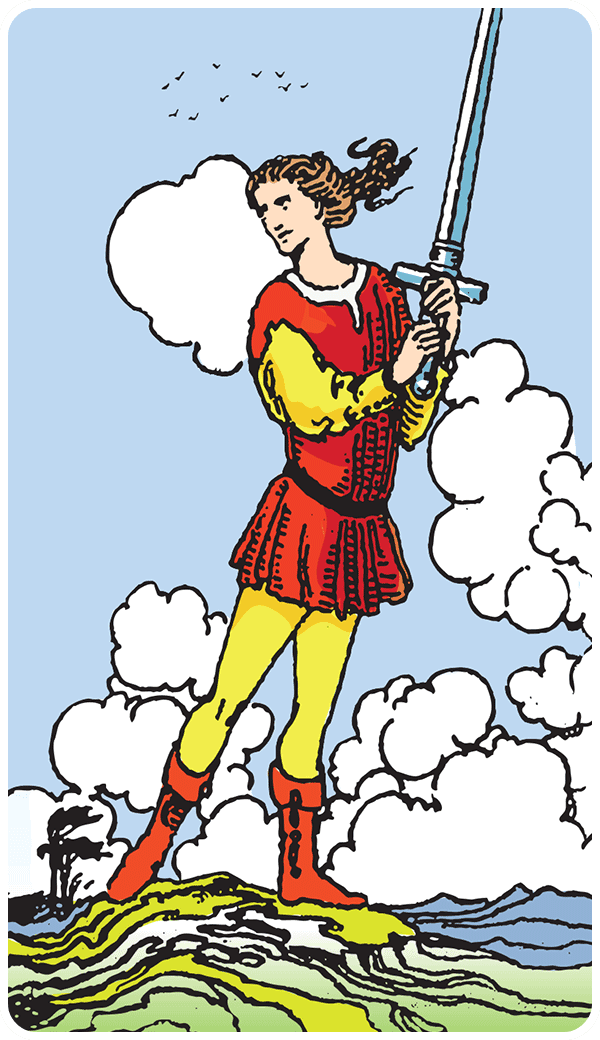
Page of Swords · plate page
What the card is actually doing
The Page of Swords shows up in a health reading and the querent immediately says: I know I'm overthinking it. I know I'm making myself anxious. I need to calm down. That is not what the card is doing. The Page of Swords is not naming your anxiety about the symptom. It is naming the symptom as information your body is trying to send and you do not yet have the vocabulary to decode.
Reading Page of Swords in health
What the suit, the rank, and the image are doing
Swords is the mental suit, but in a health reading it governs the nervous system — the part of you that processes signals, registers threat, and decides what counts as danger. When Swords cards dominate a health spread, the question is almost always about how information is moving through the body, not what the diagnosis is. The suit describes the signaling system, not the tissue.
Pages in tarot are messengers. They are not masters. They are not authorities. A Page is the figure who arrives with news you were not expecting, in a language you may not speak yet. The Page of Pentacles brings word about the physical body. The Page of Cups brings word about emotional weather. The Page of Swords brings word from the part of you that is trying to alert you to something and does not yet have your attention.
Look at the image. A young figure holds a sword upright, standing on unstable ground. The wind is blowing. The posture is alert, not aggressive. The sword is raised as if testing the air. This is reconnaissance. This is the body scanning for what it needs to know. The Page is not attacking. The Page is gathering information.
The most common misreading in a health context is to collapse the Page of Swords into "you are anxious and the anxiety is the problem." That flattens the card. The Page of Swords is not your anxiety about the chest pain. It is the chest pain as a message your nervous system sent and your conscious mind has not yet translated. The card is asking: what is your body trying to tell you that you are reading as noise?
How the card reads for two different situations
For someone who has been to six doctors and received six different opinions, the Page of Swords is the moment they realize the confusion is data. Each doctor heard the symptom through a different filter. The card is not telling them to pick one story. It is telling them the symptom itself is trying to say something none of the frameworks have captured yet. Go back and look at what changed the week before the symptom started.
For someone who keeps Googling their symptoms at 2 a.m., the Page of Swords is not the catastrophic diagnosis they are afraid of. It is the part of them that knows something is off and is trying to name it with the wrong tools. The Googling is not the problem. The problem is they are asking the search bar instead of asking their body. The card says: stop reading about it and start tracking it. Write down when it happens, what you ate, who you were with, what you were thinking about right before.
The tell that someone is misreading the card
The tell is when someone says "I just need to stop worrying about it" and then does nothing else. That is treating the Page of Swords as a command to suppress the signal. The card is the opposite. It is the signal insisting on being heard. If you are reading the Page of Swords as "calm down," you are reading it backward. The card is not soothing. It is clarifying. What you are calling anxiety is your body trying to get your attention with the only language it has.
From the practice
“A card never tells you what to do. It tells you what you're already deciding — and gives you the words to name it.”
A grounded observation
Go back through your calendar and find the week the symptom started. Look at what else was happening. The Page of Swords tends to show up when the body noticed something before the mind did.
Key themes to watch for
- № 01Theme
Emotional renewal
- № 02Theme
Mind-body link
- № 03Theme
Soft restoration
What to do with this reading
Read the upright meaning first, even if you pulled the card reversed. The reversal is a commentary on the upright — not a separate card.
Notice what your body did when you saw Page of Swords. That reaction is usually closer to the truth than the interpretation.
Write down one sentence: What is this card asking me to stop avoiding? Let the answer be smaller than you expect.
Come back to this card in 48 hours. Most health readings sharpen with a little distance.
Questions answered
Frequently asked
For health, the Page of Swords suggests a proactive approach to learning about your well-being. You might find yourself eager to research health topics or try new routines. Picture yourself as a student of your own body, curious about what works best for you. It's a time to explore different methods and gather information. What new practices could you experiment with to enhance your health?
Reversed, the Page of Swords in health might indicate confusion or mixed messages about your well-being. Perhaps you're feeling overwhelmed by too much information or conflicting advice. Think of a jumbled bookshelf in need of sorting; clarity comes from organization. How might you simplify the noise and focus on what's truly beneficial for you?
Page of Swords colors the cards around it. Pay attention to where its themes — mental clarity, the truth being named, what the mind needs to release — show up in the next card. That is usually where the story is.
Tarot is observational, not predictive. Page of Swords describes the conditions in front of you right now and where they tend to lead if nothing changes — not a guarantee of timing.
Repeat cards are the deck underlining a theme. With Page of Swords, that usually means the question you are asking is the right one — but you have not yet acted on what the card is showing you.
Read next
Related readings
More Swords · Health
- Ace of Swords — HealthHow Ace of Swords reads in a health context.
- Two of Swords — HealthHow Two of Swords reads in a health context.
- Three of Swords — HealthHow Three of Swords reads in a health context.
- Four of Swords — HealthHow Four of Swords reads in a health context.
- Five of Swords — HealthHow Five of Swords reads in a health context.
- Six of Swords — HealthHow Six of Swords reads in a health context.
Other Page of Swords readings
- General MeaningPage of Swords read for general meaning.
- Love & RelationshipsPage of Swords read for love & relationships.
- Career & WorkPage of Swords read for career & work.
- Money & FinancePage of Swords read for money & finance.
- SpiritualityPage of Swords read for spirituality.
- Yes / No AnswerPage of Swords read for yes / no answer.