Page of Pentacles in Yes / No
The Page of Pentacles leans yes, but only if the question allows for a slow build. Here's what the card is actually measuring in a binary reading.
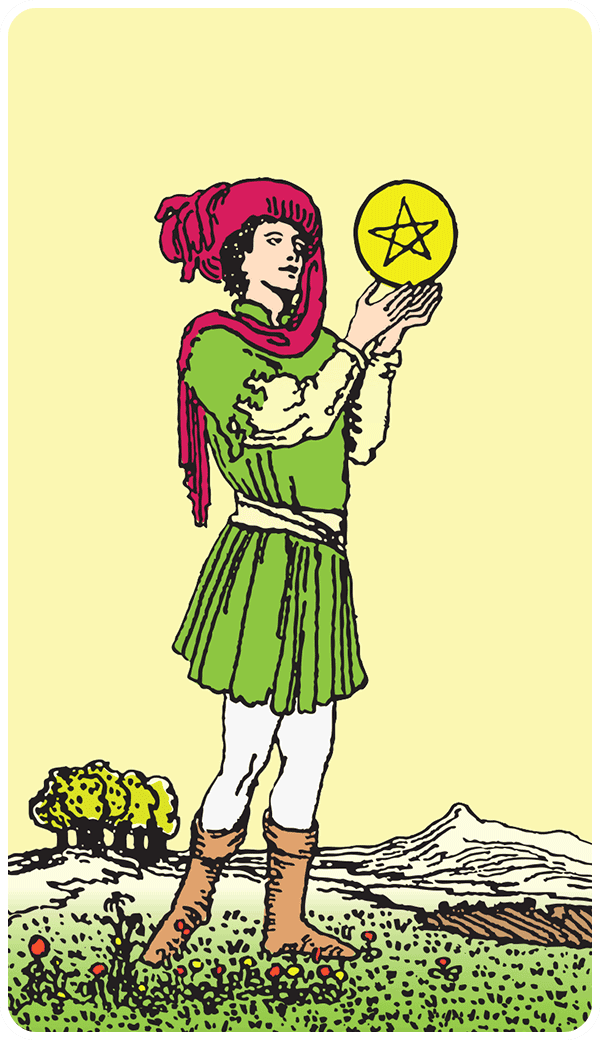
Page of Pentacles · plate page
YES
The Page of Pentacles leans yes, but it's a qualified yes — the kind that depends on whether you're willing to start small and stay consistent. Most people read it as enthusiasm or good news and miss what the card is actually describing: the beginning of a learning curve. The yes it offers is not "this will work out fast" but "this can work if you treat it like a first draft." If your question needs speed or certainty, the card reads closer to maybe. If your question can tolerate a phase of not-yet-competent effort, it's a yes.
Why Page of Pentacles reads this way
What the rank, suit, and image are doing on the card
Pages in tarot are students. They are not masters, not even journeymen — they are the person at the beginning of the process, holding the tool for the first time, trying to figure out how it works. The Page of Pentacles specifically is a student of material reality: money, skill, physical craft, the mechanics of how things get built in the world. The figure on the card is standing still, holding a pentacle in both hands, staring at it. Not using it. Not spending it. Not even moving. Just looking.
Pentacles is the suit of resources, labor, and tangible outcome. It governs what you can touch, what you can count, what shows up in your bank account or your hands at the end of the day. When Pentacles cards appear, the question being answered is almost always about whether something will materialize — whether the thing you're asking about will actually happen in the physical world.
The most common misreading in a yes/no context is treating the Page of Pentacles as pure optimism. The querent sees a young figure, a coin, and reads it as "good energy" or "new opportunity" and decides the answer is yes without qualification. What they miss is that the Page is not holding the outcome. The Page is holding the starting point. The card is describing someone who is about to begin learning how to produce the outcome, not someone who already has it.
How the card reads for two different querent situations
If the question is "Should I start this business?" or "Should I take this class?" or "Should I commit to this new skill?" — the Page of Pentacles is a clean yes. The card is describing exactly the posture the question requires: beginners' focus, willingness to be bad at something for a while, the decision to treat the first six months as training instead of proof. The yes here is structural. The card is naming the correct starting conditions.
If the question is "Will I get the job?" or "Will this deal close?" or "Will this person commit?" — the Page of Pentacles reads as maybe, leaning toward not yet. The card is not describing someone who has already secured the thing. It's describing someone in the early research phase, the "I'm looking into it" phase, the phase before the decision gets made. In a yes/no frame, that translates to: the pieces are not in place yet. You are still in the part of the process where nothing is guaranteed.
The tell that someone is misreading the card on themselves
The tell is when someone draws the Page of Pentacles and immediately starts talking about how excited they are, how motivated they feel, how this is definitely a sign to move forward — and then three weeks later they're stuck because they didn't account for how long the learning curve actually is. They read the card as confirmation that the outcome was close, when the card was describing how far from the outcome they still were. The Page of Pentacles is not the card of "it's about to happen." It's the card of "you're about to start the part where you don't know what you're doing yet." If you mistake that for a green light without building in time for incompetence, you will feel betrayed by the card when the result doesn't show up fast.
A grounded observation
Go back through your calendar and look for the last time you started something new and had no idea what you were doing. That's the Page of Pentacles. If your question can survive that phase, the answer is yes.
Key themes to watch for
- № 01Theme
Affirmative current
- № 02Theme
Open door
- № 03Theme
Forward motion
What to do with this reading
Read the upright meaning first, even if you pulled the card reversed. The reversal is a commentary on the upright — not a separate card.
Notice what your body did when you saw Page of Pentacles. That reaction is usually closer to the truth than the interpretation.
Write down one sentence: What is this card asking me to stop avoiding? Let the answer be smaller than you expect.
Come back to this card in 48 hours. Most yes / no readings sharpen with a little distance.
Questions answered
Frequently asked
The Page of Pentacles leans yes, but it's a qualified yes — the kind that depends on whether you're willing to start small and stay consistent. Most people read it as enthusiasm or good news and miss what the card is actually describing: the beginning of a learning curve. The yes it offers is not "this will work out fast" but "this can work if you treat it like a first draft." If your question needs speed or certainty, the card reads closer to maybe. If your question can tolerate a phase of not-yet-competent effort, it's a yes.
Reversed cards are rarely "bad." Page of Pentacles reversed asks you to look at where the same theme is blocked, postponed, or being avoided — usually with more compassion than the upright version.
Page of Pentacles colors the cards around it. Pay attention to where its themes — embodiment, material follow-through, the slow build of resource — show up in the next card. That is usually where the story is.
Tarot is observational, not predictive. Page of Pentacles describes the conditions in front of you right now and where they tend to lead if nothing changes — not a guarantee of timing.
Repeat cards are the deck underlining a theme. With Page of Pentacles, that usually means the question you are asking is the right one — but you have not yet acted on what the card is showing you.
Read next
Related readings
More Pentacles · Yes / No
- Ace of Pentacles — Yes / NoHow Ace of Pentacles reads in a yes / no context.
- Two of Pentacles — Yes / NoHow Two of Pentacles reads in a yes / no context.
- Three of Pentacles — Yes / NoHow Three of Pentacles reads in a yes / no context.
- Four of Pentacles — Yes / NoHow Four of Pentacles reads in a yes / no context.
- Five of Pentacles — Yes / NoHow Five of Pentacles reads in a yes / no context.
- Six of Pentacles — Yes / NoHow Six of Pentacles reads in a yes / no context.
Other Page of Pentacles readings
- General MeaningPage of Pentacles read for general meaning.
- Love & RelationshipsPage of Pentacles read for love & relationships.
- Career & WorkPage of Pentacles read for career & work.
- Money & FinancePage of Pentacles read for money & finance.
- Health & WellbeingPage of Pentacles read for health & wellbeing.
- SpiritualityPage of Pentacles read for spirituality.