Nine of Pentacles in Yes / No
The Nine of Pentacles in a yes/no reading leans yes—but only if the question allows you to proceed alone. Here's what the card is actually measuring.
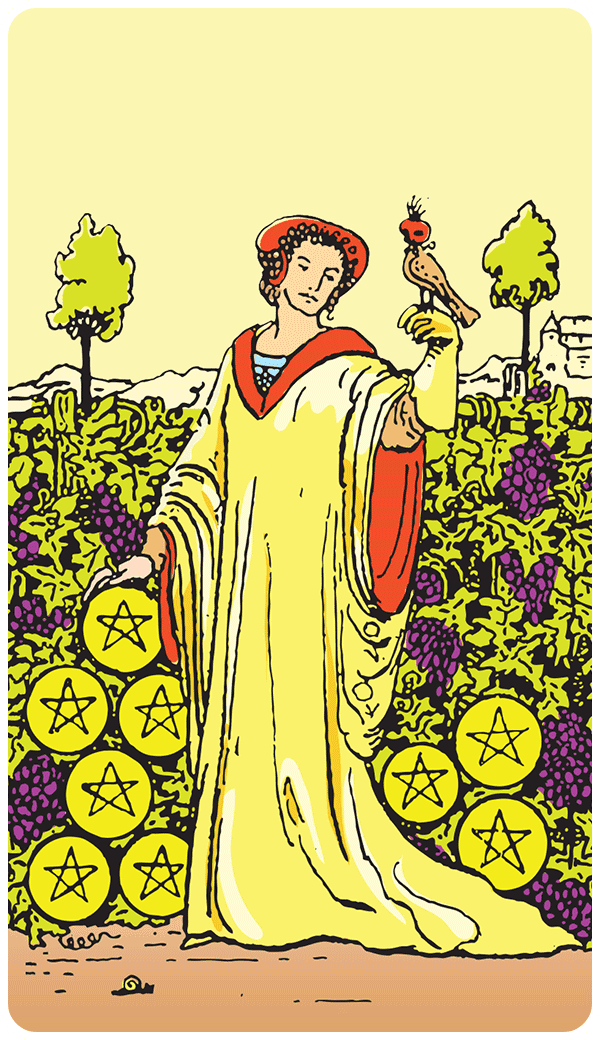
Nine of Pentacles · plate 9
YES
The Nine of Pentacles in a yes/no reading leans yes. But the yes comes with a condition most people miss: the card only confirms questions where you can execute the outcome independently, without waiting for another person's cooperation or external timing to align. If your question requires someone else to show up, change their mind, or meet you halfway, the card is not saying yes—it's saying you're asking the wrong question.
Why Nine of Pentacles reads this way
What the suit, rank, and image are measuring
Pentacles governs material results—what you can touch, count, or point to as evidence that something worked. The suit doesn't care about feelings or intentions; it cares about whether the thing got built. Nines in tarot are completion cards, but not the final completion—that's the Ten. Nine is the moment before the harvest comes in, when the work is done and the outcome is now a matter of maintenance, not effort. You've already put in what you're going to put in.
The image shows a woman alone in a garden she clearly built herself. She's holding a falcon. The garden is thriving. She is not waiting for anyone. This is the mechanical point: the Nine of Pentacles describes self-sufficiency that has already been achieved. The question is not whether you can do it—the card assumes you already have the skills, the resources, and the discipline. The question is whether the thing you're asking about allows you to operate that way.
The most common misreading in a yes/no context is treating this card as a blanket affirmative—"yes, it will work out." But the Nine of Pentacles doesn't promise external cooperation. It confirms internal capacity. If you're asking "Will they text me back?" and you pull this card, the answer is not yes. The answer is: you don't need them to.
How the answer changes depending on what you're actually asking
If the question is about something you control—"Should I launch this project?" "Can I afford to quit?" "Is this the right time to buy the house?"—the Nine of Pentacles reads as yes, you have what you need to proceed. The card is confirming that the groundwork is in place. You are not gambling; you are harvesting.
If the question is about something that requires another person's participation—"Will they hire me?" "Is this relationship going somewhere?" "Will the deal close?"—the card does not answer the question you asked. It answers a different question: Can you be fine either way? The yes/no flips to maybe, and the maybe is conditional on whether you're willing to proceed as if the other person is irrelevant to your stability. Most people are not willing to proceed that way, which makes the card's appearance in these readings feel like a non-answer. It is not a non-answer. It is the card saying: if the yes depends on them, you've already lost the plot.
Reversed, the Nine of Pentacles in a yes/no reading often shows up when someone is asking a question they cannot afford to execute alone, but they are pretending they can. The self-sufficiency is performance, not fact. The answer is no until the performance stops.
The tell that someone is misreading this card on themselves
The tell is this: they pull the Nine of Pentacles, read it as yes, and then immediately start planning around someone else's behavior. They assume the yes means the other person will come through, the timing will work out, the external conditions will align. Two months later, they are confused about why nothing moved. What moved was their own capacity to stop waiting. They missed it because they were still watching the door.
A grounded observation
Go back through your calendar and look for the week you stopped checking your phone. That's when the Nine of Pentacles was actually active. Whether you acted on it is a separate question.
Key themes to watch for
- № 01Theme
Affirmative current
- № 02Theme
Open door
- № 03Theme
Forward motion
What to do with this reading
Read the upright meaning first, even if you pulled the card reversed. The reversal is a commentary on the upright — not a separate card.
Notice what your body did when you saw Nine of Pentacles. That reaction is usually closer to the truth than the interpretation.
Write down one sentence: What is this card asking me to stop avoiding? Let the answer be smaller than you expect.
Come back to this card in 48 hours. Most yes / no readings sharpen with a little distance.
Questions answered
Frequently asked
The Nine of Pentacles in a yes/no reading leans yes. But the yes comes with a condition most people miss: the card only confirms questions where you can execute the outcome independently, without waiting for another person's cooperation or external timing to align. If your question requires someone else to show up, change their mind, or meet you halfway, the card is not saying yes—it's saying you're asking the wrong question.
Reversed cards are rarely "bad." Nine of Pentacles reversed asks you to look at where the same theme is blocked, postponed, or being avoided — usually with more compassion than the upright version.
Nine of Pentacles colors the cards around it. Pay attention to where its themes — embodiment, material follow-through, the slow build of resource — show up in the next card. That is usually where the story is.
Tarot is observational, not predictive. Nine of Pentacles describes the conditions in front of you right now and where they tend to lead if nothing changes — not a guarantee of timing.
Repeat cards are the deck underlining a theme. With Nine of Pentacles, that usually means the question you are asking is the right one — but you have not yet acted on what the card is showing you.
Read next
Related readings
More Pentacles · Yes / No
- Ace of Pentacles — Yes / NoHow Ace of Pentacles reads in a yes / no context.
- Two of Pentacles — Yes / NoHow Two of Pentacles reads in a yes / no context.
- Three of Pentacles — Yes / NoHow Three of Pentacles reads in a yes / no context.
- Four of Pentacles — Yes / NoHow Four of Pentacles reads in a yes / no context.
- Five of Pentacles — Yes / NoHow Five of Pentacles reads in a yes / no context.
- Six of Pentacles — Yes / NoHow Six of Pentacles reads in a yes / no context.
Other Nine of Pentacles readings
- General MeaningNine of Pentacles read for general meaning.
- Love & RelationshipsNine of Pentacles read for love & relationships.
- Career & WorkNine of Pentacles read for career & work.
- Money & FinanceNine of Pentacles read for money & finance.
- Health & WellbeingNine of Pentacles read for health & wellbeing.
- SpiritualityNine of Pentacles read for spirituality.