Knight of Pentacles in Yes / No
The Knight of Pentacles reads as yes in a yes/no question — but only if you're willing to wait. Here's what the card is actually measuring.
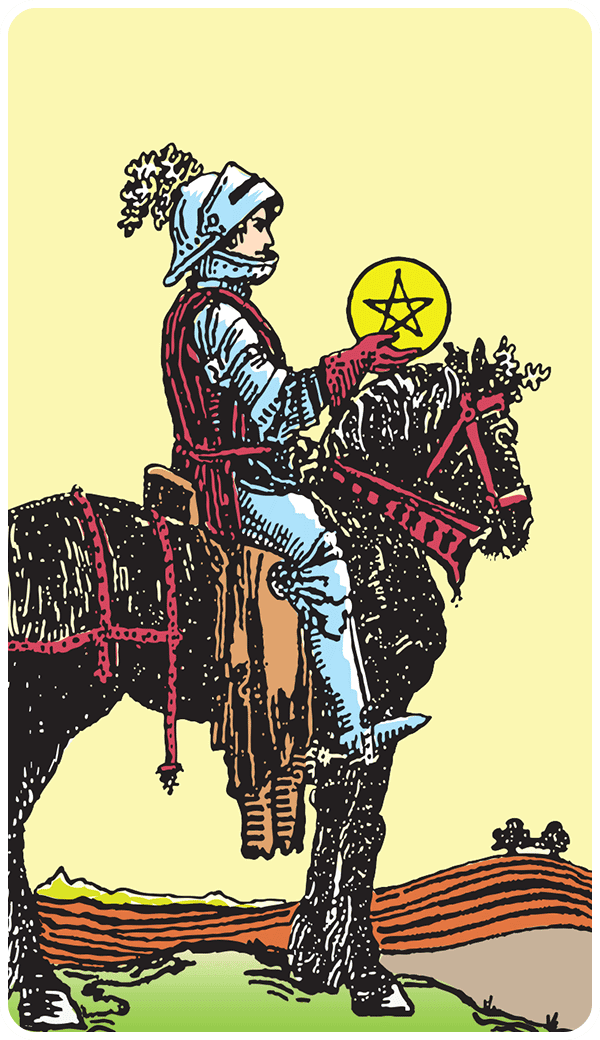
Knight of Pentacles · plate knight
YES
The Knight of Pentacles is a yes. But it is the slowest yes in the deck, and most querents hear it as a maybe or miss the condition entirely. They pull the card, see a knight on a horse, and expect momentum. Then nothing happens for three months and they decide the reading was wrong. What they missed: the card was describing the pace, not denying the outcome.
Why Knight of Pentacles reads this way
What the suit, the rank, and the image are each doing
Pentacles governs material reality — money, work, health, anything you can measure or hold. It is the suit of tangible results, which means Pentacles cards describe outcomes you can photograph. The Knight rank in tarot is motion. Knights are the only court cards actively traveling somewhere. They have left the castle and have not yet arrived. They describe a process in transit, not a person. The Knight of Pentacles sits on a motionless horse in a plowed field, holding a single coin, looking at it. He is not charging forward. He is checking the work. The image is someone moving toward a goal at the exact speed required to not make a mistake. The card is yes, but the yes is contingent on whether you can sustain effort without visible progress for longer than feels reasonable.
The most common misreading in a yes/no context is treating this card as hesitation or blockage. Querents see the stillness and read it as a no. What the card is actually describing is the difference between motion and speed. The Knight of Pentacles moves every day. He just moves in increments too small to feel like winning. If your question is 'Will I get the job?' and this card appears, the answer is yes — if you are still applying in two months when the hiring manager finally calls you back. If your question is 'Will this business work?' the answer is yes — if you can run it at a loss for a year while you build the client base. The card is not saying maybe. It is saying yes, slowly, and testing whether you hear that as the same thing.
How the card reads for two different querent situations
If the question is time-sensitive — 'Will the loan come through before the deadline?' or 'Will they text me back tonight?' — the Knight of Pentacles reads as a functional no. Not because the outcome won't happen, but because it won't happen inside the window that matters. The card describes a pace that outlasts urgency. If the question has no deadline — 'Will I ever pay off this debt?' or 'Will I get better at this skill?' — the Knight of Pentacles is the most reliable yes in the deck. It is the card of someone who shows up every day for two years and wins by still being there when everyone else quit.
In reversal, the card names the moment you stop showing up. The motion stops. The yes becomes a no not because the goal was impossible, but because you decided the pace was intolerable and walked away before the outcome arrived. Reversed Knight of Pentacles in a yes/no reading almost always means the querent will answer their own question by giving up.
The tell that someone is misreading the card on themselves
The tell is impatience disguised as realism. The querent pulls the Knight of Pentacles, reads it as a no, and says 'I knew it wouldn't work.' What they are actually saying is 'I am not willing to work on something for six months without proof it's working.' The card is not confirming their doubt. It is naming the trait that will determine the outcome. If they can outlast their own boredom, the answer is yes. If they can't, the card already knows.
A grounded observation
Go back through your phone and look for the last time you quit something that was working, just slowly. That is the Knight of Pentacles in reverse. The card you pulled today is asking if you will do that again.
Key themes to watch for
- № 01Theme
Affirmative current
- № 02Theme
Open door
- № 03Theme
Forward motion
What to do with this reading
Read the upright meaning first, even if you pulled the card reversed. The reversal is a commentary on the upright — not a separate card.
Notice what your body did when you saw Knight of Pentacles. That reaction is usually closer to the truth than the interpretation.
Write down one sentence: What is this card asking me to stop avoiding? Let the answer be smaller than you expect.
Come back to this card in 48 hours. Most yes / no readings sharpen with a little distance.
Questions answered
Frequently asked
The Knight of Pentacles is a yes. But it is the slowest yes in the deck, and most querents hear it as a maybe or miss the condition entirely. They pull the card, see a knight on a horse, and expect momentum. Then nothing happens for three months and they decide the reading was wrong. What they missed: the card was describing the pace, not denying the outcome.
Reversed cards are rarely "bad." Knight of Pentacles reversed asks you to look at where the same theme is blocked, postponed, or being avoided — usually with more compassion than the upright version.
Knight of Pentacles colors the cards around it. Pay attention to where its themes — embodiment, material follow-through, the slow build of resource — show up in the next card. That is usually where the story is.
Tarot is observational, not predictive. Knight of Pentacles describes the conditions in front of you right now and where they tend to lead if nothing changes — not a guarantee of timing.
Repeat cards are the deck underlining a theme. With Knight of Pentacles, that usually means the question you are asking is the right one — but you have not yet acted on what the card is showing you.
Read next
Related readings
More Pentacles · Yes / No
- Ace of Pentacles — Yes / NoHow Ace of Pentacles reads in a yes / no context.
- Two of Pentacles — Yes / NoHow Two of Pentacles reads in a yes / no context.
- Three of Pentacles — Yes / NoHow Three of Pentacles reads in a yes / no context.
- Four of Pentacles — Yes / NoHow Four of Pentacles reads in a yes / no context.
- Five of Pentacles — Yes / NoHow Five of Pentacles reads in a yes / no context.
- Six of Pentacles — Yes / NoHow Six of Pentacles reads in a yes / no context.
Other Knight of Pentacles readings
- General MeaningKnight of Pentacles read for general meaning.
- Love & RelationshipsKnight of Pentacles read for love & relationships.
- Career & WorkKnight of Pentacles read for career & work.
- Money & FinanceKnight of Pentacles read for money & finance.
- Health & WellbeingKnight of Pentacles read for health & wellbeing.
- SpiritualityKnight of Pentacles read for spirituality.