King of Swords in Health
The King of Swords in a health reading names the body being managed like a problem to solve. Here's what the card is actually describing.
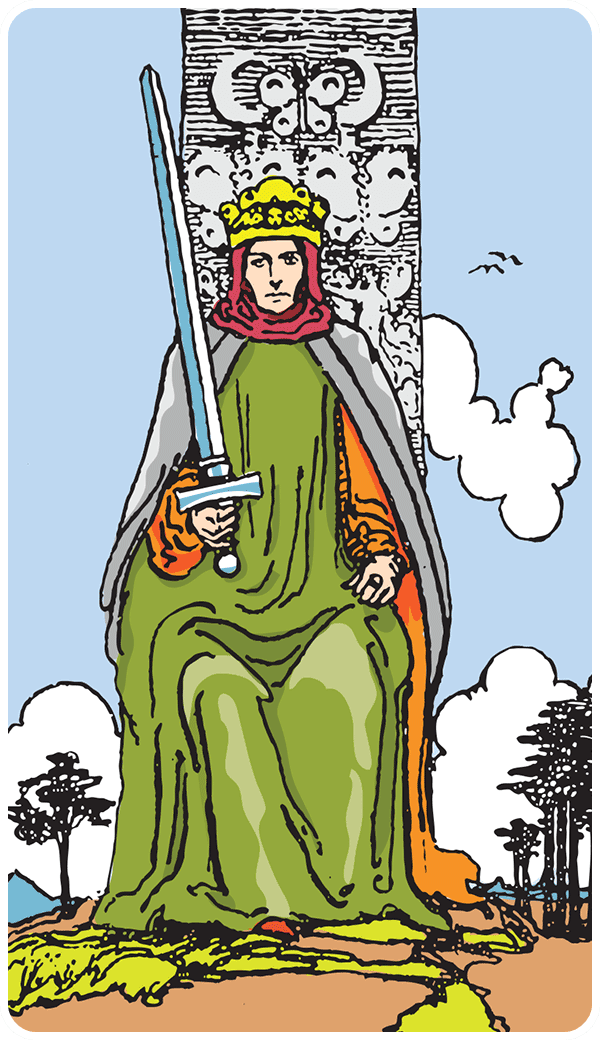
King of Swords · plate king
What the card is actually doing
The King of Swords shows up in a health reading and the querent assumes it means they need to be more disciplined. More strategic. Better at tracking symptoms, logging meals, following protocols. They think the card is telling them to think their way through the body. That is not what is happening. The King of Swords describes a relationship to the body that is already happening — one where the mind has taken full administrative control and the body has become a project under surveillance.
Reading King of Swords in health
What the suit, the rank, and the image are doing
Swords is the suit of thought, analysis, and the narratives you build to make sense of experience. It governs how you frame a situation, what story you tell yourself about what is happening, and the mental distance you create between yourself and what you feel. When Swords cards dominate a health reading, the body is not being experienced directly — it is being interpreted, managed, explained.
Kings in tarot are figures of mastery and authority within their suit. They are not learning the suit's lesson; they have already internalized it and now operate from that position as default. The King of Swords is someone who has made thinking the primary tool. They assess, they strategize, they solve. The body, in this framework, becomes another system to understand and optimize.
Look at the image. A figure sits on a throne, holding a sword upright. The posture is upright, alert, contained. There is no motion. There is no softness. The sword is not being used to cut through confusion — it is being held as a constant readiness, a vigilance that never rests. This is the mechanical answer: the King of Swords in a health context describes the body being held under intellectual authority. Symptoms are data. Pain is information to be categorized. Rest is scheduled if the logic supports it.
How this reads for two different querent situations
For someone with a chronic condition, the King of Swords often describes the coping mechanism that let them survive the diagnostic maze. They learned to track, to research, to speak the language of doctors, to manage their body like a failing system that could be stabilized through better information. The card is not wrong — that skill kept them functional. But when the King of Swords shows up now, it is naming the cost. The body has become a problem to manage, not a thing they live inside. They no longer feel hunger or fatigue as sensations; they feel them as data points that require a decision.
For someone dealing with acute illness or injury, the King of Swords describes the impulse to immediately understand what happened, why it happened, what it means about their future. They want a clear diagnosis, a clear plan, a clear timeline. The card is describing the mind trying to take control of a situation where control is not available. The body is doing something the mind cannot narrate its way out of, and the King of Swords is the moment that gap becomes unbearable.
The tell that someone is misreading this card on themselves
The querent thinks the King of Swords is advice. They think it means they need to be smarter about their health, more disciplined, better at research. They leave the reading planning to optimize harder. That is the misread. The King of Swords is not a prescription — it is a diagnosis of what is already happening. If you are reading this card and your first thought is "I need to figure this out," you are already the King of Swords. The card is naming the strategy you are using, not telling you to use it more.
From the practice
“A card never tells you what to do. It tells you what you're already deciding — and gives you the words to name it.”
A grounded observation
Go back through the last two weeks and notice how many times you described your body as something you are managing versus something you are living inside. That ratio is what the card is measuring.
Key themes to watch for
- № 01Theme
Emotional renewal
- № 02Theme
Mind-body link
- № 03Theme
Soft restoration
What to do with this reading
Read the upright meaning first, even if you pulled the card reversed. The reversal is a commentary on the upright — not a separate card.
Notice what your body did when you saw King of Swords. That reaction is usually closer to the truth than the interpretation.
Write down one sentence: What is this card asking me to stop avoiding? Let the answer be smaller than you expect.
Come back to this card in 48 hours. Most health readings sharpen with a little distance.
Questions answered
Frequently asked
The King of Swords in health points to the importance of understanding your body and health needs with clarity. This card encourages you to seek out information, perhaps consulting experts or doing thorough research. It's about making informed choices about your well-being. Are you tapping into resources that can enhance your health journey? Consider how knowledge can empower you to make better health decisions.
In a health context, the reversed King of Swords may indicate confusion or misinformation. You might feel overwhelmed by conflicting advice or unsure about a diagnosis. This card suggests taking a step back and seeking a second opinion if necessary. Are you open to exploring different perspectives on your health? Reflect on where you might need more clarity or support.
King of Swords colors the cards around it. Pay attention to where its themes — mental clarity, the truth being named, what the mind needs to release — show up in the next card. That is usually where the story is.
Tarot is observational, not predictive. King of Swords describes the conditions in front of you right now and where they tend to lead if nothing changes — not a guarantee of timing.
Repeat cards are the deck underlining a theme. With King of Swords, that usually means the question you are asking is the right one — but you have not yet acted on what the card is showing you.
Read next
Related readings
More Swords · Health
- Ace of Swords — HealthHow Ace of Swords reads in a health context.
- Two of Swords — HealthHow Two of Swords reads in a health context.
- Three of Swords — HealthHow Three of Swords reads in a health context.
- Four of Swords — HealthHow Four of Swords reads in a health context.
- Five of Swords — HealthHow Five of Swords reads in a health context.
- Six of Swords — HealthHow Six of Swords reads in a health context.
Other King of Swords readings
- General MeaningKing of Swords read for general meaning.
- Love & RelationshipsKing of Swords read for love & relationships.
- Career & WorkKing of Swords read for career & work.
- Money & FinanceKing of Swords read for money & finance.
- SpiritualityKing of Swords read for spirituality.
- Yes / No AnswerKing of Swords read for yes / no answer.