Three of Pentacles in General
Most readers call the Three of Pentacles 'teamwork.' What it actually names is the moment skill becomes visible to someone who can use it.
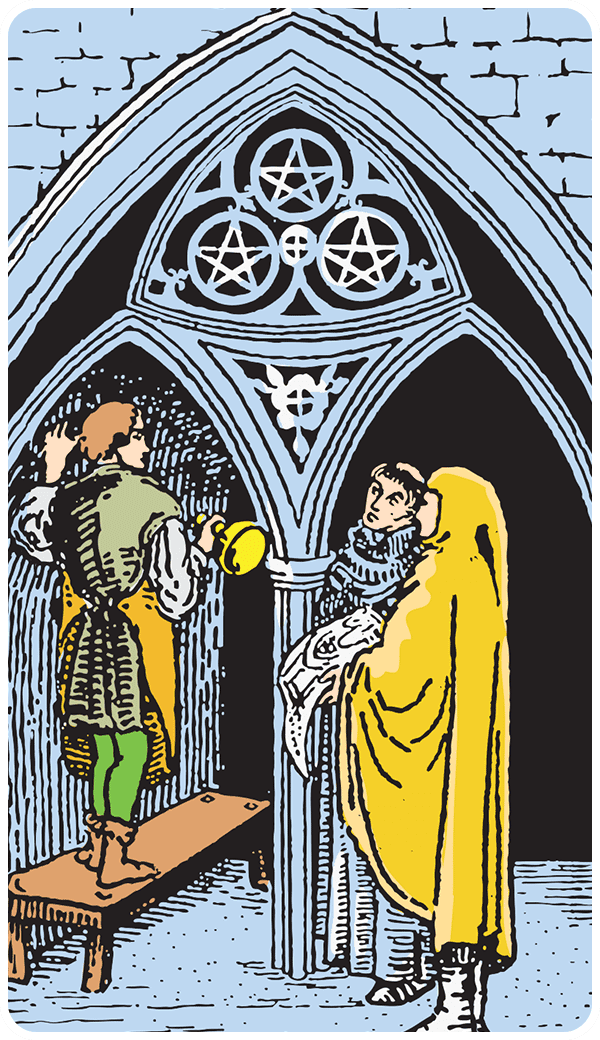
Three of Pentacles · plate 3
What the card is actually doing
The Three of Pentacles gets flattened into 'teamwork' or 'collaboration' and the querent nods politely and leaves the reading with nothing actionable. The card shows up when someone asks about work, creative projects, or whether they should take a new opportunity, and the reader says something about synergy or combined effort. That is not what is happening on the card.
What the card is actually describing is the moment your skill level becomes legible to someone with institutional power. The apprentice shows their work to the architect. The architect can see what the apprentice can do. What happens next depends on whether the querent is the apprentice or the architect.
Reading Three of Pentacles in general
What the suit, rank, and image are doing
Pentacles governs material structures — money, work, skill acquisition, anything you can point to and say 'I built that.' It is the suit of craft, not inspiration. When Pentacles cards dominate a reading, the question is almost always about whether something will produce a tangible result.
Threes in tarot mark the first stable form. The Ace is potential, the Two is pairing or choice, the Three is the thing that can now stand on its own. It is the minimum viable structure. In Pentacles, that means the skill has reached the threshold where it can be recognized and compensated.
The image: a stonemason stands on a bench inside a cathedral, carving. Two figures watch from below — one in religious robes, one in merchant or noble dress. The stonemason is mid-work. The two watchers are evaluating. The card is not about the teamwork happening; it is about the assessment. The stonemason's skill is being seen by people who control resources. Whether they hire him, fund the next phase, or walk away is the question the card opens but does not answer.
How the card reads for two different querent positions
If the querent is early in a skill — learning to code, starting a side business, showing a portfolio for the first time — the Three of Pentacles says: someone with leverage is about to see what you can do. This is not 'you will succeed.' This is 'you are now legible.' What you do with that visibility is a separate card. The mistake here is treating the card as a green light. It is a threshold. You still have to perform.
If the querent is established and asking about a new hire, a collaborator, or whether to bring someone into a project, the Three of Pentacles says: you are the architect in this scenario. You are the one evaluating. The card is describing your position in the structure, not the quality of the person you are assessing. The question it opens is whether you can actually see skill when it is in front of you, or whether you are looking for something else — credentialing, likability, someone who reminds you of yourself.
The tell that someone is misreading the card on themselves
The querent reads the Three of Pentacles, decides it means 'collaboration,' and starts looking for a co-founder or a creative partner when what they actually need is an audience. They are trying to share the labor when the real block is that no one with resources knows they exist yet. The card is not telling them to find a peer. It is telling them to show the work to someone who can do something with it. If six months later they are still 'building in private' or 'looking for the right team,' they misread the card. The card was naming the next move: make the skill visible.
From the practice
“A card never tells you what to do. It tells you what you're already deciding — and gives you the words to name it.”
A grounded observation
Go back through your calendar and look for the moments when someone with institutional power — a boss, a client, a gallery owner, an investor — saw your work for the first time. That is what the card is pointing to. Whether they said yes is a different question.
Key themes to watch for
- № 01Theme
Beginnings
- № 02Theme
Inner movement
- № 03Theme
Receptivity
What to do with this reading
Read the upright meaning first, even if you pulled the card reversed. The reversal is a commentary on the upright — not a separate card.
Notice what your body did when you saw Three of Pentacles. That reaction is usually closer to the truth than the interpretation.
Write down one sentence: What is this card asking me to stop avoiding? Let the answer be smaller than you expect.
Come back to this card in 48 hours. Most general readings sharpen with a little distance.
Questions answered
Frequently asked
The Three of Pentacles speaks to collaboration and craftsmanship. It suggests that you're building something meaningful with others, and each person brings a unique skill or perspective to the table. This card reminds you that shared goals can create a richer tapestry than going it alone. As you move forward, notice how the different pieces fit together. Is there a missing link or a way to enhance the synergy? It's a moment to appreciate the harmony of teamwork and the beauty of collective effort.
In reverse, the Three of Pentacles hints at a breakdown in collaboration or a lack of recognition for your efforts. Maybe roles are unclear, or communication has faltered. This isn't about blame, but about understanding where things might be going off track. Reflect on whether everyone involved is on the same page. Are there unspoken expectations or misaligned goals? This card invites you to consider how you might realign intentions to foster a more cohesive working environment.
Three of Pentacles colors the cards around it. Pay attention to where its themes — embodiment, material follow-through, the slow build of resource — show up in the next card. That is usually where the story is.
Tarot is observational, not predictive. Three of Pentacles describes the conditions in front of you right now and where they tend to lead if nothing changes — not a guarantee of timing.
Repeat cards are the deck underlining a theme. With Three of Pentacles, that usually means the question you are asking is the right one — but you have not yet acted on what the card is showing you.
Read next
Related readings
More Pentacles · General
- Ace of Pentacles — GeneralHow Ace of Pentacles reads in a general context.
- Two of Pentacles — GeneralHow Two of Pentacles reads in a general context.
- Four of Pentacles — GeneralHow Four of Pentacles reads in a general context.
- Five of Pentacles — GeneralHow Five of Pentacles reads in a general context.
- Six of Pentacles — GeneralHow Six of Pentacles reads in a general context.
- Seven of Pentacles — GeneralHow Seven of Pentacles reads in a general context.
Other Three of Pentacles readings
- Love & RelationshipsThree of Pentacles read for love & relationships.
- Career & WorkThree of Pentacles read for career & work.
- Money & FinanceThree of Pentacles read for money & finance.
- Health & WellbeingThree of Pentacles read for health & wellbeing.
- SpiritualityThree of Pentacles read for spirituality.
- Yes / No AnswerThree of Pentacles read for yes / no answer.