Seven of Pentacles in General
The Seven of Pentacles isn't telling you to wait. It's naming the gap between effort already spent and results not yet visible — and asking what you do in that gap.
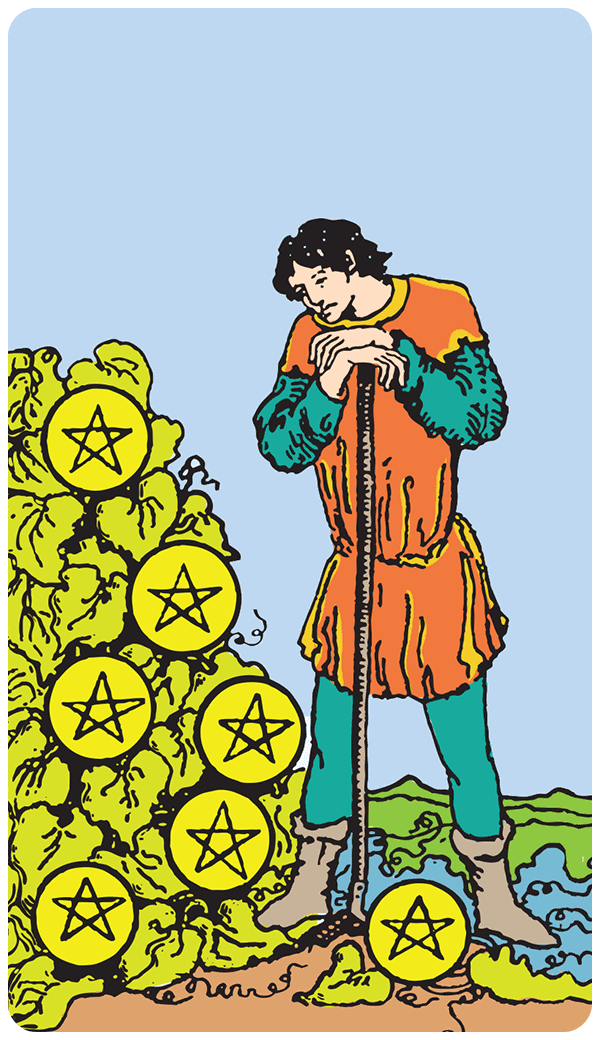
Seven of Pentacles · plate 7
What the card is actually doing
The Seven of Pentacles shows up and the querent exhales. They read it as permission to rest, to step back, to stop pushing so hard. The card shows a figure leaning on a tool, looking at six pentacles growing on a vine, with one pentacle at their feet. Most readers land on "patience" or "waiting for results" and stop there. That is not what the card is doing. The Seven of Pentacles is not about waiting. It is about the specific psychological state that arrives when you have already done the work and the outcome is not yet legible — and what that gap reveals about whether you are still committed to the project or already halfway out the door.
Reading Seven of Pentacles in general
What the suit, the rank, and the image are each doing
Pentacles governs material reality: money, work, health, anything you can measure or hold. It is the suit of effort that produces tangible results, or fails to. When Pentacles cards dominate a reading, the question is almost always about whether something is actually working — not whether it feels good, but whether it is producing the outcome you said you wanted.
Sevens in tarot mark the reassessment point. You are past the halfway mark of the suit's cycle. You have invested time, energy, or resources. The initial momentum is gone. You are far enough in that turning back feels wasteful, but not far enough along that the payoff is obvious. Sevens ask: are you still in this, or are you performing commitment while mentally calculating the exit?
The image shows a figure pausing mid-labor. They are leaning on their tool — not resting, but stopped. Six pentacles hang on the vine. One pentacle sits at their feet, separated from the others. The figure is looking at what they have grown so far, and the card does not tell you what conclusion they reach. The pause is the point. The Seven of Pentacles names the moment when you stop moving and take stock, and what you see in that moment tells you whether the project still has your real attention or whether you are already rehearsing the story you will tell about why you quit.
How the card reads differently depending on what the querent is actually asking
If the querent is asking whether to keep going with something — a job, a relationship, a creative project — the Seven of Pentacles is not answering that question. It is reflecting the fact that they are asking it. The card describes the in-between state: effort is visible, results are not yet. What the card is actually doing is showing you what you do in that gap. Do you keep tending the thing, or do you start shopping for the next thing? Most people who pull this card are already leaning toward the exit and hoping the cards will give them permission.
If the querent is asking about something they claim to be committed to — building a business, getting healthier, saving money — and the Seven of Pentacles appears, the card is naming a problem they have not said out loud yet. The work is happening, but the person doing the work is not present. They are going through motions. The card is the moment they notice that the effort feels effortful in a way it did not before, and that noticing is information.
The tell that someone is misreading the card on themselves
The misreading sounds like this: "The card is telling me to be patient. The results will come." That is not what the card says. The card does not promise results. It does not tell you to wait. It names the fact that you are in the waiting, and it asks what you are doing with your attention while you wait. If you are using the Seven of Pentacles to justify staying in something you have already emotionally left, you are misreading it. The card is not permission. It is a mirror.
From the practice
“A card never tells you what to do. It tells you what you're already deciding — and gives you the words to name it.”
A grounded observation
Go back through your calendar and look at how much time you spent on the thing you say you are building. Then look at how much time you spent thinking about whether to keep building it. The ratio tells you what the card already knows.
Key themes to watch for
- № 01Theme
Beginnings
- № 02Theme
Inner movement
- № 03Theme
Receptivity
What to do with this reading
Read the upright meaning first, even if you pulled the card reversed. The reversal is a commentary on the upright — not a separate card.
Notice what your body did when you saw Seven of Pentacles. That reaction is usually closer to the truth than the interpretation.
Write down one sentence: What is this card asking me to stop avoiding? Let the answer be smaller than you expect.
Come back to this card in 48 hours. Most general readings sharpen with a little distance.
Questions answered
Frequently asked
The Seven of Pentacles speaks to the slow, steady progress of tending to what you've planted. It's about the quiet satisfaction in seeing your hard work begin to bear fruit, even if the harvest isn't quite ready yet. Imagine a gardener pausing to admire their growing plants, knowing that consistent care is needed. It's a moment to reflect on your efforts and decide if you're content with the current trajectory. Are you willing to continue nurturing your goals, or is it time to adjust your approach?
When the Seven of Pentacles appears reversed, it hints at impatience or frustration with the pace of progress. Perhaps you're feeling like the effort you've invested hasn't yielded the results you expected. This card invites you to reassess: Are you putting your energy into the right places? Sometimes, a lack of progress might suggest it's time to reconsider your priorities or methods. What might you learn from this pause, and how can it inform your next steps?
Seven of Pentacles colors the cards around it. Pay attention to where its themes — embodiment, material follow-through, the slow build of resource — show up in the next card. That is usually where the story is.
Tarot is observational, not predictive. Seven of Pentacles describes the conditions in front of you right now and where they tend to lead if nothing changes — not a guarantee of timing.
Repeat cards are the deck underlining a theme. With Seven of Pentacles, that usually means the question you are asking is the right one — but you have not yet acted on what the card is showing you.
Read next
Related readings
More Pentacles · General
- Ace of Pentacles — GeneralHow Ace of Pentacles reads in a general context.
- Two of Pentacles — GeneralHow Two of Pentacles reads in a general context.
- Three of Pentacles — GeneralHow Three of Pentacles reads in a general context.
- Four of Pentacles — GeneralHow Four of Pentacles reads in a general context.
- Five of Pentacles — GeneralHow Five of Pentacles reads in a general context.
- Six of Pentacles — GeneralHow Six of Pentacles reads in a general context.
Other Seven of Pentacles readings
- Love & RelationshipsSeven of Pentacles read for love & relationships.
- Career & WorkSeven of Pentacles read for career & work.
- Money & FinanceSeven of Pentacles read for money & finance.
- Health & WellbeingSeven of Pentacles read for health & wellbeing.
- SpiritualitySeven of Pentacles read for spirituality.
- Yes / No AnswerSeven of Pentacles read for yes / no answer.