The Tower in Yes / No
The Tower in a yes/no reading almost always means no—but not because the outcome is bad. The question itself is collapsing. Here's what the card is actually naming.
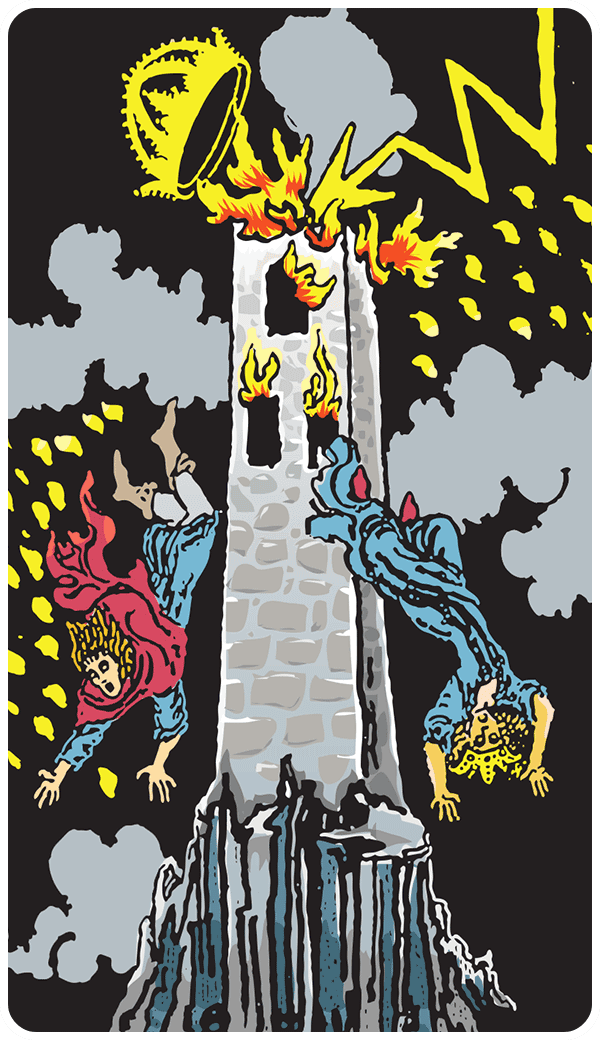
The Tower · plate 16
NO
The Tower in a yes/no reading is a no. Not because the thing you want won't happen, but because the frame you're using to ask the question is already breaking. Most people read The Tower as disaster—something external crashing down on them. They think the card is warning them away from a choice. That's backwards. The Tower doesn't prevent collapse. It names the structure that was already unstable. The shock isn't the card's doing. It's the moment you stop pretending the foundation was solid.
Why The Tower reads this way
What the card is doing and why people misread it as external catastrophe
The Tower is Major Arcana, which means it describes a psychological threshold, not an event on a calendar. It governs the part of the psyche that builds certainty—the stories you tell yourself about how things work, what's safe, what you can count on. When those stories stop matching reality, the card appears. The image shows a tower struck by lightning, figures falling, the crown blown off the top. People see violence. What the card is actually showing is structural failure. The lightning is the truth that was always true. The tower is the belief system that couldn't hold it. The fall is what happens when you can no longer maintain the fiction.
In a yes/no reading, people want The Tower to mean "don't do the thing" or "brace for impact." They think the card is predictive. It is not. The Tower describes a process that is already underway. If you're asking "Should I take this job?" and The Tower appears, the card is not saying the job will be bad. It's saying the reason you're asking the question in the first place is because something about your current situation has already stopped working. The ground is moving. The binary framing—yes or no—is trying to stabilize something that won't stabilize.
How the card reads differently depending on what the querent is actually asking
If the question is "Will this relationship work?" and The Tower appears, the answer is no—but the no is about the relationship as currently structured, not about the people. The Tower names the dynamic that's collapsing: the unspoken agreement, the role one person has been playing, the story about who needs what. The card says the old version is done. Whether a new version can be built is a separate question, answered by what comes after The Tower in the spread.
If the question is "Should I leave this job?" and The Tower appears, the answer flips to yes—but only because the leaving is already happening internally. The card is confirming that the structure (the role, the identity, the routine) has already broken for you. You're asking permission for something you've already decided. The Tower doesn't grant permission. It describes the fact that you can't go back to believing what you believed last month.
The tell that someone is misreading the card on themselves
The tell is when someone sees The Tower and immediately starts bracing—stocking the pantry, avoiding risk, clutching tighter to what they have. That's someone who thinks the card is a warning they can heed. The Tower is not a warning. It is a description of a collapse that is already in motion, usually one the querent has been working very hard not to notice. If you pull The Tower and your first move is to double down on control, you are misreading it. The card is naming the thing that control was built to avoid facing. The honest read is: go back through the last six weeks and look for the moment you realized something wasn't true anymore. That moment was The Tower. The question you're asking now is just the aftermath.
A grounded observation
The Tower never arrives early. By the time it shows up in a reading, the foundation was already cracked. The card just names the moment you stopped being able to ignore it.
Key themes to watch for
- № 01Theme
Affirmative current
- № 02Theme
Open door
- № 03Theme
Forward motion
What to do with this reading
Read the upright meaning first, even if you pulled the card reversed. The reversal is a commentary on the upright — not a separate card.
Notice what your body did when you saw The Tower. That reaction is usually closer to the truth than the interpretation.
Write down one sentence: What is this card asking me to stop avoiding? Let the answer be smaller than you expect.
Come back to this card in 48 hours. Most yes / no readings sharpen with a little distance.
Questions answered
Frequently asked
The Tower in a yes/no reading is a no. Not because the thing you want won't happen, but because the frame you're using to ask the question is already breaking. Most people read The Tower as disaster—something external crashing down on them. They think the card is warning them away from a choice. That's backwards. The Tower doesn't prevent collapse. It names the structure that was already unstable. The shock isn't the card's doing. It's the moment you stop pretending the foundation was solid.
Reversed cards are rarely "bad." The Tower reversed asks you to look at where the same theme is blocked, postponed, or being avoided — usually with more compassion than the upright version.
The Tower colors the cards around it. Pay attention to where its themes — archetype, pattern, invitation — show up in the next card. That is usually where the story is.
Tarot is observational, not predictive. The Tower describes the conditions in front of you right now and where they tend to lead if nothing changes — not a guarantee of timing.
Repeat cards are the deck underlining a theme. With The Tower, that usually means the question you are asking is the right one — but you have not yet acted on what the card is showing you.
Read next
Related readings
Other The Tower readings
- General MeaningThe Tower read for general meaning.
- Love & RelationshipsThe Tower read for love & relationships.
- Career & WorkThe Tower read for career & work.
- Money & FinanceThe Tower read for money & finance.
- Health & WellbeingThe Tower read for health & wellbeing.
- SpiritualityThe Tower read for spirituality.