The Tower in Money
The Tower in money readings gets read as disaster. What it actually names is the structure that was already failing — and the relief that follows the collapse.
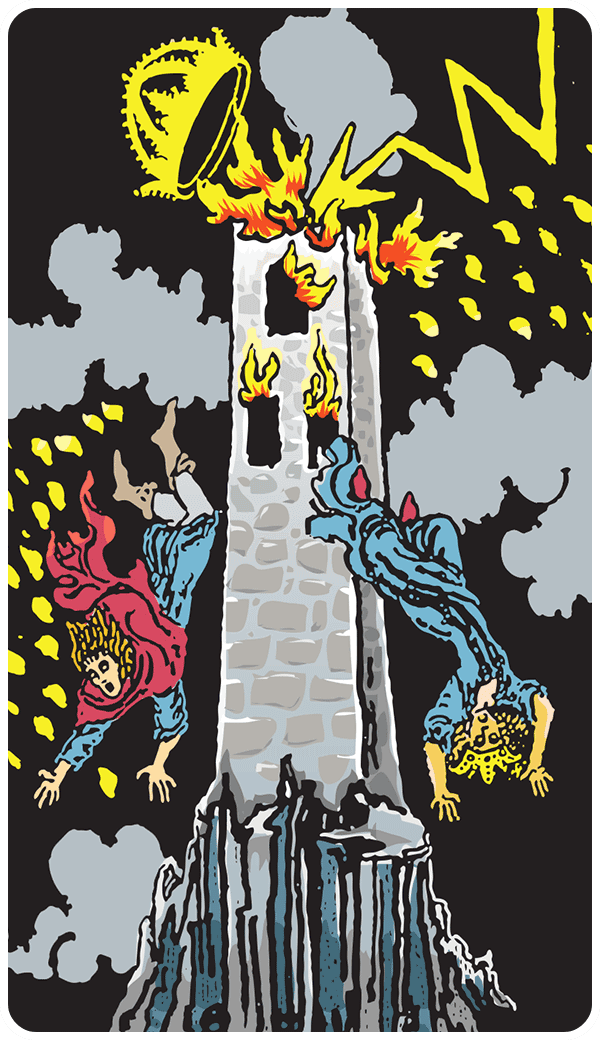
The Tower · plate 16
What the card is actually doing
The Tower shows up in a finance reading and the querent's body language changes immediately. They sit back. They brace. They want me to tell them it doesn't mean what they think it means. Most readers try to soften it — "necessary change," "breakthrough disguised as breakdown," "clearing space for something better." That is not what the card is doing. The Tower does not arrive to teach you a lesson or create an opening. It names the moment a financial structure that was already unstable stops being sustainable, and you stop being able to pretend it isn't.
Reading The Tower in money
What the image and the Major Arcana rank are doing
The Tower is Major Arcana XVI. Major cards don't describe events; they describe the psychic or structural shifts that make certain events inevitable. The Tower is not the job loss or the market crash or the surprise tax bill. It is the recognition that the foundation was never solid. The image shows a tower struck by lightning, figures falling, the crown blown off the top. The structure is not being destroyed by an outside force. The lightning is revealing what was always true: the thing was built wrong, or built on sand, or kept standing through willful ignorance.
In a finance reading, the Tower describes the moment you can no longer maintain the budget that doesn't add up, the business model that requires you to work 80 hours to break even, the debt load you've been servicing by not looking at the statement. The card does not create the problem. The problem was already there. The Tower is the moment the pretending stops.
The most common misreading is to treat the Tower as a warning you can avoid. Querents ask what they should do differently, what they should hedge against, how to prevent it. But the Tower does not show up in the preventable future. It shows up in the already-collapsed present that you have not yet admitted to yourself. If the card appears, the structure is already done. What comes next is not damage control. It is the question of what you rebuild.
How the card reads for two different financial situations
For someone in active denial — someone who has been floating expenses on credit, or staying in a failing business because they've already sunk the cost, or pretending the severance will last longer than it will — the Tower reads as the moment the math stops mathing. The account overdrafts. The investor pulls out. The lease comes due and there is no cash. The external world stops cooperating with the internal story. The card is not punitive. It is structural. The relief, when it comes, is that you no longer have to perform the charade of solvency.
For someone who already knows the structure is failing but has not yet acted — someone still showing up to the job they know is ending, still holding the investment they know is underwater, still splitting the rent with the person they're leaving — the Tower reads as permission. The lightning is the event that makes the decision for you. You do not have to be the one who pulls the trigger. The external collapse creates the exit you could not give yourself. This is not the same as relief. But it is the end of the waiting.
The tell that someone is misreading the card on themselves
The querent asks what the Tower means for their financial future. That is the tell. The Tower does not describe the future. It describes the structure that is collapsing now, in this reading, whether you have named it yet or not. If you are asking what it means, you are still pretending the thing it names has not already happened. Go back through your bank statements for the last six months. Look for the month where the baseline shifted and you started managing around it instead of addressing it. That is the Tower. The card is not warning you. It is naming what you already know.
From the practice
“A card never tells you what to do. It tells you what you're already deciding — and gives you the words to name it.”
A grounded observation
The Tower does not arrive to destroy your finances. It arrives when the financial structure you built has already become unsustainable, and your nervous system finally stops trying to hold it together.
Key themes to watch for
- № 01Theme
Non-material wealth
- № 02Theme
Generosity
- № 03Theme
Values check
What to do with this reading
Read the upright meaning first, even if you pulled the card reversed. The reversal is a commentary on the upright — not a separate card.
Notice what your body did when you saw The Tower. That reaction is usually closer to the truth than the interpretation.
Write down one sentence: What is this card asking me to stop avoiding? Let the answer be smaller than you expect.
Come back to this card in 48 hours. Most money readings sharpen with a little distance.
Questions answered
Frequently asked
Upright, the Tower in finance signals a sudden financial shake-up. It's like a surprise expense or an unexpected market shift that demands your attention. While it might be disruptive, this card invites you to reassess your financial strategies. Consider this an opportunity to rebuild your financial habits with more stability. Are there outdated financial practices that need reevaluation?
Reversed, the Tower in finance suggests a gradual realization of financial instability. It’s like a slow leak in a budget that, if left unchecked, could lead to bigger issues. This card hints at the need to address these concerns before they escalate. What small adjustments can you make to shore up your financial security?
The Tower colors the cards around it. Pay attention to where its themes — archetype, pattern, invitation — show up in the next card. That is usually where the story is.
Tarot is observational, not predictive. The Tower describes the conditions in front of you right now and where they tend to lead if nothing changes — not a guarantee of timing.
Repeat cards are the deck underlining a theme. With The Tower, that usually means the question you are asking is the right one — but you have not yet acted on what the card is showing you.
Read next
Related readings
Other The Tower readings
- General MeaningThe Tower read for general meaning.
- Love & RelationshipsThe Tower read for love & relationships.
- Career & WorkThe Tower read for career & work.
- Health & WellbeingThe Tower read for health & wellbeing.
- SpiritualityThe Tower read for spirituality.
- Yes / No AnswerThe Tower read for yes / no answer.