The Moon in Health
The Moon in a health reading gets misread as mystery illness. What it actually describes is the gap between what you're reporting and what you're feeling.
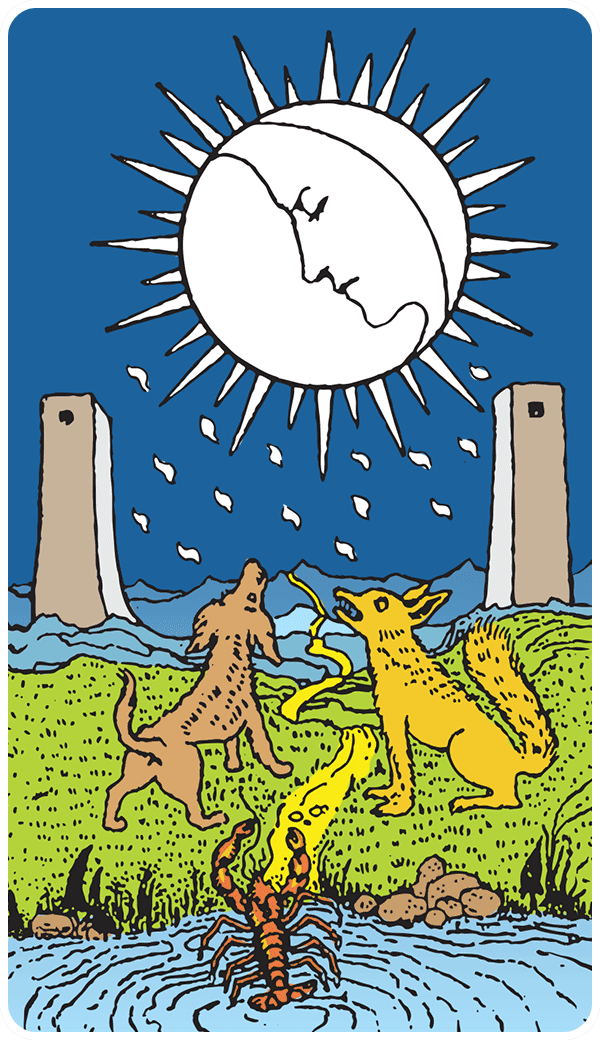
The Moon · plate 18
What the card is actually doing
The Moon shows up in a health reading and the querent immediately goes to worst-case. They think it means something is hidden. Something undiagnosed. Something the doctors are missing. They want me to tell them what's lurking under the surface. That is not what the card is doing. The Moon does not name a hidden illness. It names the part of the experience you are not yet willing to describe plainly — the symptom you're downplaying, the pattern you're calling random, the thing you know but have not said out loud.
Reading The Moon in health
What the Major Arcana rank and the image are doing
The Moon is Major Arcana, which means it describes a psychological threshold, not a medical event. Major cards point to the internal structure through which you are interpreting what is happening to you. They describe the lens, not the diagnosis. The Moon specifically governs the gap between conscious report and somatic truth — the space where your body is saying one thing and your narrative about your body is saying another.
Look at the image. A path runs between two towers toward a distant horizon. A dog and a wolf howl at the moon. A crayfish emerges from water. The path is visible but unclear. The animals are calling toward something above them. The crayfish is surfacing. This is not concealment. This is the moment before articulation. Something is moving from the unconscious into range, but it has not yet been named. The most common misreading in a health context is to treat the card as ominous — as if it's warning you that something terrible is hiding. What it actually describes is the discomfort of not yet having language for what you are feeling. The fog is not external. The fog is the gap between sensation and description.
How the card reads for two different querent situations
For someone with a new or worsening symptom, The Moon describes the week or month before they finally make the appointment. They notice something. They minimize it. They tell themselves it's stress, or sleep, or nothing. The card is naming the delay between the body's signal and the decision to treat the signal as real. The reading is not saying "something is hidden." It is saying "you are hiding from something."
For someone already in treatment or diagnosis, The Moon describes the experience of not being believed — or of not believing yourself. The test comes back normal but the pain is still there. The doctor says it's anxiety but the fatigue is not improving. The card points to the mismatch between what the medical system is registering and what you are living with. It does not mean the system is wrong. It means the gap itself is the current problem, and the gap is making you doubt your own report.
The tell that someone is misreading the card on themselves
The tell is when the querent treats The Moon as permission to avoid the next concrete step. They decide the card means "it's too unclear to act," so they don't book the appointment, don't ask for the second opinion, don't tell anyone what's actually happening. The Moon is not a card of waiting. It is a card of pre-articulation. If you are using it to justify staying in the fog, you are misreading it. The card is the moment before you say the thing out loud. It is not the moment you decide the thing is unsayable.
From the practice
“A card never tells you what to do. It tells you what you're already deciding — and gives you the words to name it.”
A grounded observation
Go back through your calendar and find the week you first noticed the symptom you are now talking about. The Moon describes that week. What you did not say then is what the card is pointing to now.
Key themes to watch for
- № 01Theme
Emotional renewal
- № 02Theme
Mind-body link
- № 03Theme
Soft restoration
What to do with this reading
Read the upright meaning first, even if you pulled the card reversed. The reversal is a commentary on the upright — not a separate card.
Notice what your body did when you saw The Moon. That reaction is usually closer to the truth than the interpretation.
Write down one sentence: What is this card asking me to stop avoiding? Let the answer be smaller than you expect.
Come back to this card in 48 hours. Most health readings sharpen with a little distance.
Questions answered
Frequently asked
The Moon card in health highlights the importance of listening to your body's signals, even when they're subtle or confusing. This is a time to pay attention to symptoms that might not have a clear explanation. It suggests that there could be underlying issues that require introspection. Are you in tune with the whispers of your physical and emotional well-being? Consider keeping a journal to track any recurring patterns and what they might be trying to communicate.
Reversed, The Moon in health suggests that things might be becoming clearer, but it's important not to ignore subtle signs. There's a temptation to dismiss symptoms that don't have an immediate explanation. Are you seeking quick answers instead of acknowledging the body's complex signals? Reflect on the importance of patience and thoroughness in understanding your health journey.
The Moon colors the cards around it. Pay attention to where its themes — archetype, pattern, invitation — show up in the next card. That is usually where the story is.
Tarot is observational, not predictive. The Moon describes the conditions in front of you right now and where they tend to lead if nothing changes — not a guarantee of timing.
Repeat cards are the deck underlining a theme. With The Moon, that usually means the question you are asking is the right one — but you have not yet acted on what the card is showing you.
Read next
Related readings
Other The Moon readings