The Moon in Money
The Moon in a finance reading isn't warning you about deception. It's naming the part of your money story you're not looking at directly.
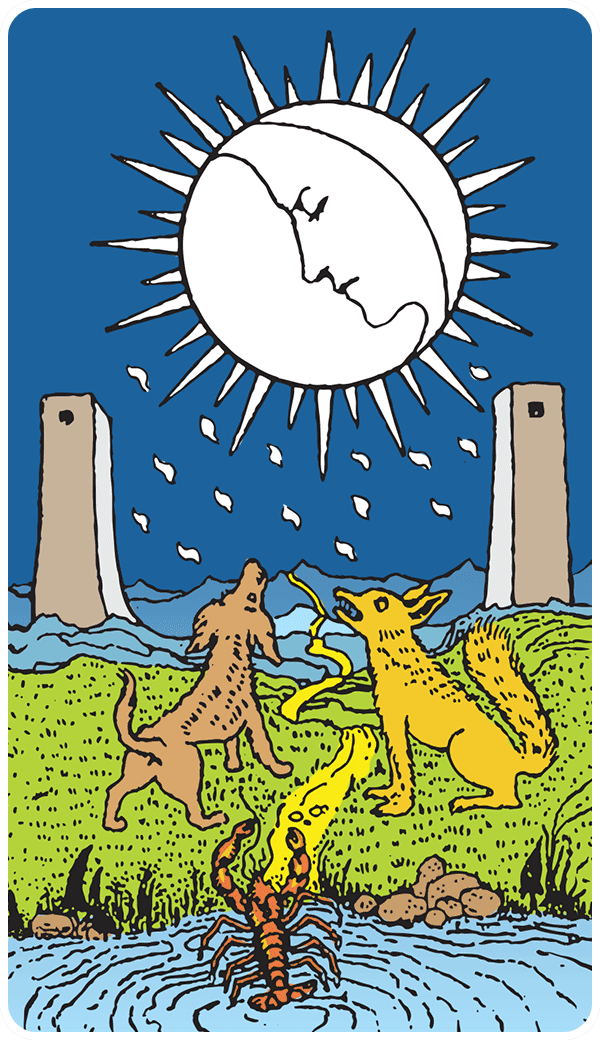
The Moon · plate 18
What the card is actually doing
The Moon shows up in a finance reading and the querent tenses. They ask if someone is lying to them. If there's fraud. If the investment is a scam. They want the card to be about external threat — someone else's deception, someone else's hidden agenda. That is almost never what the card is doing. The Moon names the part of your own financial situation you are not looking at directly. The number you're avoiding. The pattern you're pretending isn't a pattern. The Moon doesn't warn you that someone is hiding something. It names that you are.
Reading The Moon in money
What the Major Arcana rank and the image are doing on the card
The Moon is Major Arcana, which means it describes a structural psychological dynamic, not a passing mood or a single transaction. Major cards name the architecture of how you relate to a domain of life. When the Moon appears in a finance context, it is pointing to the relationship between what you consciously know about your money and what you are unconsciously editing out of the story you tell yourself.
Look at the image. A moon hangs in the sky. A path runs between two towers toward the horizon, but it is not straight — it curves, it is uncertain. A dog and a wolf howl at the moon. A crayfish emerges from water. The path is visible, but what lies on either side of it is in shadow. You can see enough to move forward, but not enough to see clearly. The card is not describing external fog. It is describing the gap between the financial reality and the version of that reality you are willing to admit to yourself.
The most common misreading is treating the Moon as a card about other people's dishonesty. Someone is hiding assets. A business partner is lying. The bank is concealing fees. That reading projects the discomfort outward. What the Moon actually does is name the internal editing — the part of the financial picture you are not letting yourself see because seeing it would require a decision you are not ready to make.
How the card reads differently depending on what the querent is avoiding
For someone who has been overspending but not tracking it, the Moon names the refusal to look at the account balance. The information is available. The login exists. They are choosing not to look because looking would mean stopping, and they are not ready to stop. The card is not predicting disaster. It is naming that the disaster is already in motion and they are walking the path with their eyes half-closed.
For someone in a business partnership where the financial arrangement has never been formalized, the Moon names the willful vagueness. They have not asked the hard questions because asking would surface a conflict they don't want to have. The card describes the choice to stay in the gray zone because clarity would require confrontation. The cost of that choice is mounting, but slowly enough that it can still be ignored.
Reversed, the Moon often marks the moment the querent stops pretending. The number gets looked at. The conversation gets had. The vagueness becomes unbearable and they choose clarity even though clarity is uncomfortable. The reversed Moon is not the resolution — it is the decision to stop walking the unclear path.
The tell that someone is misreading the Moon on themselves
The tell is this: if the querent is asking what the Moon means and they do not immediately know what part of their financial situation they are avoiding looking at, they are not being honest in the reading. The Moon does not describe mystery. It describes willful not-looking. If there is genuine confusion — no sense of what the card could be pointing to — the confusion itself is the avoidance. Go back through the last three months of spending, or the last five conversations about money with a partner, or the last time a financial decision got made without a budget. The thing the Moon is naming is there. The querent just hasn't been willing to name it themselves yet.
From the practice
“A card never tells you what to do. It tells you what you're already deciding — and gives you the words to name it.”
A grounded observation
When the Moon shows up in a finance reading, the question is not what is hidden. The question is what you already know and have been choosing not to act on.
Key themes to watch for
- № 01Theme
Non-material wealth
- № 02Theme
Generosity
- № 03Theme
Values check
What to do with this reading
Read the upright meaning first, even if you pulled the card reversed. The reversal is a commentary on the upright — not a separate card.
Notice what your body did when you saw The Moon. That reaction is usually closer to the truth than the interpretation.
Write down one sentence: What is this card asking me to stop avoiding? Let the answer be smaller than you expect.
Come back to this card in 48 hours. Most money readings sharpen with a little distance.
Questions answered
Frequently asked
Financially, The Moon upright suggests a period of uncertainty or hidden aspects. It's a time to be cautious and aware of illusions or deceptions in financial matters. You might feel unsure about your financial future, but this card invites you to look beyond the surface. Consider what might be obscured in your financial dealings, and trust your instincts to guide you. What might be revealed if you dig a little deeper into the details?
In finances, a reversed Moon indicates that clarity might be on the horizon. However, there's a risk of misjudging situations if you rush decisions. The urge to find solid ground can be strong, but ensure you're not overlooking important details. Are you too eager for answers, or is there value in a more measured approach? Reflect on the balance between seeking clarity and understanding the complexities of your financial situation.
The Moon colors the cards around it. Pay attention to where its themes — archetype, pattern, invitation — show up in the next card. That is usually where the story is.
Tarot is observational, not predictive. The Moon describes the conditions in front of you right now and where they tend to lead if nothing changes — not a guarantee of timing.
Repeat cards are the deck underlining a theme. With The Moon, that usually means the question you are asking is the right one — but you have not yet acted on what the card is showing you.
Read next
Related readings
Other The Moon readings
- General MeaningThe Moon read for general meaning.
- Love & RelationshipsThe Moon read for love & relationships.
- Career & WorkThe Moon read for career & work.
- Health & WellbeingThe Moon read for health & wellbeing.
- SpiritualityThe Moon read for spirituality.
- Yes / No AnswerThe Moon read for yes / no answer.