The Fool in Love
The Fool shows up in a love reading and people think it means new love is arriving. It doesn't. Here's what the card is actually describing.
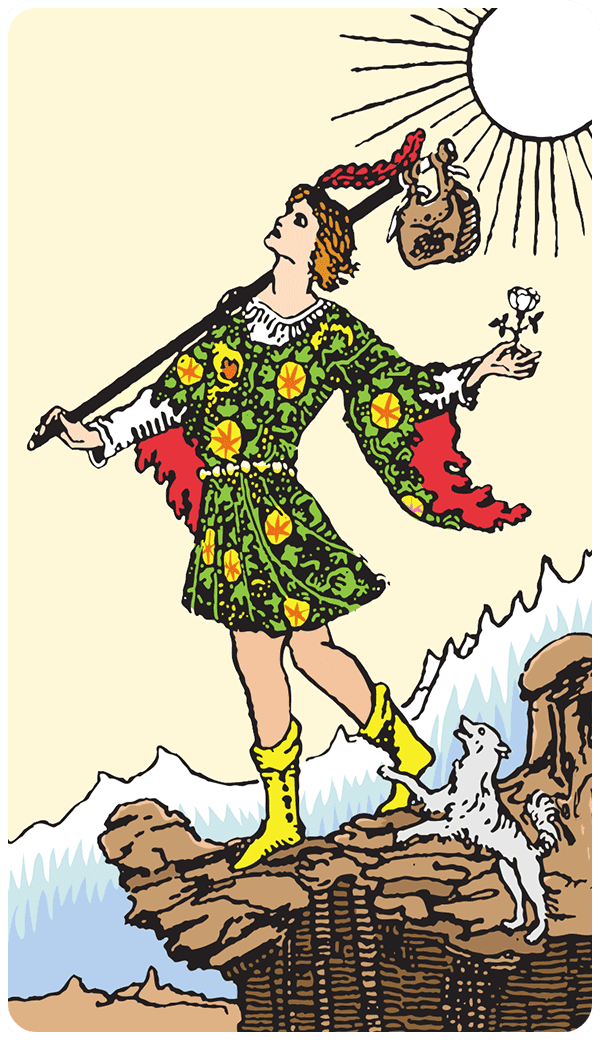
The Fool · plate 0
What the card is actually doing
The Fool shows up in a love reading and the querent smiles. They want me to tell them it means a fresh start, a new person, the beginning of something real. That is not what the card is saying. The Fool does not describe a relationship forming. It describes the moment before you know what you're walking into — the moment you step forward anyway, with no map and no guarantees. The card names the state of being open, not the arrival of someone worth opening for.
Reading The Fool in love
What the Major Arcana rank and the image are doing
The Fool is Major Arcana zero. It sits outside the sequence. It is not a stage of development; it is the recurring condition that makes development possible. Every Major Arcana card describes a psychological threshold or archetypal encounter. The Fool is the threshold of not-knowing. It is the moment you act without enough information, without a plan, without certainty that the ground will hold.
Look at the image. A figure steps toward a cliff edge, eyes on the sky, carrying a small bag. A dog barks at their heels — some versions show it as warning, others as companion. The figure is not falling. They have not jumped. They are in the instant before consequence, when the step is still voluntary and the outcome is still unknown. This is what the card describes: the choice to move forward while the variables are still open.
In a love reading, people want the Fool to mean "new love is beginning." What it actually means is "you are willing to not-know again." The misreading happens because openness feels like readiness, and readiness feels like arrival is imminent. But the card does not promise anyone is coming. It names the interior state that makes connection possible if someone does.
How the card reads differently depending on what the querent is actually asking
If the querent is recently single and asking when they'll meet someone, the Fool describes the moment they stop requiring the next person to make sense before they'll consider them. They're willing to go to the party. They're willing to swipe without a full risk assessment. The card is not confirming someone is on the calendar. It's confirming the door is no longer locked from the inside.
If the querent is in a long-term relationship and asking about the future, the Fool describes a different openness: the willingness to not-know what the relationship will become. They're considering a move, a marriage, a separation, a rekindling — and the card says they've stopped needing to control the outcome before they'll allow the conversation. This is not the same as recklessness. It's the opposite of the closed loop where you only act once you've guaranteed safety.
Reversed, the Fool often shows up when someone is performing openness but has already decided the answer. They're swiping but pre-disqualifying everyone. They're saying yes to dates but armoring through them. The cliff-step has become a gesture, not a real risk.
The tell that someone is misreading the card on themselves
The tell is this: they're waiting for the Fool to prove itself correct by delivering a person. They check their phone more. They read arrival into every small signal. When nothing materializes in two weeks, they decide the card was wrong. What they miss is that the card already described what happened — they became available again, even briefly. The Fool does not guarantee you'll meet someone. It names the moment you're no longer refusing to.
From the practice
“A card never tells you what to do. It tells you what you're already deciding — and gives you the words to name it.”
A grounded observation
Go back through your calendar and look for the week you stopped needing to know how it would go before you'd let it start. That's the Fool. What happened after that is a different card.
Key themes to watch for
- № 01Theme
Vulnerability
- № 02Theme
New chapters
- № 03Theme
Emotional truth
What to do with this reading
Read the upright meaning first, even if you pulled the card reversed. The reversal is a commentary on the upright — not a separate card.
Notice what your body did when you saw The Fool. That reaction is usually closer to the truth than the interpretation.
Write down one sentence: What is this card asking me to stop avoiding? Let the answer be smaller than you expect.
Come back to this card in 48 hours. Most love readings sharpen with a little distance.
Questions answered
Frequently asked
In the realm of romance, The Fool suggests an exciting new chapter, where possibilities seem endless. Whether single or attached, there’s a sense of freedom and spontaneity in your love life. This card invites you to experience relationships with a fresh perspective, perhaps unburdened by past expectations. It could be a time to explore connections with an open heart, embracing the joy and unpredictability of love. How does it feel to trust in the moment, letting curiosity guide your interactions?
Reversed in love, The Fool hints at caution, suggesting that you may be holding back or feeling unsure about taking a step forward. Perhaps past experiences have made you wary, or fear of vulnerability restrains you. This card asks you to reflect on what might be preventing you from fully engaging with the present moment. Are there assumptions or fears that need untangling? What might change if you allowed yourself to approach love with a touch more openness?
The Fool colors the cards around it. Pay attention to where its themes — archetype, pattern, invitation — show up in the next card. That is usually where the story is.
Tarot is observational, not predictive. The Fool describes the conditions in front of you right now and where they tend to lead if nothing changes — not a guarantee of timing.
Repeat cards are the deck underlining a theme. With The Fool, that usually means the question you are asking is the right one — but you have not yet acted on what the card is showing you.
Read next
Related readings
Other The Fool readings