The Fool in General
The Fool gets read as 'take a leap of faith.' What it actually names is the moment before you've committed to a story about what you're doing.
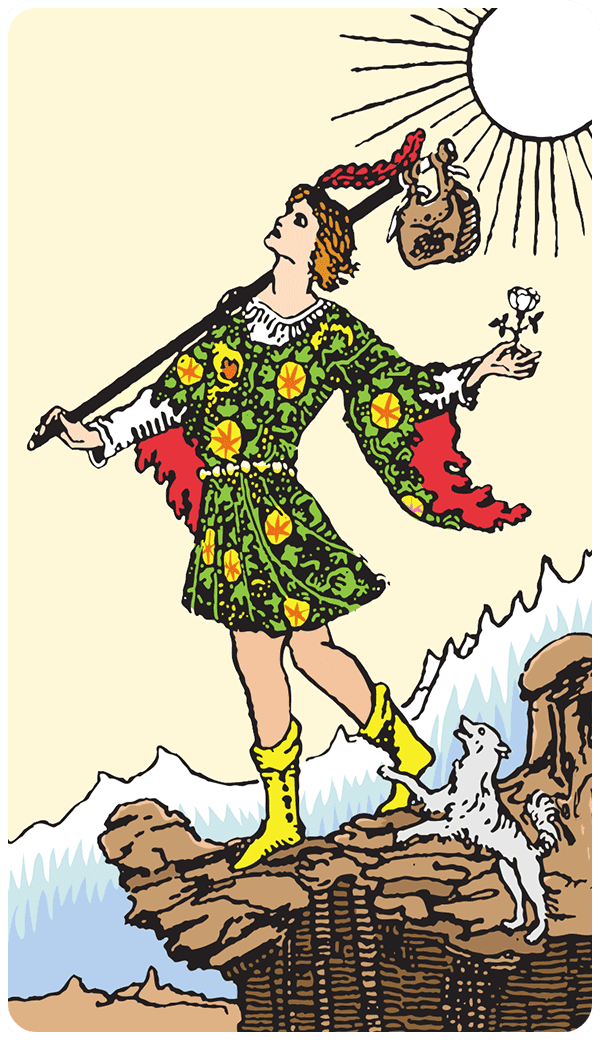
The Fool · plate 0
What the card is actually doing
The Fool shows up in a general reading and most people read it as permission. Permission to quit the job, book the flight, say the thing they've been rehearsing. They want the card to mean: go ahead, the universe has your back. That is not what the card is doing. The Fool does not give permission and it does not promise safety. It describes a specific psychological state — the moment before you've committed to a story about what you're doing — and that state has nothing to do with whether the action is wise.
Reading The Fool in general
What the rank, the position, and the image are each doing
The Fool is numbered zero in the Major Arcana, which means it sits outside the developmental sequence that runs from The Magician through The World. Zero is the unmarked state. It is not innocence and it is not ignorance. It is the moment before you've named what this is. Before you've decided whether you're being brave or reckless, spontaneous or irresponsible. The number tells you: no story has attached yet.
The Fool stands at the edge of a cliff, one foot suspended over open air. He is not looking down. A small dog jumps at his heels — some readings call it a warning, but look at the dog's posture. It is playful, not alarmed. The Fool carries a bindle, nearly empty. The sun rises behind him. What matters here is not whether he steps forward. What matters is that in this moment, he has not yet made stepping forward mean something. He has not yet decided this is the beginning of an adventure or the beginning of a mistake. The cliff is just a cliff. The step is just a step.
The most common misreading treats The Fool as advice: be spontaneous, trust your instincts, take the leap. But the card does not advocate for action. It describes a state you are already in or about to enter. If The Fool appears in a reading about whether to leave your job, it is not saying yes, leave. It is saying: you are in the part where you haven't committed to the narrative yet. You are still in the open question. What you do with that openness is not on the card.
How the card reads for two different situations
For someone who is naturally cautious, The Fool shows up when they have briefly stepped outside their usual risk calculus. They said yes to the dinner without checking their budget first. They bought the ticket before they figured out the logistics. The card is not celebrating this or condemning it. It is naming it. You are in unmarked territory right now. You have not yet made this mean you're being foolish or finally living. The story comes later.
For someone who moves fast by default, The Fool often appears when they are about to do the thing they always do — leap, decide, commit — but this time without the performance of confidence. No narrative about being bold. No Instagram caption half-written in their head. Just the step. The card marks the difference between I am taking a risk (a story) and the moment before you've named it as a risk at all.
The tell that someone is misreading the card on themselves
If you pull The Fool and immediately feel permission, you are misreading it. If the card makes you feel like you now have cosmic backing for the thing you were already going to do, you have added a story the card is not carrying. The Fool does not endorse. It does not warn. It points to the state you are in: the moment before the story locks. If you are using the card to justify the leap, you are no longer in the state the card describes. You have already left zero and entered one.
From the practice
“A card never tells you what to do. It tells you what you're already deciding — and gives you the words to name it.”
A grounded observation
Go back through your calendar and look for the last time you did something without deciding in advance whether it was smart. That small window — after the action, before the story — is what the card is pointing at.
Key themes to watch for
- № 01Theme
Beginnings
- № 02Theme
Inner movement
- № 03Theme
Receptivity
What to do with this reading
Read the upright meaning first, even if you pulled the card reversed. The reversal is a commentary on the upright — not a separate card.
Notice what your body did when you saw The Fool. That reaction is usually closer to the truth than the interpretation.
Write down one sentence: What is this card asking me to stop avoiding? Let the answer be smaller than you expect.
Come back to this card in 48 hours. Most general readings sharpen with a little distance.
Questions answered
Frequently asked
The Fool dances on the edge of a new beginning, painting the world with fresh eyes. This card brings a sense of adventure and possibility, as if anything could happen. It’s a moment to embrace new experiences without the usual safety nets. Perhaps you're on the brink of a significant change, ready to leap into the unknown. Consider how it feels to be at the start of something, where curiosity and a little risk-taking could lead you. What might you discover if you lean into this sense of openness and wonder?
When The Fool turns upside down, it suggests hesitation at the precipice of change. This isn’t about recklessness, but rather an uncertainty that might keep you stuck. Are you holding back due to fear of the unknown? The reversed Fool whispers of opportunities missed or delayed by caution or doubt. It’s a gentle nudge to examine what’s anchoring you to the familiar. What if you allowed yourself to explore without overthinking each step? How might that shift the path ahead?
The Fool colors the cards around it. Pay attention to where its themes — archetype, pattern, invitation — show up in the next card. That is usually where the story is.
Tarot is observational, not predictive. The Fool describes the conditions in front of you right now and where they tend to lead if nothing changes — not a guarantee of timing.
Repeat cards are the deck underlining a theme. With The Fool, that usually means the question you are asking is the right one — but you have not yet acted on what the card is showing you.
Read next
Related readings
Other The Fool readings
- Love & RelationshipsThe Fool read for love & relationships.
- Career & WorkThe Fool read for career & work.
- Money & FinanceThe Fool read for money & finance.
- Health & WellbeingThe Fool read for health & wellbeing.
- SpiritualityThe Fool read for spirituality.
- Yes / No AnswerThe Fool read for yes / no answer.