Six of Wands in Health
The Six of Wands in a health reading gets read as 'you're winning the battle.' What it actually describes is validation after effort — and the specific risk that creates.
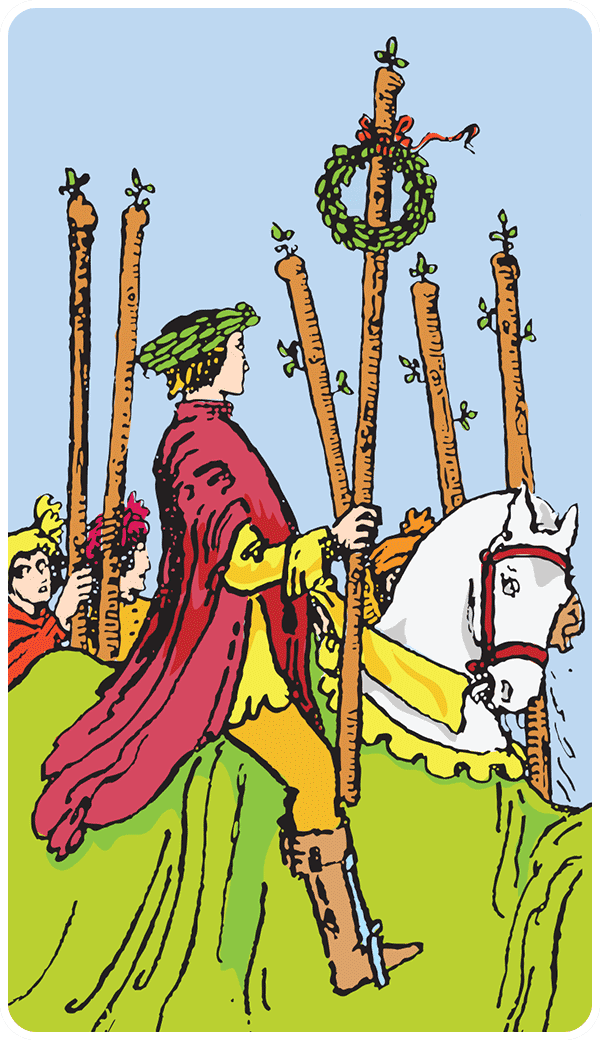
Six of Wands · plate 6
What the card is actually doing
The Six of Wands shows up in a health reading and the querent hears 'recovery' or 'victory over illness.' They want the card to mean the hard part is over. That is not what the card is describing. The Six of Wands is a recognition card, not a resolution card. It marks the moment other people see the effort you've been putting in — the weight you lost, the pain that finally let up, the bloodwork that came back clean. The card names public validation, not private healing. And the gap between those two things is where the misreading happens.
Reading Six of Wands in health
What the suit, the rank, and the image are doing
Wands is the suit of energy, willpower, and the part of you that initiates action. It governs how much fuel you have, how you spend it, and whether you're moving toward something or just burning. In a health context, Wands cards describe your vitality level, your relationship to effort, and the stories you tell yourself about what your body should be capable of.
Sixes in tarot describe equilibrium after struggle. They are not triumph cards. They are 'the thing has stabilized enough that you can take a breath' cards. The Four was the rest. The Five was the fight. The Six is the moment you can stand up again and other people notice you're standing.
Look at the image. A figure on horseback, holding a wand with a laurel wreath, surrounded by a crowd. The crowd is cheering. The figure is elevated. They are being seen. The card is not describing what the body feels like in private. It is describing what happens when the effort becomes legible to witnesses. This is the mechanical answer. The Six of Wands is the moment your health progress gets recognized — by a doctor, by your family, by the scale, by the mirror. The recognition feels like proof. That feeling is the risk.
How it reads for two different situations
If you're coming out of a long recovery — surgery, chronic pain flare, depressive episode — the Six of Wands describes the week people stop asking how you're doing in that worried voice. You went back to work. You showed up to the dinner. You posted a photo where you look like yourself again. The validation is real. The risk is that you take the validation as permission to push harder than your body is actually ready for. The crowd doesn't see what it costs you to stay upright.
If you're in the middle of a fitness or weight loss effort, the Six of Wands is the compliment. The point where someone says 'you look great' or 'I can really see the difference.' The card is not saying the goal is reached. It is saying the effort has become visible. What tends to happen next is the querent either doubles down to keep the validation coming or they ease off because the external proof made the internal motivation feel less urgent. Both are misreadings. The card is describing a moment, not an instruction.
The tell that you're misreading it
You're misreading the Six of Wands if you take it as a finish line. If the card shows up and you hear 'I can stop being careful now' or 'I've earned the right to coast,' you are confusing recognition with completion. The other tell: if you find yourself performing health — posting the gym selfie, narrating the meal prep, turning recovery into content — because the validation became the point. The Six of Wands describes the moment the audience arrives. It does not describe what happens when you're alone with your body again.
From the practice
“A card never tells you what to do. It tells you what you're already deciding — and gives you the words to name it.”
A grounded observation
Go back through your calendar and look for the day someone first said 'you seem better' or 'you look good.' Notice what you did the week after. That's the card.
Key themes to watch for
- № 01Theme
Emotional renewal
- № 02Theme
Mind-body link
- № 03Theme
Soft restoration
What to do with this reading
Read the upright meaning first, even if you pulled the card reversed. The reversal is a commentary on the upright — not a separate card.
Notice what your body did when you saw Six of Wands. That reaction is usually closer to the truth than the interpretation.
Write down one sentence: What is this card asking me to stop avoiding? Let the answer be smaller than you expect.
Come back to this card in 48 hours. Most health readings sharpen with a little distance.
Questions answered
Frequently asked
In terms of health, the Six of Wands symbolizes a period of vitality and progress. Perhaps you've achieved a fitness goal or have made strides in improving your well-being. It's a time to celebrate these victories and acknowledge the effort behind them. The card encourages you to continue nurturing your health with the same dedication. As you enjoy this state of well-being, what practices can you commit to maintaining this balance?
The reversed Six of Wands may point to health setbacks or a lack of progress. You might feel frustrated with your current state or efforts that seem unrecognized. It's an invitation to reassess your health routines and goals. Consider where adjustments might bring better results. What small change could reignite your commitment to wellness?
Six of Wands colors the cards around it. Pay attention to where its themes — creative momentum, will and appetite, the spark that wants to be tended — show up in the next card. That is usually where the story is.
Tarot is observational, not predictive. Six of Wands describes the conditions in front of you right now and where they tend to lead if nothing changes — not a guarantee of timing.
Repeat cards are the deck underlining a theme. With Six of Wands, that usually means the question you are asking is the right one — but you have not yet acted on what the card is showing you.
Read next
Related readings
More Wands · Health
- Ace of Wands — HealthHow Ace of Wands reads in a health context.
- Two of Wands — HealthHow Two of Wands reads in a health context.
- Three of Wands — HealthHow Three of Wands reads in a health context.
- Four of Wands — HealthHow Four of Wands reads in a health context.
- Five of Wands — HealthHow Five of Wands reads in a health context.
- Seven of Wands — HealthHow Seven of Wands reads in a health context.
Other Six of Wands readings
- General MeaningSix of Wands read for general meaning.
- Love & RelationshipsSix of Wands read for love & relationships.
- Career & WorkSix of Wands read for career & work.
- Money & FinanceSix of Wands read for money & finance.
- SpiritualitySix of Wands read for spirituality.
- Yes / No AnswerSix of Wands read for yes / no answer.