Four of Wands in Health
The Four of Wands in health readings gets read as 'you're healed' when it actually describes the conditions that allow recovery to stabilize — not the recovery itself.
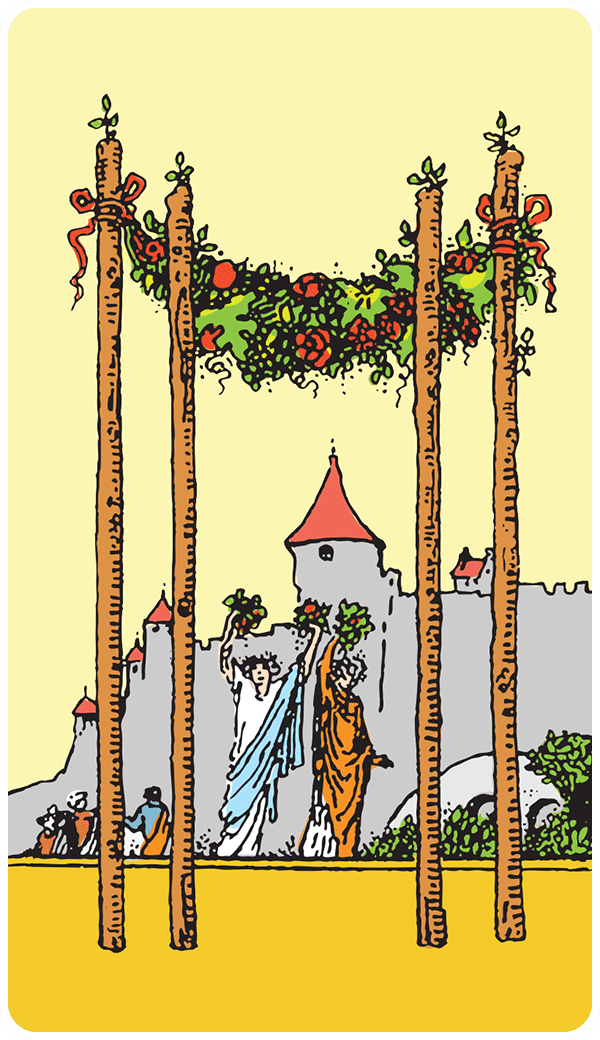
Four of Wands · plate 4
What the card is actually doing
The Four of Wands shows up in a health reading and people exhale. They read it as confirmation that the worst is over, that the body has turned a corner, that recovery is now guaranteed. I watch them relax into that interpretation and then get confused three weeks later when symptoms return or progress stalls. The card was not promising cure. It was describing the moment the support structure clicks into place — the conditions that make healing possible, not the healing itself.
Reading Four of Wands in health
What the suit, rank, and image are doing
Wands governs energy, vitality, the body's capacity to act and sustain effort. It is the suit of metabolic fire — how much charge you have available, how quickly you recover from exertion, whether your system runs hot or burns out. When Wands cards appear in health readings, the question being asked is almost always about stamina, momentum, or whether the body has enough fuel to do what's being asked of it.
Fours in tarot describe structure that holds. The Four of Pentacles is material security that locks in place. The Four of Cups is emotional withdrawal that stabilizes into a pattern. Fours are not breakthroughs; they are the pause after the initial push, the moment something stops moving and becomes a platform. They describe consolidation, not acceleration.
The image shows four wands planted in the ground, forming a canopy. Two figures stand beneath it, arms raised. A garland hangs between the wands. The structure is decorative but functional — it marks a boundary, it creates shelter, it holds space. The figures are celebrating, but they are celebrating the structure itself, not what comes after. This is the mechanical answer: the Four of Wands describes the conditions that allow recovery to stabilize. The diagnosis is clear. The treatment plan is working. The support system is in place. What happens next depends on what you do within that structure.
How the card reads for two different situations
For someone early in a health crisis — new diagnosis, acute injury, sudden symptom onset — the Four of Wands reads as the moment the chaos resolves into a plan. The doctors agree. The medication is working. The pain is managed. You are not cured, but you are no longer drowning. The card names the relief of having a container around the problem.
For someone in long-term recovery or chronic illness management, the card reads differently. It describes the week or month when everything finally clicks — sleep is regular, symptoms are predictable, you know what aggravates the condition and what doesn't. The structure is behavioral, not medical. You have built the routine that keeps you stable. The Four of Wands is not the cure; it is the life you have organized around the condition that now works.
The tell that someone is misreading it
The misreading sounds like this: "The Four of Wands showed up, so I can stop worrying." They interpret the card as permission to stop doing the thing that stabilized them — they skip physical therapy, they stop tracking symptoms, they assume the body will now take care of itself. Two weeks later, they backslide. The card was not saying the work is done. It was saying the structure is holding, which means now is when you stay inside it.
From the practice
“A card never tells you what to do. It tells you what you're already deciding — and gives you the words to name it.”
A grounded observation
Go back through your calendar and look for the week when the symptoms stopped feeling random. That is what the Four of Wands describes — not the cure, but the point when you finally knew what you were working with.
Key themes to watch for
- № 01Theme
Emotional renewal
- № 02Theme
Mind-body link
- № 03Theme
Soft restoration
What to do with this reading
Read the upright meaning first, even if you pulled the card reversed. The reversal is a commentary on the upright — not a separate card.
Notice what your body did when you saw Four of Wands. That reaction is usually closer to the truth than the interpretation.
Write down one sentence: What is this card asking me to stop avoiding? Let the answer be smaller than you expect.
Come back to this card in 48 hours. Most health readings sharpen with a little distance.
Questions answered
Frequently asked
The Four of Wands in health suggests a time of recovery or a return to balance, like the first deep breath after a cold. You might feel a renewed sense of energy or a resolution to a previous health issue. This card invites you to appreciate your body's resilience and the small victories along your health journey. Notice how this period of well-being can inspire further healthy habits and routines.
Reversed, the Four of Wands may indicate a disruption in your health routine, like missing a step in a familiar dance. There could be setbacks or new challenges that require attention. This isn't necessarily a major issue but rather a nudge to recalibrate and find what might be out of sync. Reflect on what adjustments or support could help you regain a sense of well-being.
Four of Wands colors the cards around it. Pay attention to where its themes — creative momentum, will and appetite, the spark that wants to be tended — show up in the next card. That is usually where the story is.
Tarot is observational, not predictive. Four of Wands describes the conditions in front of you right now and where they tend to lead if nothing changes — not a guarantee of timing.
Repeat cards are the deck underlining a theme. With Four of Wands, that usually means the question you are asking is the right one — but you have not yet acted on what the card is showing you.
Read next
Related readings
More Wands · Health
- Ace of Wands — HealthHow Ace of Wands reads in a health context.
- Two of Wands — HealthHow Two of Wands reads in a health context.
- Three of Wands — HealthHow Three of Wands reads in a health context.
- Five of Wands — HealthHow Five of Wands reads in a health context.
- Six of Wands — HealthHow Six of Wands reads in a health context.
- Seven of Wands — HealthHow Seven of Wands reads in a health context.
Other Four of Wands readings
- General MeaningFour of Wands read for general meaning.
- Love & RelationshipsFour of Wands read for love & relationships.
- Career & WorkFour of Wands read for career & work.
- Money & FinanceFour of Wands read for money & finance.
- SpiritualityFour of Wands read for spirituality.
- Yes / No AnswerFour of Wands read for yes / no answer.