Six of Pentacles in Love
The Six of Pentacles in love reads as generosity, but what it's actually naming is imbalance. Here's what the card is doing when one person holds the scales.
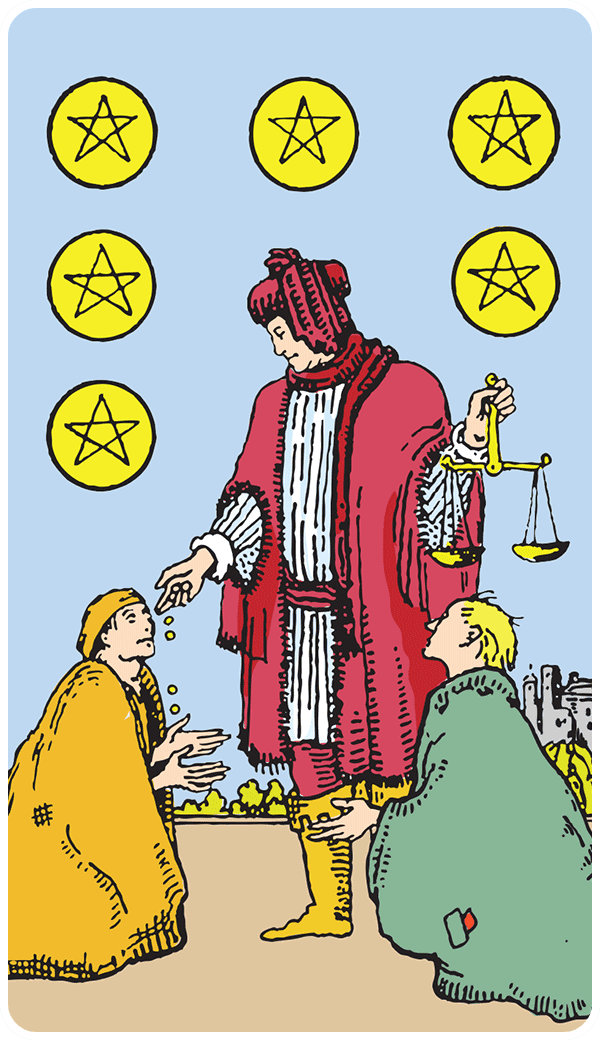
Six of Pentacles · plate 6
What the card is actually doing
The Six of Pentacles shows up in a love reading and people read it as kindness. Someone is generous. Someone is giving. The relationship feels warm and supportive. That is the pleasant reading, and it misses the mechanism entirely. What the card is actually naming is imbalance — one person is the giver, one person is the receiver, and the structure of the relationship now depends on that arrangement staying fixed.
Reading Six of Pentacles in love
What the suit, the rank, and the image are each doing
Pentacles governs resources, material exchange, and what gets measured. In a love reading, Pentacles cards describe the logistical and transactional layer of intimacy — who pays for dinner, who drives, who remembers to book the hotel, who gives more time or attention or effort than they get back. When Pentacles shows up in a relationship question, the heart might be involved, but the card is pointing at the mechanics underneath.
Sixes in tarot describe a temporary equilibrium. Not balance — equilibrium. Something has settled into a working arrangement. The arrangement might be functional, but it is not equal, and it is not permanent. Sixes feel stable until the thing that was being managed stops being manageable.
Now look at the image. A wealthy figure stands above two beggars, holding a scale in one hand and distributing coins with the other. The beggars kneel. The giver is elevated. The scale is balanced, but only because the giver is the one holding it. This is not partnership. This is patronage. One person has the power to give or withhold. The other person has learned to ask nicely.
The most common misreading in love is to see this card and think it means the relationship is generous and therefore healthy. It does not. It means someone is keeping score, someone is performing gratitude, and the person doing the giving gets to feel virtuous while the person receiving gets to feel small.
How the card reads differently depending on who is asking
If you are the giver — the one who pays, plans, remembers, initiates, apologizes first, makes it easy — the Six of Pentacles is naming the fact that you have built a relationship where your generosity is now the load-bearing structure. You are not giving freely. You are giving because if you stop, the whole thing collapses. The card is not praising you. It is asking you to notice that you have made yourself indispensable and called it love.
If you are the receiver — the one who has gotten used to someone else handling it, someone else showing up, someone else absorbing the effort — the card is naming the fact that you have accepted a dependent position and started to resent the person you depend on. You didn't ask for this arrangement, but you also haven't refused it, and now the dynamic is set.
Reversed, the card often shows up when the giver has stopped giving or the receiver has stopped performing gratitude. The scale tips. The person who was holding it lets go. What looked like generosity reveals itself as control. What looked like gratitude reveals itself as performance. The relationship has to renegotiate or end.
The tell that you are misreading the card on yourself
You are misreading the Six of Pentacles if you see it and feel relieved. If your first thought is "see, I am generous" or "see, they take care of me," you are not looking at what the card is actually describing. Go back through the last six months of the relationship and count who initiated the last ten conversations. Who apologized last. Who paid. Who remembered the birthday. Who drove. If the same person shows up in eight of those ten, the Six of Pentacles is not describing a loving relationship. It is describing a hierarchy that both of you have agreed not to name.
From the practice
“A card never tells you what to do. It tells you what you're already deciding — and gives you the words to name it.”
A grounded observation
The card is not wrong when it shows up. The imbalance it names is real. The question is whether you are willing to see it or whether you need to keep calling it love.
Key themes to watch for
- № 01Theme
Vulnerability
- № 02Theme
New chapters
- № 03Theme
Emotional truth
What to do with this reading
Read the upright meaning first, even if you pulled the card reversed. The reversal is a commentary on the upright — not a separate card.
Notice what your body did when you saw Six of Pentacles. That reaction is usually closer to the truth than the interpretation.
Write down one sentence: What is this card asking me to stop avoiding? Let the answer be smaller than you expect.
Come back to this card in 48 hours. Most love readings sharpen with a little distance.
Questions answered
Frequently asked
In love, the Six of Pentacles brings a theme of mutual support and sharing. Imagine a partnership where both parties are generous with their time, affection, and understanding. This card suggests looking at how you and your partner balance giving and receiving, and whether you feel the scales are evened out. It’s a gentle nudge to appreciate the acts of kindness you both bring into the relationship. Explore how giving and receiving love can become a nurturing cycle, strengthening your bond and promoting growth.
Reversed, the Six of Pentacles in love might indicate an imbalance. One partner may feel they're investing more without reciprocity, or there could be an undercurrent of expectation tied to acts of kindness. Reflect on whether the relationship feels equitable, and what expectations may be unspoken yet felt. This card invites you to be honest about the give-and-take dynamics in your relationship, and how they affect your emotional connection. Awareness of these patterns can open the door to healthier communication.
Six of Pentacles colors the cards around it. Pay attention to where its themes — embodiment, material follow-through, the slow build of resource — show up in the next card. That is usually where the story is.
Tarot is observational, not predictive. Six of Pentacles describes the conditions in front of you right now and where they tend to lead if nothing changes — not a guarantee of timing.
Repeat cards are the deck underlining a theme. With Six of Pentacles, that usually means the question you are asking is the right one — but you have not yet acted on what the card is showing you.
Read next
Related readings
More Pentacles · Love
- Ace of Pentacles — LoveHow Ace of Pentacles reads in a love context.
- Two of Pentacles — LoveHow Two of Pentacles reads in a love context.
- Three of Pentacles — LoveHow Three of Pentacles reads in a love context.
- Four of Pentacles — LoveHow Four of Pentacles reads in a love context.
- Five of Pentacles — LoveHow Five of Pentacles reads in a love context.
- Seven of Pentacles — LoveHow Seven of Pentacles reads in a love context.
Other Six of Pentacles readings
- General MeaningSix of Pentacles read for general meaning.
- Career & WorkSix of Pentacles read for career & work.
- Money & FinanceSix of Pentacles read for money & finance.
- Health & WellbeingSix of Pentacles read for health & wellbeing.
- SpiritualitySix of Pentacles read for spirituality.
- Yes / No AnswerSix of Pentacles read for yes / no answer.