Four of Pentacles in Love
The Four of Pentacles in love isn't about commitment—it's about control dressed up as protection. Here's what the card is actually naming.
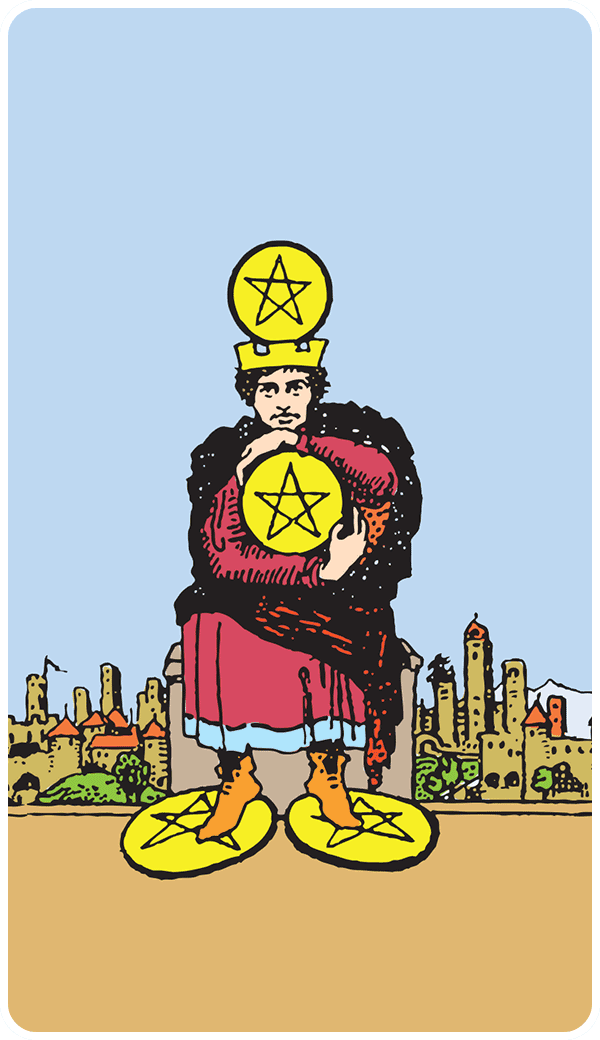
Four of Pentacles · plate 4
What the card is actually doing
The Four of Pentacles shows up in a love reading and the querent usually reads it as a good sign. They think it means they're being careful, protecting themselves, setting healthy boundaries after getting hurt. They think it means they're finally being smart about who they let in. That is not what the card is describing. The Four of Pentacles names the moment you stop letting anything move. You are not protecting the relationship. You are holding it so tightly that nothing can grow inside it.
Reading Four of Pentacles in love
What the suit, the rank, and the image are doing
Pentacles is the material suit—resources, security, what you can touch and measure. In a love reading, it governs how you handle the tangible parts of intimacy: time, access, vulnerability as something you portion out or withhold. When Pentacles cards show up in relationship questions, the issue is almost always about what you think you own versus what actually needs to circulate.
Fours in tarot are stabilization points. They describe the moment a structure locks into place. The Four of Wands is celebration inside a stable frame. The Four of Swords is rest inside enforced stillness. The Four of Pentacles is security achieved through grip. The structure is holding, but nothing is moving.
Now look at the image. A figure sits on a stone block in a city, clutching a pentacle to their chest. One pentacle is under each foot. A fourth pentacle sits balanced on their head like a crown. They are surrounded by wealth, but their body is closed. Their arms are locked. They are not using what they have. They are guarding it. The posture reads as defense, not ease.
The most common misreading in love is that this card describes healthy self-protection after being hurt. The querent sees the guarded posture and thinks: I'm being careful now. I'm not giving too much too soon. I learned my lesson. But the card is not praising caution. It is naming the moment caution turned into hoarding. You are not protecting yourself. You are refusing to let the other person in, and calling that boundary-setting.
How this reads for two different querent situations
If you are the one holding tight, the Four of Pentacles describes what you are doing to the relationship without meaning to. You ration affection. You keep score. You give access in measured doses and then withdraw when you feel exposed. You think you are being strategic, but what you are actually doing is making the other person perform for crumbs. The relationship cannot deepen because you will not let it. You mistake control for safety.
If you are on the receiving end, the Four of Pentacles describes what it feels like to love someone who will not let go of their grip. You are always auditioning. You can feel them calculating—how much to give, how much to risk, whether you have earned the next level of access. There is no ease. Every moment of closeness is followed by a pullback. You are not in a relationship. You are in a transaction where the terms keep changing.
The tell that someone is misreading this card on themselves
The tell is when the querent says I'm just being careful and then lists all the ways the other person has not yet earned their trust. They frame it as discernment, but what they are actually describing is a system where no amount of consistency will ever be enough. They have built a fortress and called it a boundary. The Four of Pentacles is not warning you to protect yourself. It is naming the fact that you already are, and the protection has become the problem.
From the practice
“A card never tells you what to do. It tells you what you're already deciding — and gives you the words to name it.”
A grounded observation
Go back through your last three conversations with the person you are thinking about. Count how many times you said yes to something without a hedge, a condition, or a mental escape route. If the number is zero, you have your answer.
Key themes to watch for
- № 01Theme
Vulnerability
- № 02Theme
New chapters
- № 03Theme
Emotional truth
What to do with this reading
Read the upright meaning first, even if you pulled the card reversed. The reversal is a commentary on the upright — not a separate card.
Notice what your body did when you saw Four of Pentacles. That reaction is usually closer to the truth than the interpretation.
Write down one sentence: What is this card asking me to stop avoiding? Let the answer be smaller than you expect.
Come back to this card in 48 hours. Most love readings sharpen with a little distance.
Questions answered
Frequently asked
In the realm of love, the Four of Pentacles upright suggests a tendency to hold onto relationships or feelings out of fear of loss. Imagine a couple clinging to past grievances, afraid to let go. This card invites you to examine if you're holding onto a relationship or emotion too tightly, perhaps out of fear of vulnerability. Are you guarding your heart so fiercely that it's hard to truly connect? Reflect on how allowing a little space might nurture a healthier bond.
Reversed in love, this card suggests a release from old patterns or relationships. It’s like finally letting go of a past hurt and feeling lighter. This change can be freeing but also daunting, as you navigate what comes next. Consider how this release might open you up to new experiences or deeper connections. Notice where you feel resistance to this shift and what that tells you about your emotional landscape.
Four of Pentacles colors the cards around it. Pay attention to where its themes — embodiment, material follow-through, the slow build of resource — show up in the next card. That is usually where the story is.
Tarot is observational, not predictive. Four of Pentacles describes the conditions in front of you right now and where they tend to lead if nothing changes — not a guarantee of timing.
Repeat cards are the deck underlining a theme. With Four of Pentacles, that usually means the question you are asking is the right one — but you have not yet acted on what the card is showing you.
Read next
Related readings
More Pentacles · Love
- Ace of Pentacles — LoveHow Ace of Pentacles reads in a love context.
- Two of Pentacles — LoveHow Two of Pentacles reads in a love context.
- Three of Pentacles — LoveHow Three of Pentacles reads in a love context.
- Five of Pentacles — LoveHow Five of Pentacles reads in a love context.
- Six of Pentacles — LoveHow Six of Pentacles reads in a love context.
- Seven of Pentacles — LoveHow Seven of Pentacles reads in a love context.
Other Four of Pentacles readings
- General MeaningFour of Pentacles read for general meaning.
- Career & WorkFour of Pentacles read for career & work.
- Money & FinanceFour of Pentacles read for money & finance.
- Health & WellbeingFour of Pentacles read for health & wellbeing.
- SpiritualityFour of Pentacles read for spirituality.
- Yes / No AnswerFour of Pentacles read for yes / no answer.