Six of Pentacles in Money
The Six of Pentacles in finance readings gets read as 'money is coming.' What it actually describes is the power position in an unequal exchange.
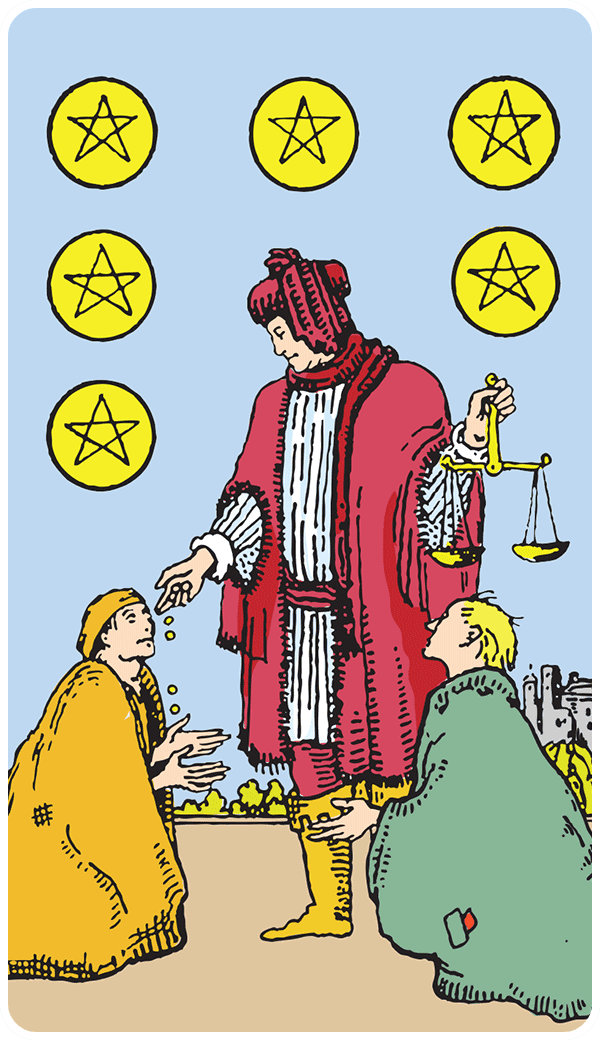
Six of Pentacles · plate 6
What the card is actually doing
The Six of Pentacles shows up in a money reading and the querent exhales. They think it means help is coming. A windfall. A loan approved. Someone stepping in to fix the problem. That is almost never what the card is describing. What the card is actually naming is the structure of the exchange itself — who has the resource, who needs it, and what position you occupy in that dynamic. The relief people feel when they see this card is often the thing that keeps them from reading it correctly.
Reading Six of Pentacles in money
What the card is structurally describing
Pentacles governs material resources — money, time, labor, anything with weight in the physical world. The Six, as a middle-rank card, describes a situation that is already in motion and relatively stable. It is not the beginning of something and it is not the resolution. It is the active state.
The image: a figure in fine clothes holds a set of scales in one hand. With the other hand, they distribute coins to two kneeling figures below them. The scales are balanced. The giver stands; the receivers kneel. This is not charity as a feeling. This is charity as a structure. Someone has the resource. Someone else needs it. The exchange is unequal by design, and the card is naming that inequality as the condition, not the problem to be solved.
The most common misreading in a finance context is to see the Six of Pentacles and assume you are about to receive. The card becomes a promise: help is on the way, the loan will go through, the raise is coming, someone will step in. But the card does not specify which figure you are. It does not promise the coins are moving toward you. It describes the fact that an unequal exchange is happening or about to happen, and you are somewhere inside it.
How the card reads for two different financial positions
If you are the one asking for help — applying for a loan, waiting on a grant, hoping a family member will cover rent — the Six of Pentacles confirms the dynamic you are already in. You are in the receiving position. The card is not saying the money will arrive. It is saying you are structurally dependent on someone else's decision, and that dependence is the reality you are navigating. The question the card is actually asking you is: what does it cost you to be in this position? What are you agreeing to by kneeling?
If you are the one with the resource — considering whether to lend money, whether to cover someone's expense, whether to say yes to a request — the Six of Pentacles is naming the power you hold in this moment. You are the figure with the scales. The card is not telling you to give or not to give. It is pointing to the fact that your decision will shape the other person's options, and that you are aware of this. The question it is asking you is: what do you want in return, and are you being honest about that?
The tell that someone is misreading the card on themselves
The tell is relief without specifics. If you pull the Six of Pentacles in a finance reading and immediately feel better, but you cannot name who holds the resource or what the terms of the exchange are, you are misreading it. The card does not resolve financial stress. It describes the architecture of the stress. If you are waiting on money and this card shows up, the next question is not "when will it arrive" — it is "what am I agreeing to in order to receive it, and is that agreement one I can live with?"
From the practice
“A card never tells you what to do. It tells you what you're already deciding — and gives you the words to name it.”
A grounded observation
Go back through the last six months and look for the moments when you needed something and someone had the option to give it or not. Notice what you said yes to in order to stay in the room.
Key themes to watch for
- № 01Theme
Non-material wealth
- № 02Theme
Generosity
- № 03Theme
Values check
What to do with this reading
Read the upright meaning first, even if you pulled the card reversed. The reversal is a commentary on the upright — not a separate card.
Notice what your body did when you saw Six of Pentacles. That reaction is usually closer to the truth than the interpretation.
Write down one sentence: What is this card asking me to stop avoiding? Let the answer be smaller than you expect.
Come back to this card in 48 hours. Most money readings sharpen with a little distance.
Questions answered
Frequently asked
Financially, the Six of Pentacles suggests a time of giving and receiving help. Consider charitable acts, loans, or gifts as part of your financial landscape. It indicates a balance between helping others and ensuring your own needs are met. This card invites you to reflect on how generosity plays a role in your financial wellbeing, and how sharing can sometimes bring unexpected rewards.
Reversed, this card highlights potential financial imbalances. Perhaps there's a feeling of being taken advantage of, or debt is causing strain. It invites you to reassess your financial relationships and consider how balance can be restored. Reflect on whether your financial exchanges are fair and sustainable.
Six of Pentacles colors the cards around it. Pay attention to where its themes — embodiment, material follow-through, the slow build of resource — show up in the next card. That is usually where the story is.
Tarot is observational, not predictive. Six of Pentacles describes the conditions in front of you right now and where they tend to lead if nothing changes — not a guarantee of timing.
Repeat cards are the deck underlining a theme. With Six of Pentacles, that usually means the question you are asking is the right one — but you have not yet acted on what the card is showing you.
Read next
Related readings
More Pentacles · Money
- Ace of Pentacles — MoneyHow Ace of Pentacles reads in a money context.
- Two of Pentacles — MoneyHow Two of Pentacles reads in a money context.
- Three of Pentacles — MoneyHow Three of Pentacles reads in a money context.
- Four of Pentacles — MoneyHow Four of Pentacles reads in a money context.
- Five of Pentacles — MoneyHow Five of Pentacles reads in a money context.
- Seven of Pentacles — MoneyHow Seven of Pentacles reads in a money context.
Other Six of Pentacles readings
- General MeaningSix of Pentacles read for general meaning.
- Love & RelationshipsSix of Pentacles read for love & relationships.
- Career & WorkSix of Pentacles read for career & work.
- Health & WellbeingSix of Pentacles read for health & wellbeing.
- SpiritualitySix of Pentacles read for spirituality.
- Yes / No AnswerSix of Pentacles read for yes / no answer.