Five of Pentacles in Money
The Five of Pentacles in a money reading gets read as broke. What it actually names is the moment you stop asking for help because you've decided no one will give it.
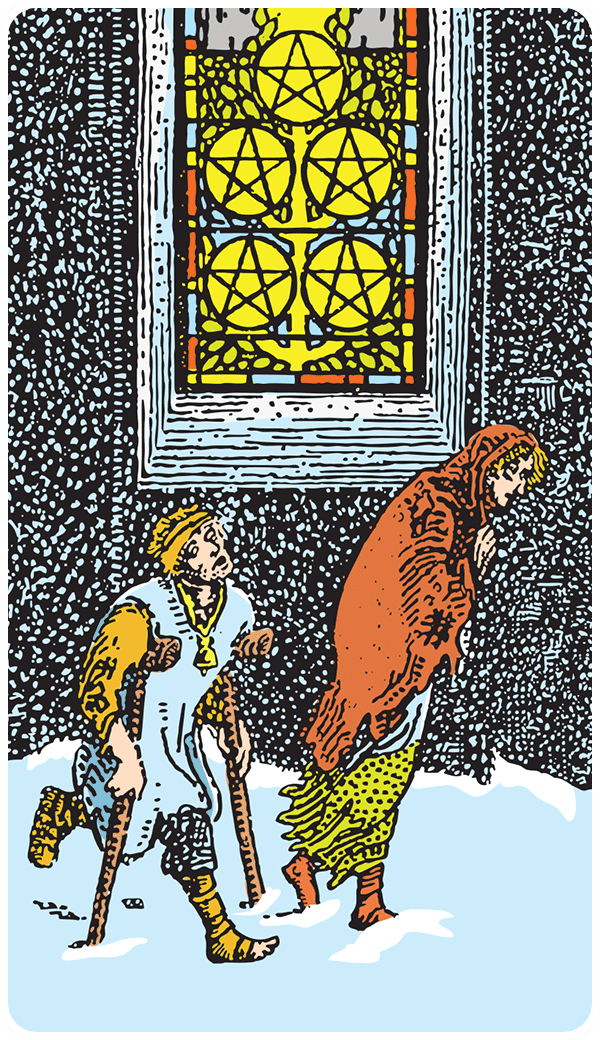
Five of Pentacles · plate 5
What the card is actually doing
The Five of Pentacles shows up in a finance reading and the querent assumes they're about to lose their job. Or that the card is confirming they're already broke. Or that money is leaving and there's nothing they can do about it. That's not what the card is doing. The Five of Pentacles does not predict bankruptcy. It names the psychological posture of someone who has decided they are outside the structure that could help them.
Reading Five of Pentacles in money
What the suit, the rank, and the image are each doing
Pentacles is the material suit. It governs money, work, physical resources, and the structures that distribute them — employers, banks, safety nets, family wealth, the apartment you can or cannot afford. When Pentacles cards dominate a reading, the question is almost always about survival logistics or the fear of not having enough.
Fives in tarot are friction cards. They describe the point where a system stops working smoothly. The Five of Wands is competing visions crashing into each other. The Five of Cups is loss that hasn't been processed. The Five of Pentacles is the moment you are outside the resource stream and you know it.
Now look at the image. Two figures walk through snow past a lit church window. They are injured, cold, poorly clothed. The church is right there. The door is presumably unlocked. They do not go in. This is the entire mechanical point of the card. The resource exists. The person in need is not accessing it. The question the card is asking is: why not?
The misreading: treating it as a prediction instead of a diagnosis
Most people read the Five of Pentacles as "I'm going to be broke" or "money is leaving." That flattens the card into a fortune-telling cliche and misses what it actually describes. The card is not saying money will vanish. It is naming a specific psychological state: the belief that you are locked out, that the help you need is unavailable to you, that asking is pointless because no one will say yes.
Here's what tends to happen when this card shows up. The querent has stopped applying for jobs they think they're unqualified for. They haven't asked their family for a loan because they've pre-decided the answer will be no. They're working a second shift instead of negotiating their salary because they assume their boss will refuse. The scarcity is real, but the card is pointing to the moment the querent removed themselves from the room where resources get distributed.
For someone in actual financial crisis — eviction-notice-on-the-door crisis — the card reads differently. It's not about pride or self-exile. It's about being structurally outside the safety net, and the card becomes a mirror: this is what it looks like when the systems that are supposed to catch you don't. In that case, the Five of Pentacles is diagnostic. It's naming what's true, not predicting what's coming.
The tell: you're treating "no" as a fact before you've asked
The clearest sign someone is misreading this card on themselves is when they say "I can't ask for that" and they haven't actually asked yet. They've decided in advance that the boss won't give them the raise, the friend won't lend them money, the institution won't approve the application. The Five of Pentacles describes the moment that pre-emptive "no" becomes the only reality you're willing to test.
Go back through your last two months. Count how many times you didn't apply, didn't ask, didn't reach out because you were certain it wouldn't work. That number is the card.
From the practice
“A card never tells you what to do. It tells you what you're already deciding — and gives you the words to name it.”
A grounded observation
The church window is lit. The door is not locked. The card is not saying you're broke. It's saying you're standing outside, and it wants you to notice that you're the one who decided not to go in.
Key themes to watch for
- № 01Theme
Non-material wealth
- № 02Theme
Generosity
- № 03Theme
Values check
What to do with this reading
Read the upright meaning first, even if you pulled the card reversed. The reversal is a commentary on the upright — not a separate card.
Notice what your body did when you saw Five of Pentacles. That reaction is usually closer to the truth than the interpretation.
Write down one sentence: What is this card asking me to stop avoiding? Let the answer be smaller than you expect.
Come back to this card in 48 hours. Most money readings sharpen with a little distance.
Questions answered
Frequently asked
The Five of Pentacles in finances can feel like a tight budget stretched to its limits. There may be concerns about meeting obligations or feeling left out of financial opportunities. It’s a stark reminder of the need for careful planning. Notice where you can make adjustments or seek advice to better manage this period. Remember that even in times of scarcity, resourcefulness can lead to surprising solutions.
Reversed, the Five of Pentacles suggests a slow improvement in your financial situation. It's as if the clouds are parting, allowing some light to shine through. You might find unexpected sources of support or small windfalls that help ease the pressure. Let this be a gentle reminder that financial recovery is possible, even if it comes in small steps.
Five of Pentacles colors the cards around it. Pay attention to where its themes — embodiment, material follow-through, the slow build of resource — show up in the next card. That is usually where the story is.
Tarot is observational, not predictive. Five of Pentacles describes the conditions in front of you right now and where they tend to lead if nothing changes — not a guarantee of timing.
Repeat cards are the deck underlining a theme. With Five of Pentacles, that usually means the question you are asking is the right one — but you have not yet acted on what the card is showing you.
Read next
Related readings
More Pentacles · Money
- Ace of Pentacles — MoneyHow Ace of Pentacles reads in a money context.
- Two of Pentacles — MoneyHow Two of Pentacles reads in a money context.
- Three of Pentacles — MoneyHow Three of Pentacles reads in a money context.
- Four of Pentacles — MoneyHow Four of Pentacles reads in a money context.
- Six of Pentacles — MoneyHow Six of Pentacles reads in a money context.
- Seven of Pentacles — MoneyHow Seven of Pentacles reads in a money context.
Other Five of Pentacles readings
- General MeaningFive of Pentacles read for general meaning.
- Love & RelationshipsFive of Pentacles read for love & relationships.
- Career & WorkFive of Pentacles read for career & work.
- Health & WellbeingFive of Pentacles read for health & wellbeing.
- SpiritualityFive of Pentacles read for spirituality.
- Yes / No AnswerFive of Pentacles read for yes / no answer.