Page of Wands in Money
The Page of Wands in a money reading gets read as entrepreneurial breakthrough. What it actually describes is the moment before you know if the idea works.
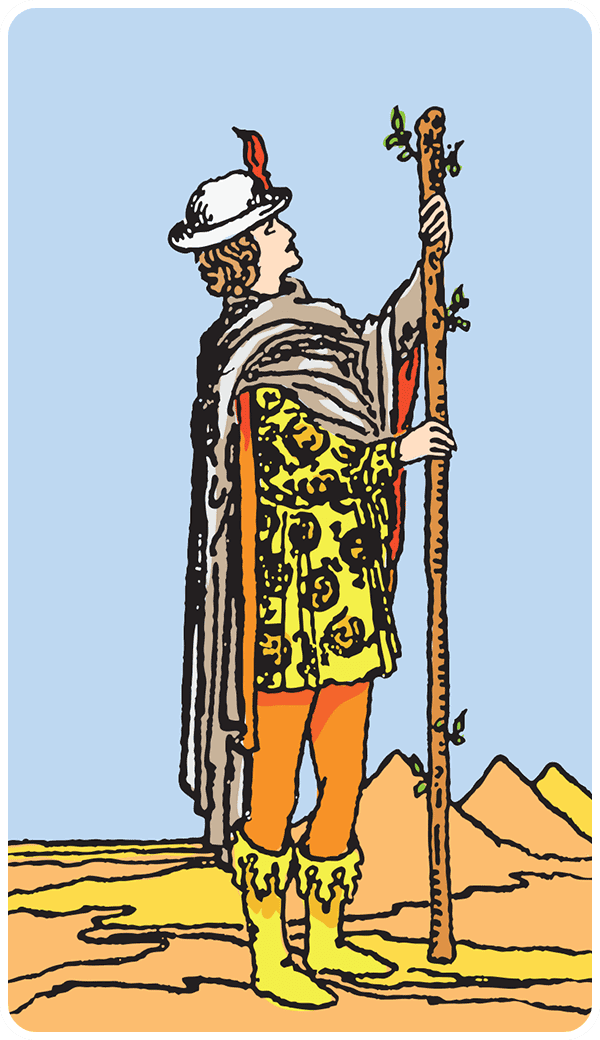
Page of Wands · plate page
What the card is actually doing
The Page of Wands shows up in a finance reading and people hear permission. Permission to quit the job, launch the side project, finally start the thing they've been sketching in notebooks for two years. The card feels like momentum, like the universe saying go. That is not what the card is describing. The Page of Wands is the moment you have an idea and enough energy to act on it. Whether the idea is sound, whether the market wants it, whether you have the skill to execute it — those are different questions, answered by different cards.
Reading Page of Wands in money
What the suit, the rank, and the image are doing
Wands is the suit of will, initiative, and creative fire. It governs the part of you that sees a possibility and wants to move toward it. In a finance reading, Wands cards describe your relationship to risk, to action, to the gap between wanting something and doing the work to get it. When Wands dominate a spread, the question is almost always about energy and direction, not about whether the money is there.
Pages are messengers and beginners. They are not mastery. They are not proof of concept. A Page is the moment you pick up the instrument, not the moment you book the gig. Pages describe early-stage energy — high on enthusiasm, low on track record. The Page of Wands specifically is the person who has just had the idea and is lit up by it, before reality has had a chance to edit.
Look at the image. A young figure holds a staff, staring at it like it just sprouted leaves. The desert stretches behind them. They are alone with the idea. No team, no infrastructure, no customers. The card is not describing a business; it is describing the moment before the business, when the vision feels so clear that execution seems like a formality.
The most common misreading in a finance context is treating this card as a green light. The querent sees the Page of Wands and hears "your idea will work." What the card is actually saying is "you have an idea and the energy to try it." Those are not the same sentence.
How the card reads for two different situations
If the querent already has stable income and is asking about a side project, the Page of Wands reads as accurate. You are in the earliest stage. You are testing. You do not yet know if this will scale, if anyone will pay for it, if you can sustain interest past the first three months. The card is naming that stage honestly. It is not telling you to quit your job. It is telling you that you are at the beginning, and the beginning is supposed to feel like this — exciting and unproven.
If the querent is asking whether to leave stable income to pursue the idea full-time, the Page of Wands is a warning card. It is describing the developmental stage of the idea, not the readiness of the idea. A Page-level project cannot carry your rent yet. It might never carry your rent. The card is not saying don't do it. The card is saying you are about to bet your material security on something that is still in the "just got the idea" phase. Make sure you know that.
The tell that someone is misreading the card on themselves
The tell is when the querent talks about the idea more than they talk about the work. When they describe the vision in detail but cannot name the first five operational steps. When they say "I just need to go all-in" but have not yet run a single small test. The Page of Wands mistake is mistaking the thrill of the idea for evidence that the idea is ready. Enthusiasm is not the same as a business plan. The card is naming the enthusiasm. It is not vouching for the plan.
From the practice
“A card never tells you what to do. It tells you what you're already deciding — and gives you the words to name it.”
A grounded observation
Go back through your calendar and look for the last time you had this much energy about a financial idea. Check what happened in the six months after. That pattern is the one the card is pointing to.
Key themes to watch for
- № 01Theme
Non-material wealth
- № 02Theme
Generosity
- № 03Theme
Values check
What to do with this reading
Read the upright meaning first, even if you pulled the card reversed. The reversal is a commentary on the upright — not a separate card.
Notice what your body did when you saw Page of Wands. That reaction is usually closer to the truth than the interpretation.
Write down one sentence: What is this card asking me to stop avoiding? Let the answer be smaller than you expect.
Come back to this card in 48 hours. Most money readings sharpen with a little distance.
Questions answered
Frequently asked
Financially, the Page of Wands suggests a period ripe for new opportunities and inventive approaches. There might be fresh ideas about how to manage or increase your resources. You're encouraged to think outside the box, perhaps exploring side projects or investments that excite you. While it's important to remain grounded, this card invites a sense of exploration and curiosity. What innovative financial paths or ideas are capturing your attention, and how might they contribute to your long-term stability?
Reversed, this card warns of impulsivity in financial matters. You might be tempted by risky ventures without fully considering the consequences. It's a reminder to take a step back and evaluate your financial decisions carefully. Reflect on whether your current actions align with your long-term financial goals. Are there areas where you might be acting hastily, and how can you bring more consideration into your financial planning?
Page of Wands colors the cards around it. Pay attention to where its themes — creative momentum, will and appetite, the spark that wants to be tended — show up in the next card. That is usually where the story is.
Tarot is observational, not predictive. Page of Wands describes the conditions in front of you right now and where they tend to lead if nothing changes — not a guarantee of timing.
Repeat cards are the deck underlining a theme. With Page of Wands, that usually means the question you are asking is the right one — but you have not yet acted on what the card is showing you.
Read next
Related readings
More Wands · Money
- Ace of Wands — MoneyHow Ace of Wands reads in a money context.
- Two of Wands — MoneyHow Two of Wands reads in a money context.
- Three of Wands — MoneyHow Three of Wands reads in a money context.
- Four of Wands — MoneyHow Four of Wands reads in a money context.
- Five of Wands — MoneyHow Five of Wands reads in a money context.
- Six of Wands — MoneyHow Six of Wands reads in a money context.
Other Page of Wands readings
- General MeaningPage of Wands read for general meaning.
- Love & RelationshipsPage of Wands read for love & relationships.
- Career & WorkPage of Wands read for career & work.
- Health & WellbeingPage of Wands read for health & wellbeing.
- SpiritualityPage of Wands read for spirituality.
- Yes / No AnswerPage of Wands read for yes / no answer.