Six of Wands in Money
The Six of Wands in a finance reading describes visible success, not actual money. Here's what the card is actually pointing to and why most people misread it.
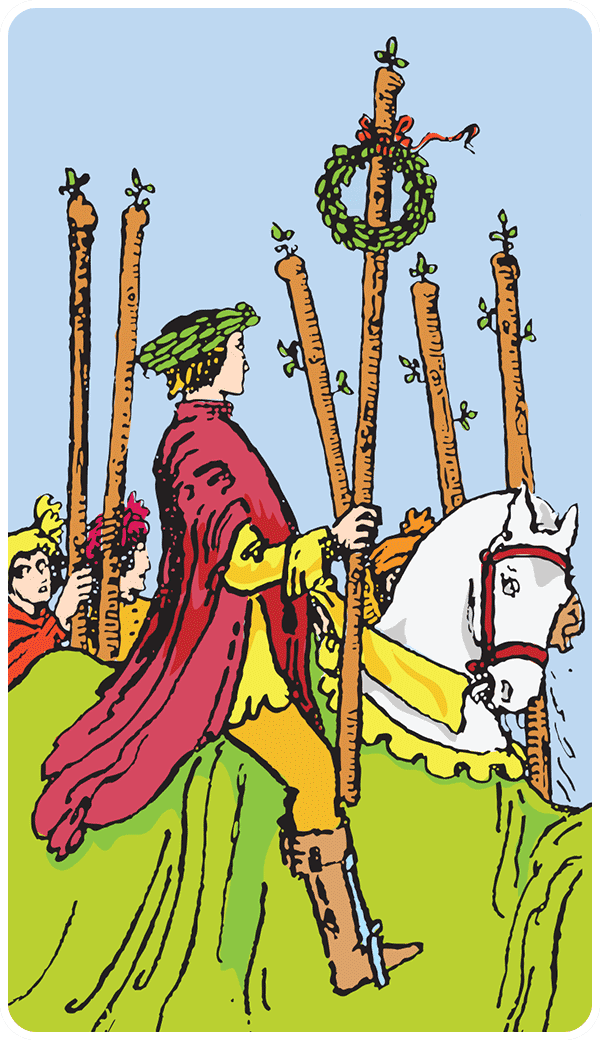
Six of Wands · plate 6
What the card is actually doing
The Six of Wands shows up in a finance reading and people assume it means money is coming. They see the figure on the horse, the crowd, the laurel wreath, and read it as victory — which must mean profit, right? A win is a win. Except the card doesn't describe profit. It describes recognition. The honest version is that the Six of Wands names the moment your work becomes visible, your competence gets acknowledged, or your brand starts to land. Whether that visibility converts to revenue is a different card.
Reading Six of Wands in money
What the suit, the rank, and the image are each doing
Wands is the suit of action, energy, and the forward momentum of a project or enterprise. It governs what you're building, how much drive you have behind it, and whether the thing is moving or stalled. Wands cards in a finance reading almost never describe money itself — they describe the engine that generates money, the work that precedes payment, the effort that may or may not convert.
Sixes in tarot describe a moment of equilibrium after struggle. The chaos of the Five has resolved. Something has stabilized. You've crossed a threshold and the new position holds. Sixes are not climaxes; they are plateaus. The Six of Wands specifically describes the plateau where other people start to notice what you've done.
Now look at the image. A figure rides a horse through a crowd. They're holding a wand with a laurel wreath. The crowd is watching. Some are holding their own wands up in acknowledgment. The figure is elevated, visible, receiving attention. But no one is handing them money. No one is signing a contract. The transaction is social, not financial. The card describes the moment your work gets seen and validated — a good review, a speaking invitation, a compliment from someone whose opinion matters, a post that goes viral. What happens after that is not on this card.
How the card reads for two different situations
If the querent is early in a business or freelance career, the Six of Wands describes the first time they get real traction. A client refers them. A project gets shared. Someone they respect says "you're good at this." It feels like a turning point because it is — but it's the turning point where credibility starts to build, not where the bank account fills. The misreading here is thinking the recognition will automatically convert to bookings. It won't, not without follow-through. The card names the open door; walking through it is separate work.
If the querent already has an established income stream, the Six of Wands describes a moment where their reputation visibly shifts. They get invited to a bigger table. A competitor acknowledges them. A media outlet picks up their story. It reads as a win because it is — but again, the card does not promise that the new visibility translates to new revenue. Plenty of people experience a Six of Wands moment and then watch their income stay flat because they didn't convert the attention into an offer.
The tell that someone is misreading the card on themselves
The tell is when someone pulls the Six of Wands in a finance reading and starts planning how they'll spend the money. They're already mentally allocating the windfall. But if you go back and look at what actually happened in the week after the reading, what you'll find is that someone praised their work, or shared their content, or asked them to speak at an event. The visibility arrived. The payment didn't. The card was correct. The interpretation was off.
From the practice
“A card never tells you what to do. It tells you what you're already deciding — and gives you the words to name it.”
A grounded observation
Go back through your calendar and look for the moments when your work got acknowledged but your income didn't move. That gap is what the Six of Wands describes. The card names the recognition. What you do with it is your next move.
Key themes to watch for
- № 01Theme
Non-material wealth
- № 02Theme
Generosity
- № 03Theme
Values check
What to do with this reading
Read the upright meaning first, even if you pulled the card reversed. The reversal is a commentary on the upright — not a separate card.
Notice what your body did when you saw Six of Wands. That reaction is usually closer to the truth than the interpretation.
Write down one sentence: What is this card asking me to stop avoiding? Let the answer be smaller than you expect.
Come back to this card in 48 hours. Most money readings sharpen with a little distance.
Questions answered
Frequently asked
Financially, the Six of Wands suggests a period of reward and recognition. You might find yourself reaping the benefits of past investments or wise financial decisions. It's a time to appreciate the security you've built and the financial goals achieved. Consider how you can sustain this success and perhaps share it with others. While it's tempting to rest on your laurels, this card invites you to think about future financial aspirations. How can you steer this momentum toward long-term prosperity?
Reversed, the Six of Wands might indicate financial disappointments or delays. You may feel as if your efforts haven't yielded the expected returns. It's a time to reassess your financial strategy and priorities. Instead of dwelling on what's lacking, take this opportunity to refine your approach. What steps can you take to ensure a more stable financial future?
Six of Wands colors the cards around it. Pay attention to where its themes — creative momentum, will and appetite, the spark that wants to be tended — show up in the next card. That is usually where the story is.
Tarot is observational, not predictive. Six of Wands describes the conditions in front of you right now and where they tend to lead if nothing changes — not a guarantee of timing.
Repeat cards are the deck underlining a theme. With Six of Wands, that usually means the question you are asking is the right one — but you have not yet acted on what the card is showing you.
Read next
Related readings
More Wands · Money
- Ace of Wands — MoneyHow Ace of Wands reads in a money context.
- Two of Wands — MoneyHow Two of Wands reads in a money context.
- Three of Wands — MoneyHow Three of Wands reads in a money context.
- Four of Wands — MoneyHow Four of Wands reads in a money context.
- Five of Wands — MoneyHow Five of Wands reads in a money context.
- Seven of Wands — MoneyHow Seven of Wands reads in a money context.
Other Six of Wands readings
- General MeaningSix of Wands read for general meaning.
- Love & RelationshipsSix of Wands read for love & relationships.
- Career & WorkSix of Wands read for career & work.
- Health & WellbeingSix of Wands read for health & wellbeing.
- SpiritualitySix of Wands read for spirituality.
- Yes / No AnswerSix of Wands read for yes / no answer.