Page of Swords in Spirit
The Page of Swords in a spirituality reading is almost always misread as a call to study more. Here's what the card is actually describing.
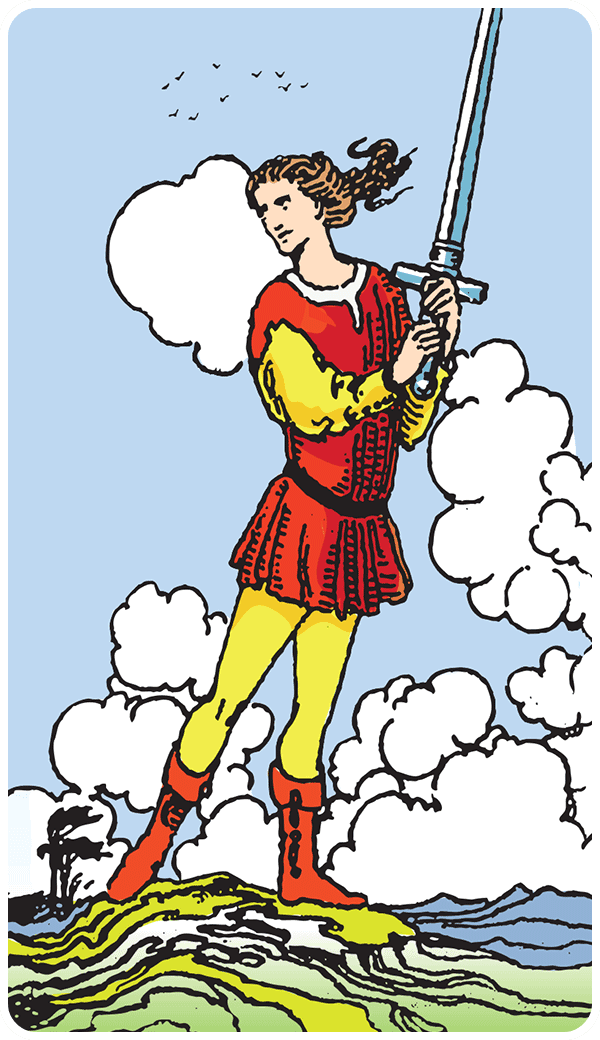
Page of Swords · plate page
What the card is actually doing
The Page of Swords shows up in a spirituality reading and the querent immediately starts listing books they haven't read yet. Courses they should take. Teachers they should find. They assume the card is telling them they don't know enough, that the next level of understanding lives in the next stack of information. That is not what the card is doing. The Page of Swords is describing a specific cognitive posture that is already active, not a curriculum you need to complete.
Reading Page of Swords in spirit
What the suit, the rank, and the image are each doing
Swords is the suit of thought, discernment, and the capacity to separate signal from noise. It governs how you cut through confusion, how you name what you're observing, how you hold a question without collapsing it into an answer too early. When Swords cards appear in spirituality readings, the work being described is almost always mental — not emotional, not devotional, but the work of seeing clearly.
Pages in tarot are messengers and scouts. They are not masters. They are the figure who goes ahead, tests the ground, reports back. A Page is curiosity in motion, the early phase of learning a new language or a new way of seeing. Pages ask questions. They do not yet have systems. The Page of Swords specifically is the mind in reconnaissance mode — alert, skeptical, testing.
Look at the image. A young figure stands on uneven ground, holding a sword upright, wind blowing. The stance is ready but not defensive. The sword is raised as a tool of attention, not combat. The ground is rocky. The sky is moving. This is someone learning to think in unstable conditions, where the answers are not yet settled.
The card describes the moment you stop accepting spiritual claims at face value and start asking what they actually mean. Not in a hostile way — in a clarifying way. The Page of Swords is the querent who hears "surrender to the divine" and thinks, okay, but what does that look like on a Tuesday when I'm angry? It is the beginning of critical spiritual literacy.
How this reads differently depending on where the querent is
If the querent is new to spiritual practice, the Page of Swords describes the useful skepticism that keeps them from swallowing every teaching whole. They are learning to ask, does this actually describe my experience, or am I just agreeing because it sounds profound? This is the card of someone who is finally allowed to think inside their practice instead of only feeling or believing.
If the querent has been practicing for years, the Page of Swords often describes a return to beginner mind — but the sharp version. They have outgrown their old framework and are now in the uncomfortable phase of dismantling it, testing which pieces still hold. The card shows up when someone realizes their spiritual vocabulary has become a script they recite instead of a live encounter with what is true.
The tell that someone is misreading the card on themselves
The misreading sounds like this: "I need to learn more before I can trust myself." The querent treats the Page of Swords as evidence of a deficit, proof they are not ready, confirmation they should stay in student mode longer. They reach for another book, another teacher, another system.
But the Page is not describing inadequacy. It is describing a method. The card is not saying you don't know enough. It is saying the way forward is through questioning, through testing, through refusing to let spiritual language become a place to hide from precision. If you are waiting for the moment you know enough to stop asking questions, you have misread the card. The questions are the work.
From the practice
“A card never tells you what to do. It tells you what you're already deciding — and gives you the words to name it.”
A grounded observation
Go back through your spiritual journal or practice notes. Find the place where you wrote something you were supposed to believe and then, two lines later, wrote what you actually thought. That gap is the Page of Swords.
Key themes to watch for
- № 01Theme
Heart-opening
- № 02Theme
Divine flow
- № 03Theme
Soul refresh
What to do with this reading
Read the upright meaning first, even if you pulled the card reversed. The reversal is a commentary on the upright — not a separate card.
Notice what your body did when you saw Page of Swords. That reaction is usually closer to the truth than the interpretation.
Write down one sentence: What is this card asking me to stop avoiding? Let the answer be smaller than you expect.
Come back to this card in 48 hours. Most spirit readings sharpen with a little distance.
Questions answered
Frequently asked
In spirituality, the Page of Swords encourages a journey of exploration and questioning. You're invited to delve into new philosophies or practices with an open mind. Imagine yourself as an adventurer, seeking truths and expanding your spiritual horizons. There's a sense of excitement in discovering what resonates with you. What spiritual questions are you curious to explore, and how might they lead you to deeper understanding?
Reversed, the Page of Swords might suggest spiritual doubt or conflicting beliefs. You may feel like you're treading water, unsure of what path to follow. Picture a map with too many routes; it might be time to pause and reflect on what truly speaks to you. How can you sift through the noise and find what aligns with your inner truth?
Page of Swords colors the cards around it. Pay attention to where its themes — mental clarity, the truth being named, what the mind needs to release — show up in the next card. That is usually where the story is.
Tarot is observational, not predictive. Page of Swords describes the conditions in front of you right now and where they tend to lead if nothing changes — not a guarantee of timing.
Repeat cards are the deck underlining a theme. With Page of Swords, that usually means the question you are asking is the right one — but you have not yet acted on what the card is showing you.
Read next
Related readings
More Swords · Spirit
- Ace of Swords — SpiritHow Ace of Swords reads in a spirit context.
- Two of Swords — SpiritHow Two of Swords reads in a spirit context.
- Three of Swords — SpiritHow Three of Swords reads in a spirit context.
- Four of Swords — SpiritHow Four of Swords reads in a spirit context.
- Five of Swords — SpiritHow Five of Swords reads in a spirit context.
- Six of Swords — SpiritHow Six of Swords reads in a spirit context.
Other Page of Swords readings
- General MeaningPage of Swords read for general meaning.
- Love & RelationshipsPage of Swords read for love & relationships.
- Career & WorkPage of Swords read for career & work.
- Money & FinancePage of Swords read for money & finance.
- Health & WellbeingPage of Swords read for health & wellbeing.
- Yes / No AnswerPage of Swords read for yes / no answer.