Ace of Swords in Spirit
The Ace of Swords in spirituality readings gets misread as enlightenment arriving. What it actually names is the cut of a new thought that disrupts your current framework.
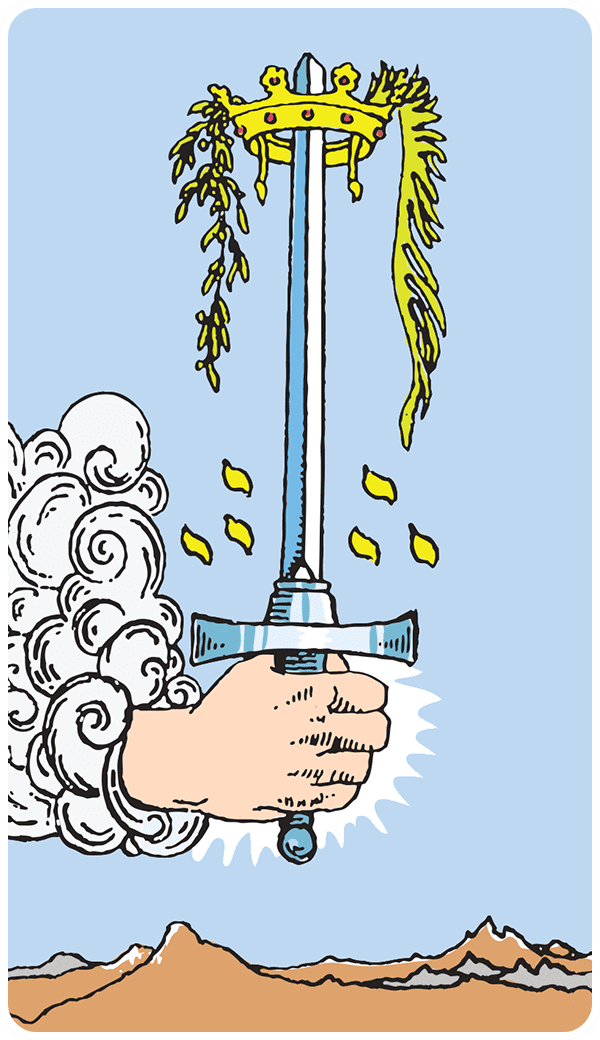
Ace of Swords · plate 1
What the card is actually doing
The Ace of Swords shows up in a spirituality reading and the querent reads it as confirmation. They think it means they've finally figured it out — that the insight they just had is the right one, the true one, the breakthrough that changes everything. They want me to tell them they can stop looking now. That is not what the card does. The Ace of Swords is not the answer. It is the arrival of a question sharp enough to cut through the story you were telling yourself about what your spiritual life was supposed to look like.
Reading Ace of Swords in spirit
What the suit, the rank, and the image are each doing
Swords is the mental suit. It governs thought, discernment, the part of you that names things and sorts them into categories. In a spirituality context, Swords describes the frameworks you use to make sense of your inner life — the belief systems, the concepts, the language you reach for when you try to explain what meditation feels like or why you stopped going to church or what you think happens after you die. When Swords cards dominate a reading about spirituality, the question is always about whether your current framework still fits what you're actually experiencing.
Aces are thresholds. They are not completions. An Ace is the moment a new channel opens — the precondition for something, not the something itself. The Ace of Swords is not clarity achieved. It is the cut of a new thought arriving. It is the first stroke of a blade that will eventually dismantle an entire structure, but right now it has only made one clean incision.
Look at the image. A hand emerges from a cloud, holding a sword upright. A crown sits at the tip. Mountains rise in the distance. The sword is being offered, not wielded. It has not cut anything yet. It is suspended, waiting. This is the mechanical answer: the Ace of Swords is the moment a new way of thinking becomes available to you. Whether you pick up the sword is a separate question.
How the card reads for two different situations
If the querent has been in a rigid spiritual framework — a religion they inherited, a practice they committed to years ago, a teacher whose authority they haven't questioned — the Ace of Swords names the thought that won't go away. The doubt. The question they keep trying to suppress because asking it out loud would mean admitting the framework doesn't fit anymore. The card is not telling them to leave. It is naming the fact that the leaving has already started in their head.
If the querent has been drifting — sampling practices, collecting concepts, unable to commit to any single path — the Ace of Swords is the cut that ends the drift. It is the arrival of a thought precise enough to function as a filter. Not a full belief system, but a single sharp principle that lets them sort what belongs from what doesn't. The card shows up when they are finally ready to choose a framework instead of hovering above all of them.
The tell that someone is misreading the card on themselves
The tell is when the querent treats the Ace of Swords as validation. They think it means the insight they just had is correct, so now they can build on it. But the Ace of Swords does not confirm your conclusion. It disrupts your premise. If you feel settled after this card, you have misread it. The honest read is discomfort. The thought that just arrived does not fit neatly into your existing story about what your spiritual life is or should be. That friction is the point.
From the practice
“A card never tells you what to do. It tells you what you're already deciding — and gives you the words to name it.”
A grounded observation
Go back through your journal and look for the thought you kept writing around but not writing down. That is what the Ace of Swords is naming. The card does not tell you what to do with it.
Key themes to watch for
- № 01Theme
Heart-opening
- № 02Theme
Divine flow
- № 03Theme
Soul refresh
What to do with this reading
Read the upright meaning first, even if you pulled the card reversed. The reversal is a commentary on the upright — not a separate card.
Notice what your body did when you saw Ace of Swords. That reaction is usually closer to the truth than the interpretation.
Write down one sentence: What is this card asking me to stop avoiding? Let the answer be smaller than you expect.
Come back to this card in 48 hours. Most spirit readings sharpen with a little distance.
Questions answered
Frequently asked
Spiritually, the Ace of Swords brings a clear and cutting insight. You may experience a moment of profound understanding or a new perspective on your spiritual path. This card invites you to embrace this clarity, allowing it to shape your spiritual journey. Consider how this insight might deepen your connection to what you hold sacred.
Reversed, the Ace of Swords might indicate spiritual confusion or a lack of direction. You may feel disconnected from your spiritual path or uncertain about your beliefs. This is an opportunity to explore where this uncertainty stems from. Reflect on how you might find clarity by seeking new perspectives or revisiting foundational beliefs.
Ace of Swords colors the cards around it. Pay attention to where its themes — mental clarity, the truth being named, what the mind needs to release — show up in the next card. That is usually where the story is.
Tarot is observational, not predictive. Ace of Swords describes the conditions in front of you right now and where they tend to lead if nothing changes — not a guarantee of timing.
Repeat cards are the deck underlining a theme. With Ace of Swords, that usually means the question you are asking is the right one — but you have not yet acted on what the card is showing you.
Read next
Related readings
More Swords · Spirit
- Two of Swords — SpiritHow Two of Swords reads in a spirit context.
- Three of Swords — SpiritHow Three of Swords reads in a spirit context.
- Four of Swords — SpiritHow Four of Swords reads in a spirit context.
- Five of Swords — SpiritHow Five of Swords reads in a spirit context.
- Six of Swords — SpiritHow Six of Swords reads in a spirit context.
- Seven of Swords — SpiritHow Seven of Swords reads in a spirit context.
Other Ace of Swords readings
- General MeaningAce of Swords read for general meaning.
- Love & RelationshipsAce of Swords read for love & relationships.
- Career & WorkAce of Swords read for career & work.
- Money & FinanceAce of Swords read for money & finance.
- Health & WellbeingAce of Swords read for health & wellbeing.
- Yes / No AnswerAce of Swords read for yes / no answer.