King of Swords in Spirit
The King of Swords in spirituality readings gets mistaken for detachment from emotion. What it actually describes is the part of your practice that demands precision.
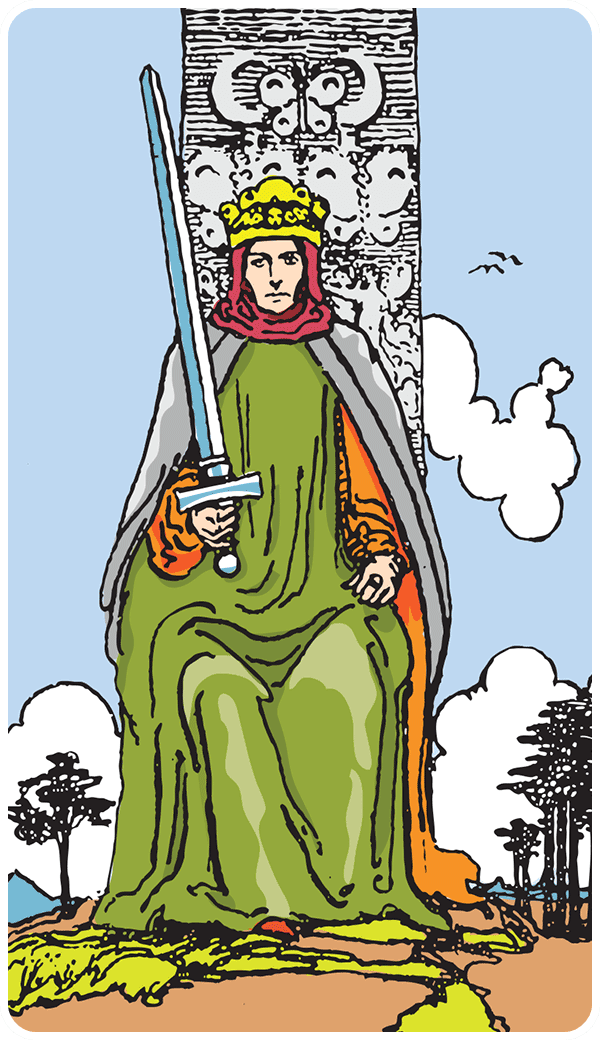
King of Swords · plate king
What the card is actually doing
The King of Swords shows up in a spirituality reading and the querent assumes they're being told to transcend their feelings. To rise above. To cut away attachment and operate from pure logic. They think the card is praising coldness as enlightenment.
That is not what the card is doing. The King of Swords is not about suppressing emotion. It is about the intellectual structure that holds a practice together when emotion alone cannot sustain it.
Reading King of Swords in spirit
What the suit, the rank, and the image are each doing
Swords governs thought, discernment, and the capacity to make distinctions. It is the suit of mental clarity, of naming what is actually happening versus what you wish were happening. In a spirituality context, Swords is the part of your practice that asks questions, that notices when a teaching contradicts itself, that refuses to mistake a good feeling for growth.
Kings are the mature, established expression of their suit. They are not learning the thing — they have integrated it. The King of Swords has spent years refining his capacity for clear thought. He can hold a complex idea without collapsing it into something simpler. He can sit with paradox. He does not need every spiritual concept to feel warm.
The image: a king sits on a throne, sword upright, facing forward. His expression is neutral. The sky behind him is clear. He is not in ecstasy. He is not in distress. He is awake and he is paying attention. The sword is not being swung; it is being held steady.
The most common misreading in spirituality work is that this card means you should detach from your emotions, that feeling less is somehow more evolved. That is a fundamental misunderstanding of what Swords does. The King of Swords is not numb. He simply does not let a strong feeling override his ability to see clearly. The card is describing discernment, not dissociation.
How the card reads for two different querent situations
If the querent is someone who has been spiritually bypassing — using meditation or affirmations to avoid looking at a real problem — the King of Swords is the card that says: stop pretending the issue isn't there. Your practice is supposed to help you see more clearly, not less. The card is asking you to bring the same rigor you apply to your meditation schedule to the question of why you keep ending up in the same situation.
If the querent is someone who has been drowning in emotional content — every spiritual experience is tears, every ritual is catharsis, every reading is about releasing trauma — the King of Swords is the card that says: you need a structure that can hold this. Feeling everything all the time is not the same as integrating anything. The card is pointing to the part of spiritual work that happens in your notebook, in the pattern recognition, in the decision to stop performing your healing and start tracking it.
The tell that someone is misreading the card on themselves
The tell is when someone reads the King of Swords and immediately decides their spiritual practice needs to be less emotional, more controlled, more "masculine." They start meditating longer. They stop journaling about feelings. They begin to pride themselves on how little they cry.
That is the card being used as permission to shut down, not as an invitation to think clearly. The King of Swords is not asking you to feel less. He is asking you to notice what you are actually doing with what you feel, and whether your practice is making you more honest or just more comfortable with your own evasions.
From the practice
“A card never tells you what to do. It tells you what you're already deciding — and gives you the words to name it.”
A grounded observation
Go back through the last six months of your spiritual practice and look for the moment you stopped asking yourself hard questions. That is the moment the King of Swords is addressing.
Key themes to watch for
- № 01Theme
Heart-opening
- № 02Theme
Divine flow
- № 03Theme
Soul refresh
What to do with this reading
Read the upright meaning first, even if you pulled the card reversed. The reversal is a commentary on the upright — not a separate card.
Notice what your body did when you saw King of Swords. That reaction is usually closer to the truth than the interpretation.
Write down one sentence: What is this card asking me to stop avoiding? Let the answer be smaller than you expect.
Come back to this card in 48 hours. Most spirit readings sharpen with a little distance.
Questions answered
Frequently asked
Spiritually, the King of Swords invites a period of intellectual exploration and seeking truth. It's a time to question beliefs and seek understanding through study and reflection. This card encourages you to engage with spiritual practices that stimulate the mind and offer new insights. Are there teachings or philosophies you're drawn to explore more deeply? Consider how intellectual curiosity can enrich your spiritual path.
Reversed, the King of Swords in spirituality suggests possible rigidity or closed-mindedness. You might find yourself clinging to beliefs without questioning them or struggling to see beyond your current perspective. This card nudges you to open your mind to new spiritual ideas. Are there ways you're limiting your spiritual growth? Reflect on how you might embrace a more expansive view.
King of Swords colors the cards around it. Pay attention to where its themes — mental clarity, the truth being named, what the mind needs to release — show up in the next card. That is usually where the story is.
Tarot is observational, not predictive. King of Swords describes the conditions in front of you right now and where they tend to lead if nothing changes — not a guarantee of timing.
Repeat cards are the deck underlining a theme. With King of Swords, that usually means the question you are asking is the right one — but you have not yet acted on what the card is showing you.
Read next
Related readings
More Swords · Spirit
- Ace of Swords — SpiritHow Ace of Swords reads in a spirit context.
- Two of Swords — SpiritHow Two of Swords reads in a spirit context.
- Three of Swords — SpiritHow Three of Swords reads in a spirit context.
- Four of Swords — SpiritHow Four of Swords reads in a spirit context.
- Five of Swords — SpiritHow Five of Swords reads in a spirit context.
- Six of Swords — SpiritHow Six of Swords reads in a spirit context.
Other King of Swords readings
- General MeaningKing of Swords read for general meaning.
- Love & RelationshipsKing of Swords read for love & relationships.
- Career & WorkKing of Swords read for career & work.
- Money & FinanceKing of Swords read for money & finance.
- Health & WellbeingKing of Swords read for health & wellbeing.
- Yes / No AnswerKing of Swords read for yes / no answer.