Wheel of Fortune in General
The Wheel of Fortune gets read as 'good luck is coming.' What it actually describes is the moment you realize you've already moved into a different chapter.
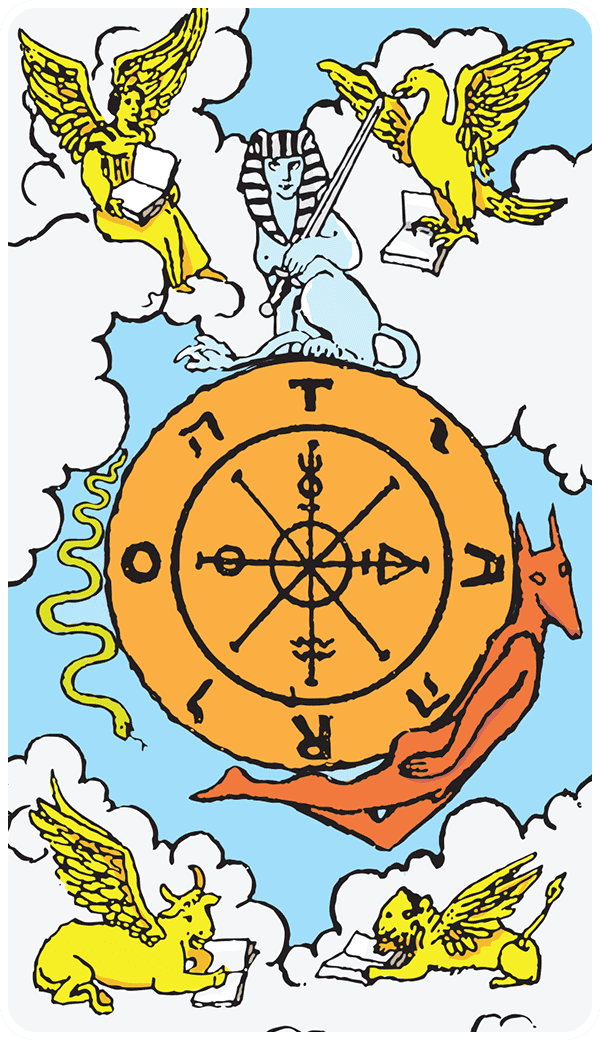
Wheel of Fortune · plate 10
What the card is actually doing
The Wheel of Fortune shows up in a general reading and the querent exhales. They think it means their luck is about to turn. Something good is finally coming. The hard part is over. That is not what the card is saying. The Wheel doesn't predict a shift — it names the shift that already happened. The one you're still calling temporary.
Reading Wheel of Fortune in general
What the wheel, the figures, and the motion are doing
The Wheel of Fortune is Major Arcana X. The Major Arcana governs the structural chapters of a life — the moves that reorganize everything downstream. This is not a card about whether you get the job or the date. It's a card about the underlying conditions that determine what jobs and dates become possible.
Look at the image. A wheel turns. Four figures sit at the cardinal points — often depicted as the fixed signs of the zodiac. A sphinx sits at the top. A snake descends on one side. Anubis rises on the other. The wheel is in motion, but the figures around it are stationary. They are not controlling the wheel. They are watching it turn.
This is the mechanical answer. The Wheel of Fortune describes the moment you register that the chapter has already changed. You are no longer in the same situation you were in six months ago, even if the furniture looks the same. The conditions have shifted. What was hard is now easy. What was available is now closed. What you were isn't what you are. The card does not say the new chapter is better. It says the wheel has turned and you are somewhere else on it now.
The most common misreading is treating the card as a promise of good fortune. The word 'fortune' does that work. But the card is named for the wheel, not the outcome. A wheel turns in both directions. The Wheel of Fortune is as likely to show up when someone is about to lose something as when they are about to gain it. What it actually marks is the transition point — the moment the structural conditions of your life have rotated and you are now operating under a different set of rules.
How the card reads for two different querents
For someone who has been stuck, grinding, white-knuckling their way through a hard chapter, the Wheel of Fortune shows up and says: that chapter is over. You are not going to wake up tomorrow in the same fight. The pressure has lifted. You may not have noticed yet, but the thing that was hard three months ago doesn't land the same way now. The wheel turned. You are on the upswing.
For someone who has been coasting, riding a good run, the Wheel of Fortune shows up and says: the conditions that made this easy are ending. The chapter where everything worked without effort is closing. What comes next will ask more of you. The wheel turned. You are moving into the part of the cycle that requires you to build something instead of receive it.
In both cases, the card is describing the same motion. The chapter changed. The querent is still living like the old chapter is in effect.
The tell that someone is misreading the card on themselves
The tell is when someone reads the Wheel of Fortune and then waits. They think the card is describing something that will happen next week. They are waiting for the turn. If you are waiting, you are misreading the card. The Wheel of Fortune does not describe what is coming. It describes what already came. Go back through your calendar. Look for the moment in the last sixty days when the thing that was hard stopped being hard, or the thing that was working stopped working. That was the wheel turning. The card is telling you to stop operating like you are still in the old chapter.
From the practice
“A card never tells you what to do. It tells you what you're already deciding — and gives you the words to name it.”
A grounded observation
The Wheel of Fortune is the card that shows up when you are still using last year's map. The territory already changed. You just haven't updated the route yet.
Key themes to watch for
- № 01Theme
Beginnings
- № 02Theme
Inner movement
- № 03Theme
Receptivity
What to do with this reading
Read the upright meaning first, even if you pulled the card reversed. The reversal is a commentary on the upright — not a separate card.
Notice what your body did when you saw Wheel of Fortune. That reaction is usually closer to the truth than the interpretation.
Write down one sentence: What is this card asking me to stop avoiding? Let the answer be smaller than you expect.
Come back to this card in 48 hours. Most general readings sharpen with a little distance.
Questions answered
Frequently asked
The Wheel of Fortune spins with life's unpredictable rhythm, suggesting a time of change. You might find yourself on the cusp of a new chapter, where events shift like the seasons. This card invites you to recognize the cycles in your life—those moments of ascent and descent—and how they contribute to your growth. Consider what patterns keep repeating and why. This isn't about control; it's about awareness. Reflect on how you respond to life's ebb and flow, and what you learn from each turn of the wheel.
When the Wheel of Fortune appears reversed, it hints at feeling stuck or caught in an unwanted cycle. Life's rhythms might seem out of sync, leaving you wondering when the tide will turn. It's a moment to pause and consider what might be resisting change. Are you gripping too tightly to the familiar? This isn't a time of stagnation without purpose. Instead, it's an opportunity to examine what lessons are being overlooked. What can you learn from this pause that might prepare you for the next shift?
Wheel of Fortune colors the cards around it. Pay attention to where its themes — archetype, pattern, invitation — show up in the next card. That is usually where the story is.
Tarot is observational, not predictive. Wheel of Fortune describes the conditions in front of you right now and where they tend to lead if nothing changes — not a guarantee of timing.
Repeat cards are the deck underlining a theme. With Wheel of Fortune, that usually means the question you are asking is the right one — but you have not yet acted on what the card is showing you.
Read next
Related readings
Other Wheel of Fortune readings
- Love & RelationshipsWheel of Fortune read for love & relationships.
- Career & WorkWheel of Fortune read for career & work.
- Money & FinanceWheel of Fortune read for money & finance.
- Health & WellbeingWheel of Fortune read for health & wellbeing.
- SpiritualityWheel of Fortune read for spirituality.
- Yes / No AnswerWheel of Fortune read for yes / no answer.