Three of Pentacles in Spirit
Most people read the Three of Pentacles as validation that their spiritual practice is working. The card is actually describing the structure, not the outcome.
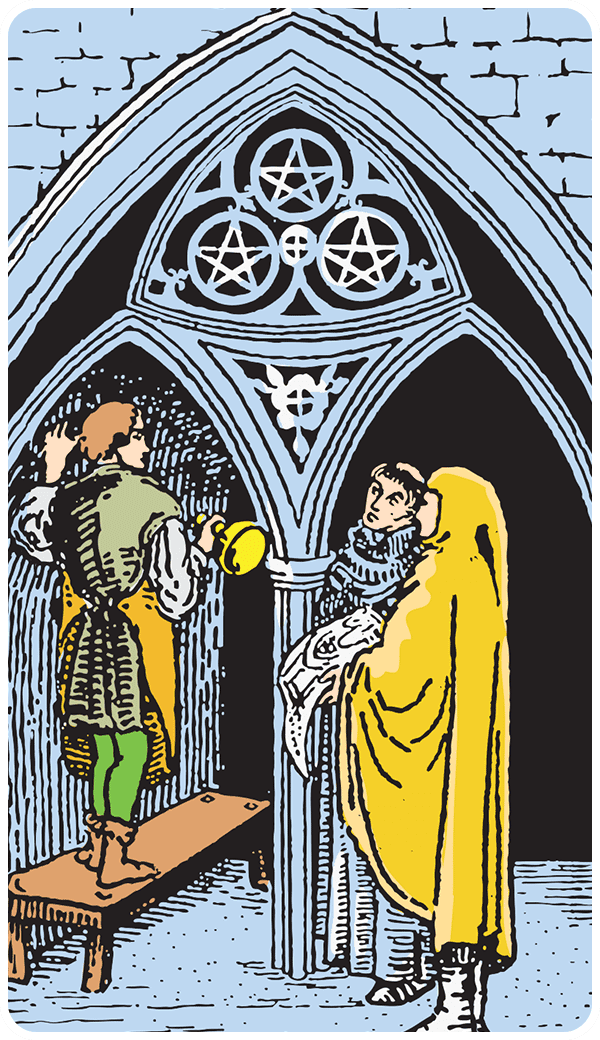
Three of Pentacles · plate 3
What the card is actually doing
The Three of Pentacles shows up in a spirituality reading and the querent exhales. They take it as confirmation: the work is paying off, the practice is valid, they're on the right path. That is not what the card is describing. The Three of Pentacles names the scaffolding—the repetition, the craft, the collaborative structure that makes a practice durable. It does not evaluate whether the practice is producing the result you want.
Reading Three of Pentacles in spirit
What the suit, the rank, and the image are doing
Pentacles governs the material plane—what you build, what you repeat, what structure you maintain over time. In a spirituality reading, Pentacles cards describe the physical container of the practice: the morning routine, the altar setup, the teacher you meet with weekly, the discipline of sitting even when you don't feel like it. They do not describe the mystical experience. They describe the conditions under which mystical experience becomes possible.
Threes in tarot are collaboration cards. They describe the moment a thing stops being solo effort and starts requiring coordination between multiple parts. The Three of Wands is you and the horizon. The Three of Cups is you and two other people. The Three of Pentacles is you, the material you're working with, and the standard you're holding yourself to. It is the first card in the deck where mastery becomes visible to someone other than yourself.
Look at the image. A stonemason works on a cathedral. Two figures—often read as a monk and an architect—stand beside him, reviewing the work. The mason is mid-task. The work is not complete. The card captures the moment of collaborative assessment: does this meet the standard we agreed to? The most common misreading in a spirituality context is to collapse this into "my practice is working." What the card actually says is: you have built enough structure that the work can now be evaluated. Whether it meets the standard is the next question.
How the card reads for two different querent situations
If the querent has been practicing alone for months and feels unmoored, the Three of Pentacles is the card that says: bring in a second perspective. Find a teacher. Join a group. The solitary phase has run its course. The practice needs an external standard now, or it will start to drift. The card is not saying the solo work was wrong. It is saying the solo work has produced enough material that it now requires structure beyond what you can hold alone.
If the querent is already in a structured practice—weekly sessions with a teacher, a formal tradition, a committed sangha—the Three of Pentacles describes maintenance. The card is not celebrating progress. It is naming the phase where the practice becomes repetition, where showing up is the work, where the gap between "I feel inspired" and "I do it anyway" is the entire point. Most people read this as boring. The card reads it as craft.
The tell that someone is misreading the card on themselves
The querent says, "This card means my spiritual practice is finally working," and then describes a single powerful experience—a vision, a breakthrough meditation, a moment of clarity. That is not what the Three of Pentacles describes. Breakthroughs are Ace or Page energy. The Three of Pentacles describes what happens after the breakthrough, when you have to build the structure that makes the breakthrough repeatable. If you are reading this card as validation of a peak experience, you are skipping the part where you turn the experience into a practice. The card is asking: what are you building that will still be here in six months?
From the practice
“A card never tells you what to do. It tells you what you're already deciding — and gives you the words to name it.”
A grounded observation
Go back through your calendar and count how many times you actually did the thing you say is your spiritual practice. The Three of Pentacles cares about that number, not how the practice felt.
Key themes to watch for
- № 01Theme
Heart-opening
- № 02Theme
Divine flow
- № 03Theme
Soul refresh
What to do with this reading
Read the upright meaning first, even if you pulled the card reversed. The reversal is a commentary on the upright — not a separate card.
Notice what your body did when you saw Three of Pentacles. That reaction is usually closer to the truth than the interpretation.
Write down one sentence: What is this card asking me to stop avoiding? Let the answer be smaller than you expect.
Come back to this card in 48 hours. Most spirit readings sharpen with a little distance.
Questions answered
Frequently asked
Spiritually, the Three of Pentacles highlights the benefits of learning and growing with others. It might be a time to join a community or group that shares your spiritual interests, allowing for shared insights and growth. Consider how collective wisdom can enhance your understanding and practice. This card suggests that engaging with others on a similar path can deepen your spiritual journey, offering new perspectives and shared experiences that enrich your practice.
Reversed, the Three of Pentacles in spirituality might suggest isolation or a disconnect from your spiritual community. It could be that differing beliefs or practices are causing friction. This card invites you to consider whether there's a way to bridge gaps or find common ground. Reflect on how opening up to dialogue or seeking new connections might restore a sense of belonging and enhance your spiritual exploration.
Three of Pentacles colors the cards around it. Pay attention to where its themes — embodiment, material follow-through, the slow build of resource — show up in the next card. That is usually where the story is.
Tarot is observational, not predictive. Three of Pentacles describes the conditions in front of you right now and where they tend to lead if nothing changes — not a guarantee of timing.
Repeat cards are the deck underlining a theme. With Three of Pentacles, that usually means the question you are asking is the right one — but you have not yet acted on what the card is showing you.
Read next
Related readings
More Pentacles · Spirit
- Ace of Pentacles — SpiritHow Ace of Pentacles reads in a spirit context.
- Two of Pentacles — SpiritHow Two of Pentacles reads in a spirit context.
- Four of Pentacles — SpiritHow Four of Pentacles reads in a spirit context.
- Five of Pentacles — SpiritHow Five of Pentacles reads in a spirit context.
- Six of Pentacles — SpiritHow Six of Pentacles reads in a spirit context.
- Seven of Pentacles — SpiritHow Seven of Pentacles reads in a spirit context.
Other Three of Pentacles readings
- General MeaningThree of Pentacles read for general meaning.
- Love & RelationshipsThree of Pentacles read for love & relationships.
- Career & WorkThree of Pentacles read for career & work.
- Money & FinanceThree of Pentacles read for money & finance.
- Health & WellbeingThree of Pentacles read for health & wellbeing.
- Yes / No AnswerThree of Pentacles read for yes / no answer.