The Hermit in Career
The Hermit in career readings gets read as 'quit your job.' What it actually describes is the withdrawal that precedes expertise, not escape.
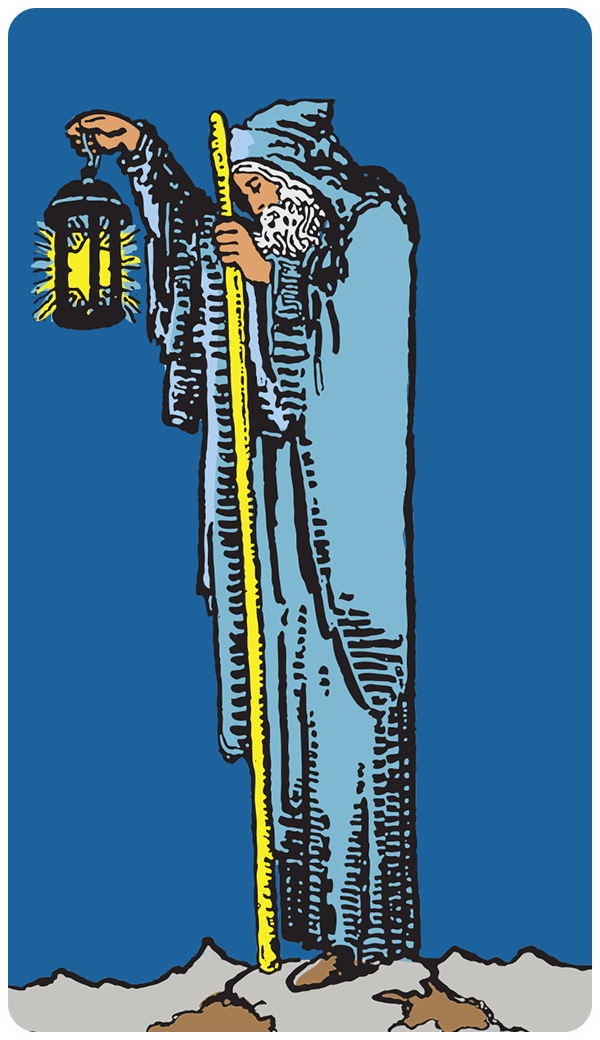
The Hermit · plate 9
What the card is actually doing
The Hermit shows up in a career reading and the querent hears permission to leave. To quit the job, drop the clients, move to the woods, start over somewhere quieter and smaller and less demanding. The card becomes an exit ramp. That is not what it describes. The Hermit is not about leaving the work. It is about the temporary withdrawal required to master the work—the period where you stop performing competence and start building it.
Reading The Hermit in career
What the card is actually describing
The Hermit is Major Arcana, which means it names a developmental threshold, not a circumstantial event. It governs the part of the journey where you pull back from external validation and figure out what you actually know. The figure on the card is alone on a mountain, holding a lantern. He is not lost. He is not hiding. He is deliberately apart, using the lamp to see something that requires his full attention. The lamp lights only a few feet ahead—this is close work, not overview.
In a career context, the Hermit describes the phase where you stop networking, stop promoting, stop asking for feedback, and go deep into the craft itself. You are not quitting. You are studying. You are refining. You are building the expertise that will eventually make the external work easier, but right now the external work is a distraction. Most people misread this as isolation or burnout because it looks like disengagement. It is not disengagement. It is focus.
How the card reads differently depending on where you are
If you are early in your career or new to the field, the Hermit describes the apprenticeship phase you are trying to skip. You want the title, the visibility, the seat at the table, but the card is saying: not yet. You do not know enough yet. The withdrawal here is about logging hours—reading the literature, watching the person who is better than you, doing the repetitive work that builds the internal map. The Hermit is the card of the person who stays late to redo the thing they already turned in because they saw a better way to do it.
If you are mid-career or established, the Hermit describes the recalibration that happens when the external metrics stop meaning anything. You have the job, the reputation, the invitations, and none of it feels like it is yours. The withdrawal here is about stripping the work back down to what you actually care about—what you would still do if no one was watching, if no one was paying you, if there was no resume line at the end. The Hermit is the card of the person who turns down the promotion to spend a year working on the project no one asked for.
The tell that you are misreading it
You are misreading the Hermit if the card makes you feel like a victim. If it lands as 'I have to leave because they don't understand me' or 'I have to quit because the system is broken,' you are using the card to justify a move you already wanted to make for other reasons. The Hermit does not describe escape. It describes the choice to prioritize depth over visibility. If you are not actively building something during the withdrawal—if you are just gone—you are not in Hermit territory. You are in avoidance territory, and that is a different card.
From the practice
“A card never tells you what to do. It tells you what you're already deciding — and gives you the words to name it.”
A grounded observation
Go back through your calendar and look for the last time you said no to a visible opportunity so you could work on something no one would see. That is the Hermit's threshold. If you cannot find that moment, the card is describing what you have not yet done.
Key themes to watch for
- № 01Theme
Creative purpose
- № 02Theme
Heart-led work
- № 03Theme
Right alignment
What to do with this reading
Read the upright meaning first, even if you pulled the card reversed. The reversal is a commentary on the upright — not a separate card.
Notice what your body did when you saw The Hermit. That reaction is usually closer to the truth than the interpretation.
Write down one sentence: What is this card asking me to stop avoiding? Let the answer be smaller than you expect.
Come back to this card in 48 hours. Most career readings sharpen with a little distance.
Questions answered
Frequently asked
With The Hermit in career, there's a focus on introspection and finding purpose in your work. This might be a time to contemplate your professional path and whether it aligns with your personal values. It could be beneficial to seek mentors or advisors who can offer guidance from their own experiences. While this card suggests a solitary journey, it also encourages thoughtful consideration of where you're headed. Consider this an opportunity to redefine what success means to you on a personal level.
Reversed, The Hermit in your career context might indicate a feeling of being lost or disconnected from your work. You could be ignoring the inner call to reevaluate your professional life. There might be reluctance to seek advice or learn from those who have walked a similar path. This reversal invites you to acknowledge any feelings of stagnation and to explore how you might reinvigorate your career with a fresh perspective or approach.
The Hermit colors the cards around it. Pay attention to where its themes — archetype, pattern, invitation — show up in the next card. That is usually where the story is.
Tarot is observational, not predictive. The Hermit describes the conditions in front of you right now and where they tend to lead if nothing changes — not a guarantee of timing.
Repeat cards are the deck underlining a theme. With The Hermit, that usually means the question you are asking is the right one — but you have not yet acted on what the card is showing you.
Read next
Related readings
Other The Hermit readings
- General MeaningThe Hermit read for general meaning.
- Love & RelationshipsThe Hermit read for love & relationships.
- Money & FinanceThe Hermit read for money & finance.
- Health & WellbeingThe Hermit read for health & wellbeing.
- SpiritualityThe Hermit read for spirituality.
- Yes / No AnswerThe Hermit read for yes / no answer.