Ten of Wands in Career
The Ten of Wands in career readings gets read as burnout. What it actually names is the structural mistake you made six months ago that you're still carrying.
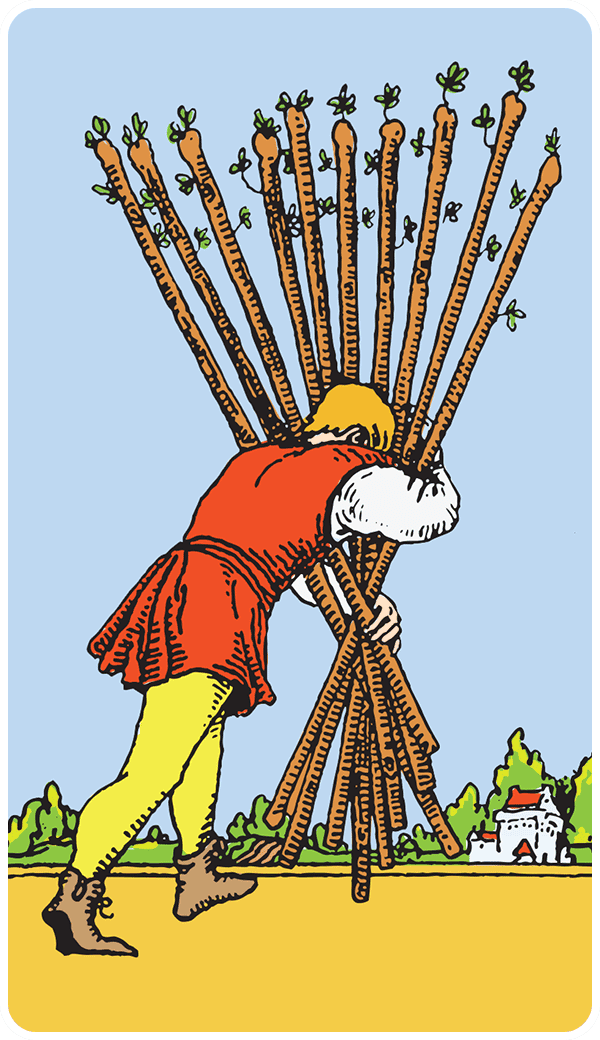
Ten of Wands · plate 10
What the card is actually doing
The Ten of Wands shows up in a career reading and the querent already knows what they want me to say. They're burned out. They're doing too much. They need to delegate, set boundaries, take a vacation. The card confirms what they already feel, and the reading becomes permission to complain.
That is not what the card is doing. The Ten of Wands is not describing burnout. It is naming the specific structural decision that created the burnout — the project you said yes to that was never yours to carry, the responsibility you took on because no one else would, the extra role you absorbed when someone quit and the job was never backfilled. The card is not about how tired you are. It is about what you are still holding that you were supposed to put down three exits ago.
Reading Ten of Wands in career
What the suit, the rank, and the image are each doing
Wands is the suit of will, initiative, and the energy you bring to a project when you believe in it. It governs the part of you that says yes to something new, that starts the engine, that decides this thing is worth doing. When Wands cards cluster in a career reading, the question is almost always about drive — whether you still have it, whether it's pointed at the right target, whether you're burning it on something that doesn't burn back.
Tens in tarot are endpoints. They are the last card in the suit's sequence, the place where the initial energy of the Ace has fully played out. Tens describe what happens when a cycle completes — sometimes victoriously, sometimes because the thing collapsed under its own weight. The Ten of Pentacles is legacy and structural security. The Ten of Swords is the moment the fight is over because you lost. Tens are not middles. They are the part where you look at what you built and reckon with whether it was worth it.
Now look at the image. A figure carries ten wands, all of them upright, all of them bundled in their arms. The figure is bent forward under the weight. The destination is visible in the background — a house, a town, the place they were trying to reach. They are almost there. But the load is so heavy they can barely see where they're going. The wands are blocking their face.
The card is not describing exhaustion. It is describing the mechanical problem of carrying something past the point where carrying it makes sense. The task is almost done, or the goal is almost reached, but the method has become the obstacle.
How this reads differently depending on who's holding the card
For someone early in their career, the Ten of Wands usually names the moment they took on someone else's incomplete project and inherited all the technical debt. They thought it would be good experience. They thought it would prove something. Now they are three months in and every task requires five workarounds because the foundation was broken before they arrived. The card is naming what they are carrying that was never theirs to fix.
For someone mid-career or senior, the Ten of Wands is almost always about scope creep that became structural. They said yes to managing one extra direct report. Then two. Then they were covering for a peer on leave. Then the peer left and the role was never replaced and now they are doing two jobs for one salary and no one has noticed because they haven't dropped anything yet. The card is naming the moment where competence became a trap.
The tell that you are misreading this card on yourself
You describe the Ten of Wands as a temporary problem. You say the project will be over soon, or the busy season will end, or once you get through this quarter things will calm down. You have been saying this for six months. The card is not describing a busy season. It is describing the load you have normalized. If your plan for the Ten of Wands is to wait it out, you are misreading the card. The card is asking what you are going to put down, not when you will feel better about carrying it.
From the practice
“A card never tells you what to do. It tells you what you're already deciding — and gives you the words to name it.”
A grounded observation
Go back through your calendar and count how many weeks you have worked over your contracted hours. If the number is more than four, the Ten of Wands is not describing a phase. It is describing your job.
Key themes to watch for
- № 01Theme
Creative purpose
- № 02Theme
Heart-led work
- № 03Theme
Right alignment
What to do with this reading
Read the upright meaning first, even if you pulled the card reversed. The reversal is a commentary on the upright — not a separate card.
Notice what your body did when you saw Ten of Wands. That reaction is usually closer to the truth than the interpretation.
Write down one sentence: What is this card asking me to stop avoiding? Let the answer be smaller than you expect.
Come back to this card in 48 hours. Most career readings sharpen with a little distance.
Questions answered
Frequently asked
The Ten of Wands in your career suggests a period of intense work and responsibility. You might be carrying a heavy load, perhaps taking on extra tasks or working long hours to meet deadlines. While your diligence is commendable, it's easy to feel burnt out. There's a risk of losing sight of the bigger picture amidst the grind. Take a moment to assess your workload and see if there's a way to delegate or prioritize. Ask yourself if this level of effort aligns with your long-term goals and satisfaction.
Reversed, this card in a career context might indicate that you're finally recognizing the unsustainable nature of your workload. There could be an opportunity to offload some tasks or say no to additional responsibilities. It's a moment when you might be re-evaluating whether the path you're on is worth the weight it demands. Consider how you can create a more balanced approach that allows for professional growth without sacrificing well-being. This could be a turning point in finding a healthier work-life balance.
Ten of Wands colors the cards around it. Pay attention to where its themes — creative momentum, will and appetite, the spark that wants to be tended — show up in the next card. That is usually where the story is.
Tarot is observational, not predictive. Ten of Wands describes the conditions in front of you right now and where they tend to lead if nothing changes — not a guarantee of timing.
Repeat cards are the deck underlining a theme. With Ten of Wands, that usually means the question you are asking is the right one — but you have not yet acted on what the card is showing you.
Read next
Related readings
More Wands · Career
- Ace of Wands — CareerHow Ace of Wands reads in a career context.
- Two of Wands — CareerHow Two of Wands reads in a career context.
- Three of Wands — CareerHow Three of Wands reads in a career context.
- Four of Wands — CareerHow Four of Wands reads in a career context.
- Five of Wands — CareerHow Five of Wands reads in a career context.
- Six of Wands — CareerHow Six of Wands reads in a career context.
Other Ten of Wands readings
- General MeaningTen of Wands read for general meaning.
- Love & RelationshipsTen of Wands read for love & relationships.
- Money & FinanceTen of Wands read for money & finance.
- Health & WellbeingTen of Wands read for health & wellbeing.
- SpiritualityTen of Wands read for spirituality.
- Yes / No AnswerTen of Wands read for yes / no answer.