Six of Cups in Career
The Six of Cups in career readings gets read as 'return to an old job' when it's actually describing how memory is editing your relationship to the present.
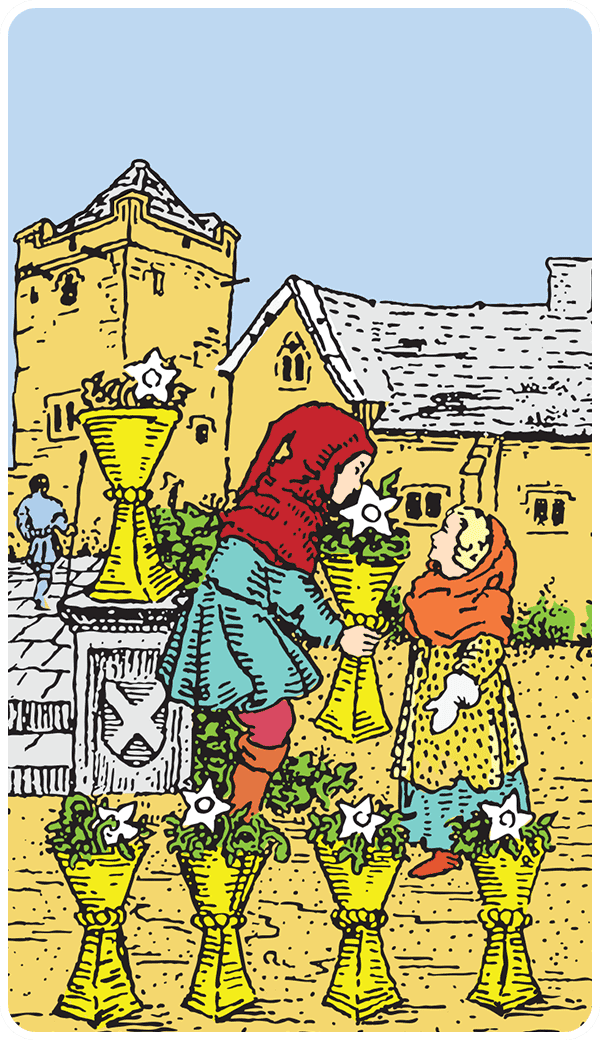
Six of Cups · plate 6
What the card is actually doing
The Six of Cups shows up in a career reading and the querent immediately names an old job. A company they left five years ago. A field they studied in college but never pursued. A version of their work life that felt easier, simpler, less complicated than what they're doing now. They ask if the card means they should go back. It does not mean that. What the card is naming is that memory has started doing editorial work on the past, and that editorial work is now shaping how they see the present. The question is not whether to return. The question is what the nostalgia is protecting them from seeing.
Reading Six of Cups in career
What the suit, rank, and image are each doing
Cups governs emotional life and relational attachment. In a career context, Cups cards describe how you feel about the work, not what the work produces. They show up when the question is about meaning, about whether you still care, about whether the job is feeding something or draining it. When Cups dominate a career reading, the logistics are usually fine. The problem is in the heart.
Sixes in tarot describe exchange and reciprocity. They are the rank of give-and-take, of relationships that have found their rhythm, of systems that have learned to balance. The Six of Cups specifically describes an exchange rooted in the past — a relationship or dynamic that was formative, that taught you what care or safety or ease could feel like, and that you are now measuring the present against.
The image shows two children in a courtyard. One child hands the other a cup filled with flowers. The scene is domestic, enclosed, small-scale. There are five more cups, all filled, arranged around them. Everything is already provided. No one is striving. The exchange happening here is not transactional. It is affectionate, nostalgic, oriented toward a version of relationship that predates ambition or stakes.
The most common misreading in career contexts is to treat this as a literal instruction: go back to the old company, return to the old field, reconnect with the old mentor. But the card is not describing a strategy. It is describing a feeling state. You are in a moment where the past feels emotionally safer than the present, and that safety is now the filter through which you are evaluating your options.
How this reads differently depending on where the querent is
If the querent is early in their career or recently promoted, the Six of Cups often describes homesickness for a role that asked less of them. They remember the job where they knew what they were doing, where expectations were clear, where they didn't have to perform authority or make decisions that affected other people. The card is naming the grief of leaving that simplicity behind. The work now is to stop using the past as evidence that the present is wrong.
If the querent is mid-career and stalled, the Six of Cups tends to show up when they are editing their own history. They have convinced themselves that an earlier version of their work life was more authentic, more aligned, more them. What the card is actually pointing to is that they have stopped trying in the present, and nostalgia is the story they are telling to justify the stopping. The past was not better. The past was easier to romanticize because it is over.
The tell that someone is misreading this card on themselves
The tell is when they start talking about the old job, the old field, the old version of their career as if it were a place they could return to unchanged. They describe it in static terms: "It was creative." "It was collaborative." "I was happy there." If you ask them what was hard about it, they pause. They have to think. The memory has been scrubbed clean. That scrubbing is the card. The Six of Cups is not describing the past. It is describing what you are doing to the past in order to avoid something in the present.
From the practice
“A card never tells you what to do. It tells you what you're already deciding — and gives you the words to name it.”
A grounded observation
Go back through your calendar and find the last time you said out loud, "I miss when work felt like…" Write down what you were avoiding saying about the job you have now.
Key themes to watch for
- № 01Theme
Creative purpose
- № 02Theme
Heart-led work
- № 03Theme
Right alignment
What to do with this reading
Read the upright meaning first, even if you pulled the card reversed. The reversal is a commentary on the upright — not a separate card.
Notice what your body did when you saw Six of Cups. That reaction is usually closer to the truth than the interpretation.
Write down one sentence: What is this card asking me to stop avoiding? Let the answer be smaller than you expect.
Come back to this card in 48 hours. Most career readings sharpen with a little distance.
Questions answered
Frequently asked
The Six of Cups in career contexts speaks to the value of past experiences and the lessons they bring. It may suggest a return to a previous job role or industry that once felt rewarding. Alternatively, it could highlight the importance of mentorship and sharing knowledge with younger colleagues. Reflect on the skills and insights you’ve acquired over the years. How might these inform your current path or inspire others in your workplace?
In its reversed position, the Six of Cups could indicate stagnation due to clinging to outdated practices or ideas. There may be a reluctance to embrace innovation, rooted in comfort with the familiar. This might be a moment to reconsider your approach to work, exploring whether old habits are holding you back from progress. How can you balance drawing from experience with an openness to new methodologies and perspectives?
Six of Cups colors the cards around it. Pay attention to where its themes — emotional intimacy, felt-sense knowing, where the water level is rising — show up in the next card. That is usually where the story is.
Tarot is observational, not predictive. Six of Cups describes the conditions in front of you right now and where they tend to lead if nothing changes — not a guarantee of timing.
Repeat cards are the deck underlining a theme. With Six of Cups, that usually means the question you are asking is the right one — but you have not yet acted on what the card is showing you.
Read next
Related readings
More Cups · Career
- Ace of Cups — CareerHow Ace of Cups reads in a career context.
- Two of Cups — CareerHow Two of Cups reads in a career context.
- Three of Cups — CareerHow Three of Cups reads in a career context.
- Four of Cups — CareerHow Four of Cups reads in a career context.
- Five of Cups — CareerHow Five of Cups reads in a career context.
- Seven of Cups — CareerHow Seven of Cups reads in a career context.
Other Six of Cups readings
- General MeaningSix of Cups read for general meaning.
- Love & RelationshipsSix of Cups read for love & relationships.
- Money & FinanceSix of Cups read for money & finance.
- Health & WellbeingSix of Cups read for health & wellbeing.
- SpiritualitySix of Cups read for spirituality.
- Yes / No AnswerSix of Cups read for yes / no answer.