Four of Pentacles in Health
The Four of Pentacles in health readings gets read as discipline. What it actually describes is grip — the body holding tension it won't release.
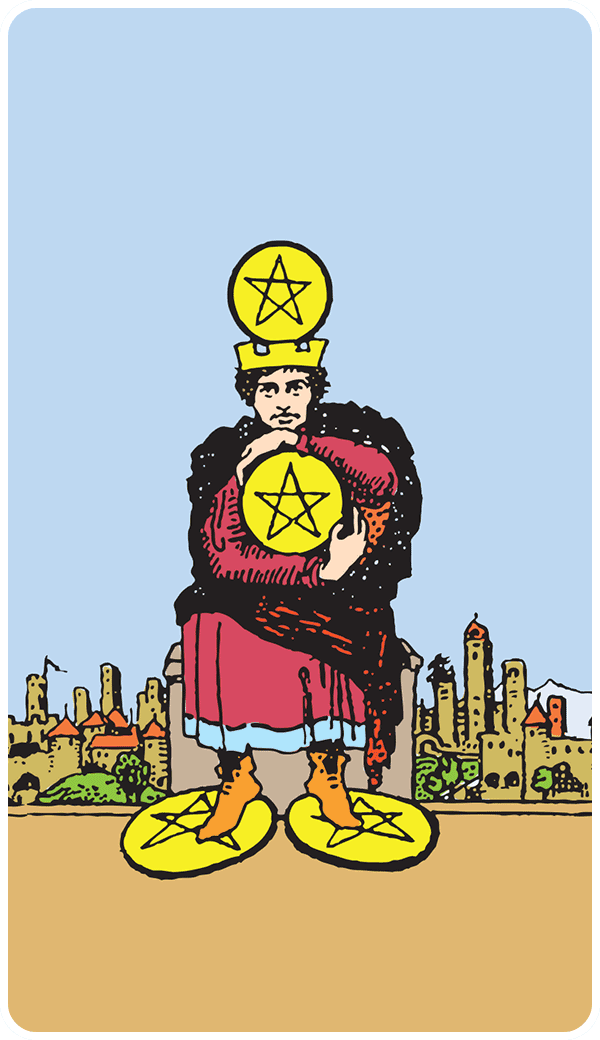
Four of Pentacles · plate 4
What the card is actually doing
The Four of Pentacles shows up in a health reading and the querent nods. They think it means they're being careful. Protecting their energy. Setting boundaries with their body. That's the flattering read. The card is not flattering. It's describing grip. The Four of Pentacles is the moment you are holding something so tightly — a routine, a posture, a way of breathing, a muscle pattern — that the holding itself has become the problem.
Reading Four of Pentacles in health
What the suit, rank, and image are actually doing
Pentacles governs the physical and material plane. In a health context, it points to the body as a structure — what you can measure, what you can feel, what moves or doesn't move. It's the suit of resources: energy, stamina, sleep, appetite, physical capacity. When Pentacles cards dominate a health reading, the question is almost always about whether the body has what it needs and whether you're letting it use what it has.
Fours in tarot describe stability that has calcified. The Two is the first balance. The Three is momentum. The Four is the point where structure stops serving and starts defending. It's not wrong to stabilize — but Fours name the moment stability becomes rigidity.
Now look at the image. A figure sits with a pentacle on their head, one under each foot, and one clutched to their chest. They are surrounded by a city, but they are not moving through it. Every pentacle is locked in place. The body is braced. The posture reads as guarding, not resting. This is not someone protecting their resources. This is someone who cannot let go of the position they are holding.
The most common misreading in health contexts is to read the Four of Pentacles as discipline or self-care. The querent says, "I'm being really careful with my energy right now," and they mean it as a good thing. But the card is naming the moment care has tipped into constriction. The body is not resting. It is clenching.
How it reads for two different querent situations
For someone dealing with chronic pain or fatigue, the Four of Pentacles describes the guarding reflex. The body learned to brace against pain, and now the bracing is constant. The shoulders stay up. The jaw stays tight. The breath stays shallow. The original injury may have healed, but the nervous system is still holding the same defensive posture. The card is not saying you're doing it wrong. It's naming what the body is doing so you can see it.
For someone in a rigid routine — same meals, same sleep schedule, same supplement stack, same exercise window — the Four of Pentacles is the point where structure stopped being useful and started being a cage. You can't skip a day. You can't adjust. The routine has become the thing you're protecting instead of the thing that's protecting you. The card shows up when the cost of maintaining the system is higher than the benefit it's delivering.
The tell that someone is misreading the card on themselves
The tell is the word "discipline." If you pull the Four of Pentacles in a health reading and your first thought is "good, I'm staying disciplined," you are not reading what the card is showing you. Discipline is a choice you make in the moment. The Four of Pentacles describes a pattern that is running automatically. The body is holding. The nervous system is braced. You are not choosing it anymore. It is choosing you.
From the practice
“A card never tells you what to do. It tells you what you're already deciding — and gives you the words to name it.”
A grounded observation
Go back through your day and count how many times you held your breath without realizing it. That's the Four of Pentacles. The body doesn't need permission to relax. It needs you to notice you told it not to.
Key themes to watch for
- № 01Theme
Emotional renewal
- № 02Theme
Mind-body link
- № 03Theme
Soft restoration
What to do with this reading
Read the upright meaning first, even if you pulled the card reversed. The reversal is a commentary on the upright — not a separate card.
Notice what your body did when you saw Four of Pentacles. That reaction is usually closer to the truth than the interpretation.
Write down one sentence: What is this card asking me to stop avoiding? Let the answer be smaller than you expect.
Come back to this card in 48 hours. Most health readings sharpen with a little distance.
Questions answered
Frequently asked
In health, the Four of Pentacles upright suggests a focus on maintaining control, perhaps to the point of rigidity. Picture someone adhering strictly to a health regimen, afraid of deviation. This card invites you to consider if this strictness is beneficial or if a little flexibility could enhance your well-being. Reflect on where balance might be needed.
Reversed, this card in health hints at a release from strict routines or fears. Imagine allowing yourself to explore new health practices or perspectives. This openness can feel risky but is often a breath of fresh air. Consider how stepping away from rigidity might support your overall well-being.
Four of Pentacles colors the cards around it. Pay attention to where its themes — embodiment, material follow-through, the slow build of resource — show up in the next card. That is usually where the story is.
Tarot is observational, not predictive. Four of Pentacles describes the conditions in front of you right now and where they tend to lead if nothing changes — not a guarantee of timing.
Repeat cards are the deck underlining a theme. With Four of Pentacles, that usually means the question you are asking is the right one — but you have not yet acted on what the card is showing you.
Read next
Related readings
More Pentacles · Health
- Ace of Pentacles — HealthHow Ace of Pentacles reads in a health context.
- Two of Pentacles — HealthHow Two of Pentacles reads in a health context.
- Three of Pentacles — HealthHow Three of Pentacles reads in a health context.
- Five of Pentacles — HealthHow Five of Pentacles reads in a health context.
- Six of Pentacles — HealthHow Six of Pentacles reads in a health context.
- Seven of Pentacles — HealthHow Seven of Pentacles reads in a health context.
Other Four of Pentacles readings
- General MeaningFour of Pentacles read for general meaning.
- Love & RelationshipsFour of Pentacles read for love & relationships.
- Career & WorkFour of Pentacles read for career & work.
- Money & FinanceFour of Pentacles read for money & finance.
- SpiritualityFour of Pentacles read for spirituality.
- Yes / No AnswerFour of Pentacles read for yes / no answer.